
Taoism

What Is the Dao De Jing? A Clear Explanation of the 81 Chapters
What Is the Dao De Jing? A Clear Explanation of the 81 Chapters
A modern, jargon-free guide to the 81-chapter Taoist classic - what the Dao actually is, what De is, the three core practices, the five most famous passages, and how to read the book today.
🎯 Key Takeaway
The Dao De Jing (道德经), also romanized as Tao Te Ching, is a 2,400-year-old book of 81 short chapters, traditionally written by the sage Laozi. It explains the Dao - the unnamed source and pattern of everything - and three practices: wu wei (non-forcing), ziran (self-so), and pu (returning to the uncarved simplicity). It is not a religion. It is a philosophy written in 5,000 Chinese characters.
The Dao De Jing is one of the most translated books in human history. It has been rendered into English over 250 times, more than any text except the Bible. And yet most English-speaking readers, when they first pick it up, close it again within ten minutes. The Chinese feels remote. The translations feel either too poetic or too flat. The advice - "do nothing," "be like water," "return to the uncarved block" - sounds like either fortune-cookie wisdom or mystical obscurantism.
This article is an attempt to fix that. It is a clear, modern explanation of what the Dao De Jing actually says, why it has lasted 2,400 years, and how to read it as a person living now. It assumes no prior knowledge of Chinese philosophy. By the end, you should know what the Dao is, what De is, what wu wei actually means, and which translation to pick up.
The short answer: what is the Dao De Jing?
A short book of 81 short chapters, written in classical Chinese about 2,400 years ago, traditionally attributed to the sage Laozi. It explains the Dao - the unnamed source and pattern of everything - and three practices that follow from it: wu wei (non-forcing), ziran (self-so naturalness), and pu (returning to the uncarved simplicity).
That is the whole book. Five thousand Chinese characters. 81 chapters. One idea, three practices.
The reason it has lasted 2,400 years is the same reason the I Ching has lasted 3,000. The text describes a way of seeing the world that, once you have seen it, you cannot un-see. Everything you do - at work, in relationships, in conflict, in the small decisions of an ordinary afternoon - looks slightly different through the lens of the Dao.
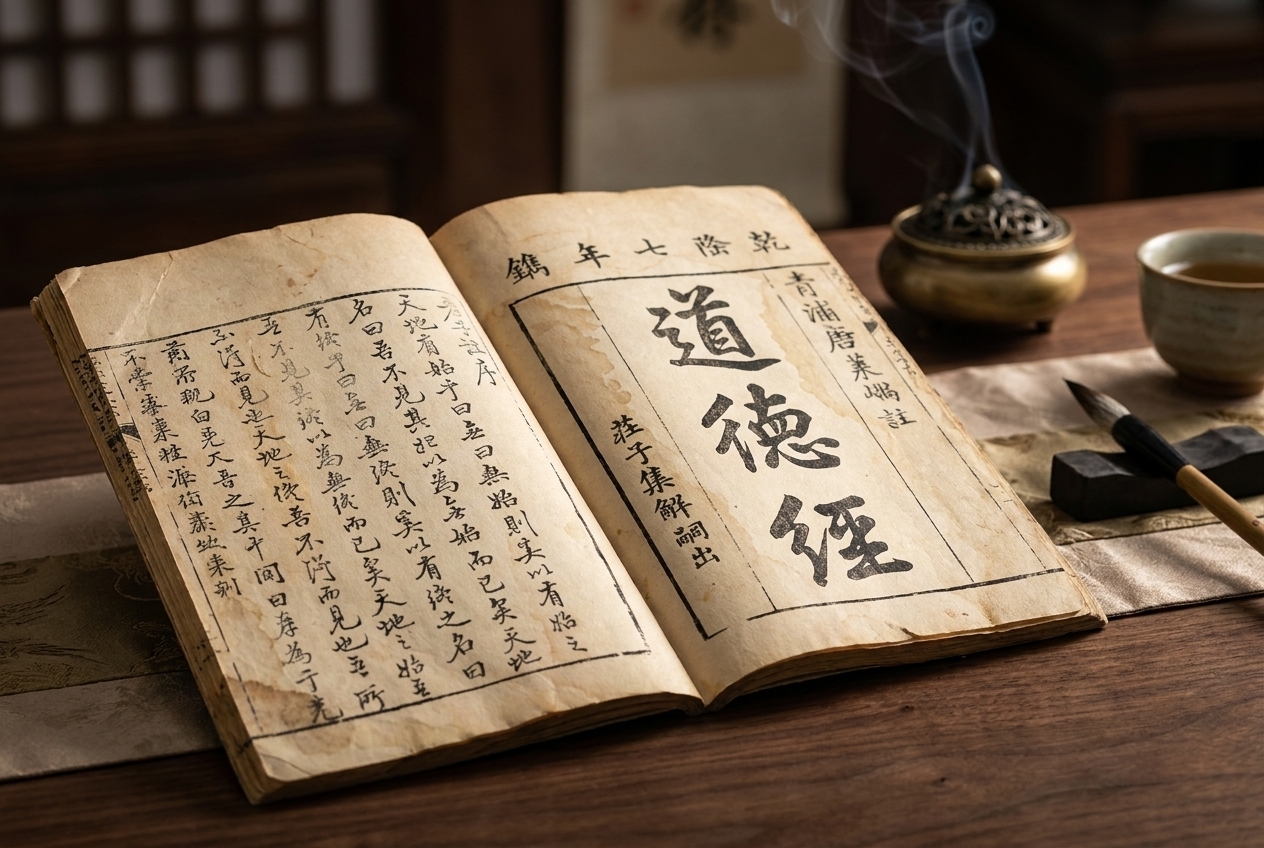
The Dao De Jing - 5,000 Chinese characters, 81 chapters, one of the most translated books in history.
Is it Dao De Jing or Tao Te Ching? They are the same book
You will see two names in English. Dao De Jing is the pinyin (modern Romanization, used in mainland China and most modern academic work). Tao Te Ching is the Wade-Giles (older Romanization, used in older Western translations and in Taiwan).
They refer to the same book. The chapter numbering is identical. The text is identical. The philosophy is identical. When a translator publishes a new version, the choice between Dao De Jing and Tao Te Ching on the cover is mostly a matter of style and audience.
| Dao De Jing (pinyin) | Modern Romanization. Used in mainland China, current academic work, and most translations after 2000. |
|---|---|
| Tao Te Ching (Wade-Giles) | Older Romanization. Used in Taiwan, in older Western translations (Mitchell 1988, Blofeld 1960s), and in many classic 20th-century editions. |
| Daodejing (one word) | Common academic style. Refers to the same text. |
| The Chinese characters | 道德经 - both characters are the same. Only the English spelling differs. |
For the rest of this article, I will use Dao De Jing. It is the modern standard, and it is also the spelling Google prefers for searches like "what is the Dao De Jing."
A short history of the book
The traditional story: in the 6th or 5th century BCE, an older man named Laozi (literally "Old Master") worked as the keeper of the imperial archives in the Zhou court. Confucius, a younger contemporary, came to visit him and asked about ritual. Laozi told him that the men he cited were already dead, and that civilization was in decline. Confucius left the meeting shaken.
Later, according to the legend, Laozi decided to leave China. As he approached the western gate, the gatekeeper Yin Xi asked him to write down his wisdom before he disappeared. Laozi sat down and dictated the Dao De Jing in a single sitting. Then he walked through the gate and was never seen again.
📜 The Traditional Account
The book presents itself as a single-author text. The historical reality is more complicated - most modern scholars believe the text was assembled over several generations, probably between the 5th and 3rd centuries BCE. But the historical question is less important than it looks. The book is the book.
This story is the one the text itself presents. It is also almost certainly not what literally happened. Modern scholars generally agree that the Dao De Jing was assembled over several generations, probably between the 5th and 3rd centuries BCE. There is no reliable external evidence that Laozi existed as a single historical author.
But the historical question is less important than it looks. The book is the book. Whether Laozi wrote it in one sitting or whether it was edited together from the sayings of several anonymous thinkers does not change what it says. The same is true of Homer, the Buddha, and most other foundational figures of world philosophy.
How the text is organized
The Dao De Jing has 81 chapters. They range from 1 to about 60 lines of classical Chinese. There is no narrative. There is no argument. Each chapter is a short, self-contained reflection on a single aspect of the Dao.
The first 37 chapters are traditionally read as the "Dao" half (upper part). The last 44 chapters are the "De" half (lower part). The division is approximate and the chapters can be read in any order.
Most English translations run 100 to 150 pages. The full Chinese text is roughly 5,000 characters - about the length of a long magazine article. It is meant to be reread, not studied once and shelved.
What the Dao actually is
The Dao (道) is the most important word in the book, and the hardest to translate. The standard English renderings - "the Way," "the Path," "the Way of all things" - are all wrong in different ways. "Way" sounds like a method. "Path" sounds like a route. The Dao is neither.
Chapter 1 opens the book with an instruction:
What the Dao is, then, is best described by what it does. The Dao is:
- The source of everything. Chapter 4 says the Dao "gives birth" to all things. Chapter 42 says it "generates" them.
- The pattern of everything. Everything in the observable world has a way of unfolding. Water flows downhill. Seeds become plants. People age. The Dao is the name for that pattern of unfolding.
- The ground everything returns to. Chapter 16 says "all things rise, the Dao does not rise. It is the mother of all things." The Dao is what remains when everything else has changed.
- Not a god. The Dao does not answer prayers. It does not judge. It does not have intentions. It is closer to "the way things actually are" than to any divine being.
A useful image: the Dao is to the world what the rules of chess are to a chess game. The rules do not play. They do not favor one side. They simply are the conditions under which the game unfolds. A Daoist sage is someone who has learned to play well within the rules, not someone who can change them.
What De is, and why it is different from virtue
The second half of the book is about De (德). The standard English translation is "virtue," but this translation is misleading. Christian "virtue" implies moral goodness. De is something else.
De is the way the Dao expresses itself through a specific thing. A river has De in the way it flows - water going where water goes, never struggling against the banks. A tree has De in the way it grows - roots down, branches up, leaves out, with no anxiety about being anything other than a tree. A person has De when their actions, words, and character all align with what they actually are, beneath all the roles and habits the world has layered on top.
"The highest De is like water. Water gives life to the ten thousand things and does not strive. It flows in places men reject and so is like the Dao." - Chapter 8 (paraphrased)
Water is the recurring image for De in the book because water is the most Dao-like thing in the observable world. It never resists. It always finds the lowest place. It yields to whatever shape contains it. And given enough time, water wears down stone. This is the kind of power the book praises - not the power that pushes, but the power that yields and persists.
The 5 most famous passages and what they actually mean
Five passages from the Dao De Jing are quoted constantly, often without context. Here is what they actually say.
The 3 core practices: wu wei, ziran, pu
The philosophy of the Dao De Jing reduces, in practice, to three related disciplines. They are not separate techniques. They are three angles on the same thing.
Wu Wei (无为) - non-forcing
Wu wei is the most mistranslated concept in the book. It is usually rendered as "do nothing" or "non-action," both of which are wrong. Wu wei means non-forcing - acting in a way that does not push against the grain of a situation.
A skilled sailor uses the wind rather than fighting it. A skilled negotiator lets the other side surface their real position rather than pressing. A skilled parent waits for the moment when the child is ready to hear, instead of forcing the lesson. Wu wei is effort aligned with the situation, not the absence of effort.
The English word sail is a good translation. A good sailor is constantly active - trimming, tacking, watching the wind - but the activity is in service of the wind, not against it. Wu wei is sailing rather than rowing.
Ziran (自然) - self-so naturalness
Ziran is the quality of being naturally what one is, without pretense or coercion. The Chinese character is a pictogram: a self (自) under the sun (日), meaning "the way something is when nothing is forcing it to be otherwise."
A child at play is ziran. A cat at rest is ziran. A person doing the work they are actually suited for, in a way that uses their real strengths, is ziran. The opposite of ziran is wei (为) - contrived, forced, performing. The Dao De Jing treats ziran as the highest human state.
This is not a license for selfishness. Ziran does not mean "whatever I want." It means "what I actually am, beneath the roles." Most people discover that what they actually are, when the roles are peeled away, is not someone who wants to dominate. It is someone who wants to do their work well, to be useful, to be in good company.
Pu (朴) - the uncarved block
Pu is the most poetic of the three. The Chinese character means uncarved wood - the raw block before a carpenter has shaped it into a beam, a table, a door. Pu is the state of being before the world has carved you into a shape.
Every person starts as pu. The baby is uncarved. Then family, school, work, ambition, fear, and habit carve the block into a particular shape. Some of that carving is good. Most of it is necessary. But some of it is not, and the Dao De Jing argues that the path of wisdom is to remember what you were before the carving - to keep the pu alive in yourself, however many shapes you have to take on in the world.
The image of pu is not "be childish." The book is not advocating a return to infancy. It is advocating a return to the unforced ground beneath all the carved shapes - the place where you can still feel what you are, before the world's pressure.
Dao De Jing vs the Analects - Daoism vs Confucianism
The Dao De Jing and the Analects of Confucius were written in roughly the same period (5th-3rd century BCE), and they are traditionally read as opposite answers to the same question: how should a person live in a time of civilizational decline?
| View of human nature | Confucian: people are trainable through ritual and learning. | Daoist: people are good by nature and corrupted by society. The cure is fewer institutions, not better ones. |
|---|---|---|
| View of civilization | Confucian: more ritual, more education, more refinement. | Daoist: the Dao De Jing has a darker view of these. |
| View of government | Confucian: benevolent rule through proper roles. | Daoist: the best government is the one that governs least. |
| The wise person | Confucius: the junzi, cultivated through learning and ritual. | Laozi: the sage who lives simply, harms no one, and is content with what is. |
| Stance toward ambition | Confucian: ambition is appropriate when directed toward proper goals. | Daoist: ambition itself is the problem. The sage "does not strive." |
The two texts are not enemies. They are two answers to the same observation: that the world is messier than it should be. The Confucian says: impose better order. The Daoist says: relax your grip on the order you think you have.
5 common misconceptions about the Dao De Jing
❌ Misconception 1: "The Dao De Jing is mystical"
It is not. The text uses images (water, the valley, the uncarved block, the infant) but its claims are concrete. It is a manual for how to live with less friction. There is no occultism, no supernatural intervention, no afterlife.
❌ Misconception 2: "Daoism is a religion"
The Dao De Jing is not a religious text. Religious Daoism developed later, drawing on the book but adding ritual, deities, alchemy, and cosmology. The book itself is closer to a meditation manual than to a Bible or a Quran. You can be a Daoist in the philosophical sense without ever entering a temple.
❌ Misconception 3: "Wu wei means do nothing"
Wu wei means non-forcing - effort aligned with the situation, not the absence of effort. The sage is highly active. The activity just does not push against reality. Wu wei is sailing, not sitting.
❌ Misconception 4: "The Dao De Jing is about being passive"
The opposite. The book praises water wearing down stone. It praises the persistence that comes from not resisting. A person who is "passive" in the everyday sense - who avoids decisions, avoids conflict, avoids commitment - is not practicing the Dao. The sage has preferences, takes action, and lives with the consequences. The sage just does not force the situation to be other than it is.
❌ Misconception 5: "Daoism is nihilistic"
Daoism is not nihilism. Nihilism says nothing matters. Daoism says what matters is not what you can hold or name. The book is full of affection for the world - for the way water flows, for the way infants move, for the way old trees bend in the wind. The stance is more like a tender realism than a refusal of value.
How to read the Dao De Jing - 3 approaches
There is no single right way to read the book. Three approaches work for different kinds of readers.
🌅 One chapter per day (81 days)
The traditional practice. Read a single chapter in the morning. Sit with it. Read it again before bed. Over three months, the chapters start talking to each other.
📖 Straight through, in an afternoon
The whole book is short. A motivated reader can finish it in two hours. The first read is to get the shape. The second read is to start catching the images that recur.
有 Translation, then the Chinese
For readers who know some Chinese (or want to learn). The Chinese is dense, image-rich, and ambiguous in ways English cannot reproduce. After a year of translation study, the original opens new layers.
Which translation?
For a first read, three translations stand out. Ursula K. Le Guin's 1997 version is the most readable in English - she is a novelist and translator, and her Dao De Jing reads like a small book of poetry. Stephen Mitchell's 1988 version is the most cited in academic and popular work. Ames and Hall's 2003 philosophical translation is the most rigorous. The choice is mostly about what kind of reader you are. Avoid the "inspirational" renderings that strip out the ambiguity - the ambiguity is the point.
How to apply the book today
The Dao De Jing is not a book you read once. It is a book you read for a few years, then return to for the rest of your life. A few small ways to begin.
- Notice forcing. For one day, pay attention to the moments when you are pushing against a situation. Most of the time, the pushing is unnecessary. Not always. But more often than you think.
- Watch water. The next time you are near a stream, a faucet, or a kettle boiling, watch how water moves. The Dao De Jing praises water because it does not force. There is a meditation in this.
- Read one chapter before bed. A single chapter is short. A single chapter reread is shorter. The book rewards this kind of slow attention.
- Try one day of ziran. For one day, try to act in ways that feel genuinely like you - not the role, not the script, not the habit. The day will feel both harder and easier than usual.
- Let one thing go. Pick one area of friction in your life - a relationship, a project, a habit, an argument you keep having - and try the path of not pushing. The result is sometimes a breakthrough. More often it is a quietness where the pushing used to be.
Continue the path
Read about the sage who wrote the Dao De Jing - and the meeting with Confucius that shaped both traditions.
Who Was Laozi? →10 questions people ask
What is the Dao De Jing in one sentence?
Is it Dao De Jing or Tao Te Ching?
How long is the Dao De Jing?
What is the Dao in the Dao De Jing?
What is De in the Dao De Jing?
Who wrote the Dao De Jing?
What is Wu Wei?
What is Ziran?
Is the Dao De Jing a religious book?
Which translation of the Dao De Jing should I read?
One more thing
The Dao De Jing is 2,400 years old. The English translations keep multiplying. There is no single right way to read it, no correct interpretation, no orthodox version. Each generation makes its own. The point of the book is not to be understood once. The point is to be reread until the rereading changes something in how you live.
If this article helped, the next one in the series is on the man who wrote the book - Laozi, his meeting with Confucius, and the legend of the western gatekeeper.
Last updated: October 14, 2026. First published: October 14, 2026.
0users like this.


Your cart is currently empty.