
Incense

Incense Holder for Sticks: How to Match Your Space, Style, and Safety Needs
Incense Holder for Sticks: How to Match Your Space, Style, and Safety Needs
30-Second Answer · The right incense holder for sticks depends on four intersecting variables: space (small desk, large altar, or outdoor), style (Taoist bagua, zen ceramic, modern brass), material (ceramic vs brass vs wood vs stone), and safety needs (kids, pets, fire risk). Match size to room scale: under 10cm for desk corners, 10-20cm for tables, 20cm+ for altars. Match style to your practice: traditional Taoist bagua/wu lou for ritual work, ceramic zen for daily meditation, brass for durability. Match material to context: ceramic for variety, brass for longevity, stone for stability. Match safety to household: minimum 500g weight + wide base + ash-catching well if children or pets are present. The five-step checklist at the end of this article will walk you through every decision in 5 minutes.
Why the Holder Matters (Not Just Decoration)
Most people think of an incense holder as a simple accessory - something to keep ash off the table. But the right holder actually does four jobs at once: stability (preventing tip-over), containment (catching falling ash and embers), heat management (protecting your table surface from a 600-700°C flame), and symbolic function (connecting your daily ritual to a specific cultural tradition).
Most incense accidents (burned tables, ash on carpets, smoke alarms triggered, kids singed fingers) happen because people underestimate the holder's role. A 100-gram ceramic dish with a 1cm-deep ash well is functional for 15-minute meditation. It's not functional for a 45-minute altar session, a multi-stick family ceremony, or a household with a curious cat.
This article takes you through the selection process systematically. By the end, you'll know exactly which holder fits your situation - without overspending or under-protecting.
🎯 The selection framework: Space → Style → Material → Safety. Reverse the order, and you risk buying something beautiful that doesn't fit your actual use. This article follows that framework exactly.
The 4 Types of Incense Holders
Before matching to space or style, understand the four functional categories. Many holders combine features; some are dedicated to one format.
| Type | Chinese | Function | Best For |
|---|---|---|---|
| Stick Holder | 香插 xiāng chā | Single pin/hole for stick incense | Personal meditation, daily practice |
| Coil Holder | 盘香炉 pán xiāng lú | Flat platform with groove for coiled incense | Long sessions, larger spaces |
| Backflow Holder | 倒流香炉 dào liú xiāng lú | Cascading smoke visual effect | Decoration, meditation visuals |
| Multi-Purpose Burner | 香炉 xiāng lú | Stick + cone + coil + ash catcher | Family altar, ceremonial use |
For this article's focus - stick incense specifically - the most common choice is a stick holder (compact, decorative) or a multi-purpose burner (versatile, larger). The four featured examples later in this article cover two distinct style and use-case options.
Match by Space: Desk, Altar, or Outdoor
Desk / Bedside / Apartment Corner
Recommended size: under 10cm (4 inches). Recommended weight: 200-400g. Stick capacity: 1 stick at a time.
The smallest category. Designed for compact living - studio apartments, dorm rooms, bedside tables, meditation corners, office desks. The constraint here isn't fire safety (one stick is manageable) - it's space economy. You want something that disappears visually when not in use, doesn't compete with your other desk items, and cleans easily.
Coffee Table / Bookshelf / Small Altar
Recommended size: 10-20cm (4-8 inches). Recommended weight: 400-800g. Stick capacity: 1-3 sticks.
The most versatile category. Suitable for living room coffee tables, bedroom dressers, small home altars, and shared meditation spaces. This is where the largest selection exists across all styles - Taoist bagua, zen ceramic, modern brass, hand-painted porcelain, wood-carved, stone. The constraint here is proportionality: the holder should feel intentional, not lost or dominating.
Living Room Centerpiece / Family Altar / Shrine
Recommended size: 20-40cm (8-16 inches). Recommended weight: 800g-2kg. Stick capacity: 3-9 sticks.
The traditional altar category. Designed for daily family ritual, multi-stick offerings, and ceremonial practice. The weight and size here serve a purpose: visual presence anchors the ritual space, and the heavier construction ensures the holder stays put during longer burn times. This is also where the most elaborate symbolic designs appear - bagua, dragon, foo dog, lotus, wu lou.
Garden / Patio / Pavilion
Recommended size: 25-50cm+. Recommended weight: 2kg+. Stick capacity: 3+ sticks.
The outdoor category has different rules. Materials must be weather-resistant (brass, bronze, stone, cast iron). Weight must withstand wind gusts up to 30 km/h. Placement must avoid dry vegetation, fabric canopies, or paper lanterns. Most indoor holders don't meet these criteria - for serious outdoor use, dedicated outdoor burners are safer.
Taoist Bagua, Wu Lou, Dragon, Foo Dog Designs
The richest symbolic category. Rooted in Taoist cosmology (I Ching 易經), feng shui lineage, and classical Chinese ritual heritage. Common motifs include:
- Bagua 八卦 - eight trigrams, cosmic order, yin-yang balance
- Wu Lou 瓠樓 - calabash gourd, containment of qi, longevity
- Dragon 龍 - imperial authority, cosmic yang energy
- Foo Dog 獅子 - guardian pair, protective warding
- Phoenix 鳳凰 - feminine yang, renewal, virtue
- Lotus 蓮花 - Buddhist-Taoist bridge, purity, enlightenment
These holders are not just functional - they are ritual implements with cultural continuity spanning 2,000+ years. For practitioners of Taoist liturgy, classical feng shui, or family ritual tradition, the symbolic dimension is integral to the holder's purpose.
Ceramic, Monochrome, Simple Lines
The contemplative category. Rooted in Chan (Zen) Buddhist aesthetics, Japanese wabi-sabi, and modern minimalism. Common features:
- Neutral palette - whites, grays, earth tones, unglazed natural clay
- Simple geometry - circular, oval, soft rectangular, no ornament
- Handmade texture - visible clay grain, slight irregularity, asymmetric character
- Subtle form - the holder recedes visually, letting the incense be the focus
Zen holders prioritize presence without performance. The aesthetic is quiet meditation rather than ceremonial display. They're popular in modern homes, design-conscious spaces, yoga and meditation studios, and work-from-home desks.
Sleek Metal, Geometric, Designer
The contemporary design category. Inspired by modern architecture, Scandinavian minimalism, and luxury home decor. Common features:
- Brushed or polished metal - stainless steel, brass with polished finish, copper
- Geometric precision - clean lines, mathematical proportions, occasional asymmetry
- Statement pieces - the holder may be a focal point, not a background element
- Designer collaborations - limited edition, gallery-worthy
Modern holders blur the line between incense accessory and home sculpture. They're often priced higher than traditional or zen categories, and they're chosen as much for visual impact as function.
Featured: Taoist Bagua Wu Lou Incense Holder

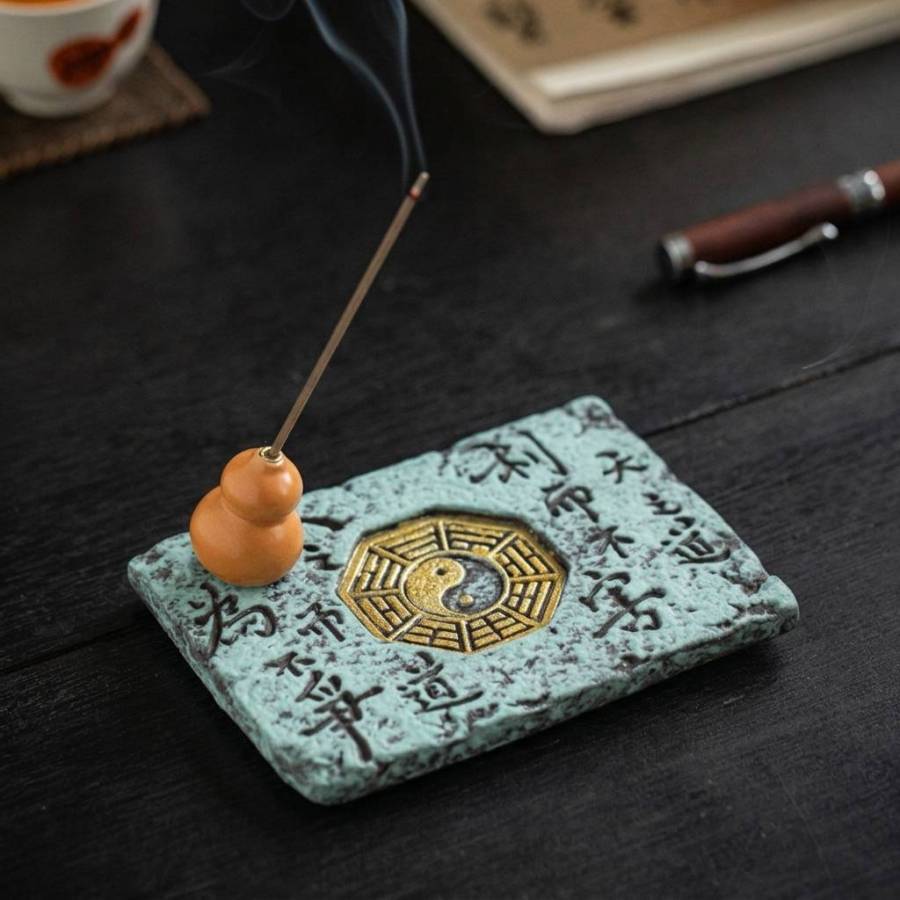
Taoist Bagua Wu Lou Incense Holder
This holder combines two of the most enduring symbols in Taoist cosmology. The bagua (八卦) pattern around the base references the eight trigrams of the I Ching - the foundational text of Taoist cosmology - and the wu lou calabash form represents containment of qi, longevity, and protective energy. Together they create a holder that functions both as a practical incense tool and as a daily ritual implement.
- Eight-trigram bagua base - eight insertion positions for full Taoist liturgy, or use one at a time for daily practice
- Wu lou calabash form - protective symbolism, longevity imagery, classical feng shui continuity
- Traditional finish - develops a deeper patina with use, becoming more beautiful over years
- Mid-size format - fits comfortably on small home altars, coffee tables, or bedside ritual spaces
- Multi-incense compatible - accommodates standard stick incense; larger variants accept longer ceremonial sticks
- Heirloom construction - built for decades of daily ritual use
Why This Holder Fits the Taoist Style Category
If you're drawn to traditional symbolism, ritual heritage, and the layered meaning of Taoist cosmology, this holder belongs in your space. It's not decorative in the modern sense - it's functional ritual. The bagua isn't a pattern; it's a cosmological reference. The wu lou isn't a shape; it's a longevity and protection symbol. For practitioners who hold daily ritual, this holder connects 2,000+ years of cultural continuity to your morning meditation.
Practical fit: small to medium altar spaces, traditional home decor, Taoist family altars, classical feng shui households. Pairs well with sandalwood, agarwood, or pure herbal incense.
Match by Safety: Kids, Pets, Fire Risk
Safety is non-negotiable. The decorative and symbolic dimensions of an incense holder matter, but a beautiful holder that tips over or scorches a table fails its primary function. Below are the seven design and placement rules that cover the highest-incidence scenarios.
⚖️Weight Matters Most
Choose a holder weighing at least 500g (1 lb). A child or large cat knocking over a 100g holder is far more dangerous than one that stays put under impact. Brass and stone naturally meet this; ceramic may need a wide base to compensate.
📐Wide Base = Stability
Base diameter should be at least 1.5x the holder's height. A tall, narrow holder looks elegant but tips easily. A short, wide base resists tipping from any direction.
🔥Ash Catching Well
The ash well must be deep enough (at least 2cm / 0.8 inches) to hold the full ash fall without overflow. Short ash wells = ash on your table, on your floor, in your carpet. The holder's most underrated safety feature.
🪨Non-Flammable Surface
Always place the holder on stone, metal, ceramic tile, or a dedicated wooden tray with heat-resistant mat. Never directly on bare wood, paper, fabric, or near curtains. Heat transfers through the holder's base.
💨Ventilation Required
Burn incense in well-ventilated rooms. Avoid small enclosed spaces (closets, sealed bathrooms) especially with sleeping children, elderly, or respiratory-sensitive individuals. CO buildup is rare but possible with heavy multi-stick burning.
👀Active Supervision
Never leave burning incense unattended with young children, curious pets, or loose paper materials nearby. Adult supervision is the single most effective fire prevention strategy - more than any holder design.
🧯Quick Extinguisher Ready
Keep a ceramic lid, snuffer tool, or damp cloth nearby for quick flame-out. The traditional snuffer (香匙 xiāng chí) is more elegant than blowing - it also prevents ash scatter.
🚫Common Mistakes to Avoid
(1) Placing the holder near curtains or fabric. (2) Burning on a wooden table without a heat mat. (3) Leaving incense burning while sleeping. (4) Using a damaged holder (cracks in ceramic, dents in metal). (5) Ignoring ash buildup.
⚠️ Hard truth about incense safety: every year, residential fires are caused by unattended incense. The holder design reduces risk, but it doesn't eliminate it. If you have young children, large pets, or a history of household fires, consider a weighted tabletop snuffer that extinguishes automatically after a set time. The peace of mind is worth the upgrade.
Featured: Ceramic Rocking Horse Incense Holder

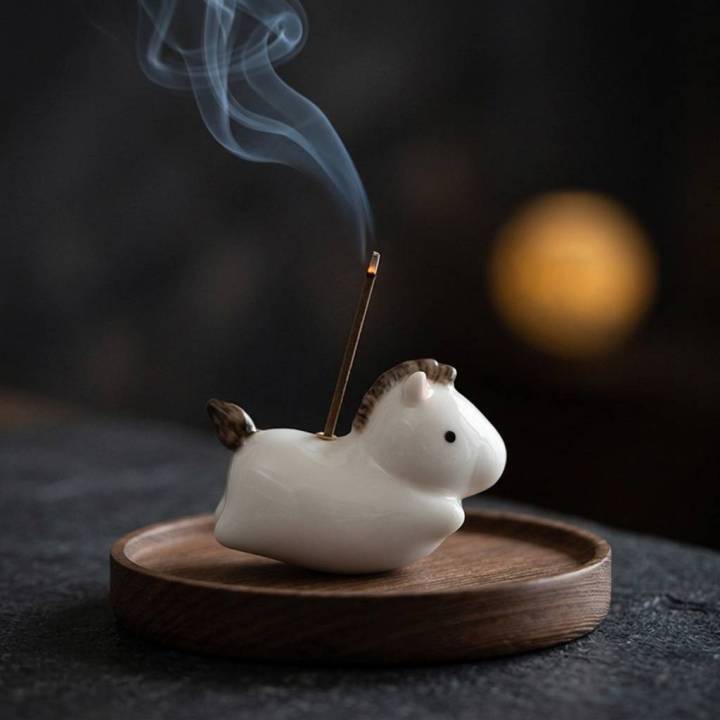
Ceramic Rocking Horse Incense Holder - Handmade Zen Desktop
Where the bagua holder references 2,000 years of tradition, this ceramic rocking horse (摇马 / 木馬) holder is a different statement entirely. Inspired by childhood memories and the gentle rocking motion of a wooden horse, this piece transforms a simple desktop incense moment into something quietly playful and meditative. The handmade ceramic construction means each piece carries slight variation - true to wabi-sabi aesthetics.
- Handmade ceramic construction - each piece is unique; no two are identical
- Rocking horse silhouette - gentle playful form that softens a modern desk
- Zen desktop aesthetic - pairs with minimal work-from-home or study environments
- Soft monochrome palette - fits neutral interiors without visual competition
- Compact footprint - designed for desk, bedside, or small meditation corner
- Stick compatible - accepts standard 20cm incense sticks for 30-45 minute sessions
Why This Holder Fits the Zen / Modern Category
Not every incense holder needs to carry cosmological symbolism. For the work-from-home professional, the daily meditator, or the design-conscious household, the right holder can simply be beautiful, calming, and unobtrusive. The rocking horse form adds a touch of warmth and humanity that pure geometric holders lack.
Practical fit: home office desks, study spaces, bedroom meditation corners, gift-giving (the handmade character makes each piece feel personal). Pairs well with single-origin or limited-edition incense.
Material Comparison: Ceramic vs Brass vs Wood vs Stone
| Material | Heat Resistance | Weight | Durability | Style Range | Price Range |
|---|---|---|---|---|---|
| Brass / Bronze | Excellent (900°C+) | Heavy | Decades | Traditional, modern | $$-$$$ |
| Ceramic / Porcelain | Good (incense-safe) | Light-Medium | Years (fragile to drops) | Widest variety | $-$$$ |
| Wood / Bamboo | Low (decorative ash catcher only) | Light | Years (sensitive to moisture) | Zen, natural | $-$$ |
| Stone (jade, marble) | Excellent | Very Heavy | Decades+ | Premium, traditional | $$$-$$$$ |
| Glass / Crystal | Moderate | Medium | Years (fragile to drops) | Modern, decorative | $$-$$$ |
| Cast Iron | Excellent | Very Heavy | Decades+ | Rustic, outdoor | $-$$ |
Honest recommendation: for most households, start with a ceramic zen holder for daily use and a brass traditional holder for ritual occasions. The ceramic handles variety (style, color, replaceable if damaged); the brass handles longevity (one piece for decades). This pairing covers 90% of household incense use without overspending.
Care & Maintenance
A well-cared incense holder lasts decades. The maintenance routine depends on use intensity:
- Light use (1-2 sticks/week): wipe out ash weekly, full clean monthly.
- Moderate use (daily meditation): wipe out ash every 2-3 uses, full clean every 2-3 weeks.
- Heavy use (multi-stick altar): daily ash removal, deep clean weekly.
The cleaning process:
- Let the holder cool completely (at least 30 minutes after the last stick).
- Empty loose ash into a metal trash bin (never plastic - hot ash can melt it).
- Wipe interior with a dry cloth or soft brush.
- For resin buildup, use a wooden or plastic scraper (never metal on ceramic - it scratches glaze).
- Optional: light wash with warm water and mild soap, dry thoroughly before next use.
⚠️ Never use harsh chemicals on incense holders used for ritual purposes - many practitioners avoid any cleaning agent beyond water. Never soak wood or bamboo holders - water damages the material. Never attempt to clean while the holder is still warm - thermal shock can crack ceramic.
5-Step Selection Checklist
📋 The 5-Step Method (5 minutes)
- Step 1 - Measure your space. Width × depth of the intended placement surface (desk, altar, table). The holder should occupy 1/8 to 1/12 of this area. Record the measurement.
- Step 2 - Identify your primary use case. Daily meditation? Family ritual? Decoration? Single stick or multi-stick? Short sessions or 60+ minutes? This determines size category and stick capacity needed.
- Step 3 - Choose your style direction. Traditional Taoist (bagua, wu lou)? Zen ceramic? Modern brass? This is the most personal choice - go with what resonates with your actual practice, not what looks impressive.
- Step 4 - Match material to context. Outdoor use → brass/stone. Heavy use → brass. Style variety → ceramic. Premium aesthetic → stone or designer metal. Daily ritual with kids → heavier ceramic with wide base.
- Step 5 - Verify safety features. Weight ≥500g? Wide base (1.5x height)? Ash well depth ≥2cm? Material non-flammable? Placement surface heat-resistant? If 5/5 yes, proceed. If any no, adjust.
Time required: 5 minutes. Result: a holder that fits your space, style, and safety needs - without regret.
FAQs
What's the difference between an incense holder and an incense burner?
An incense HOLDER (香插 xiāng chā) is a simple device with a small hole or groove where you insert a single stick of incense so the ash falls cleanly into a catching dish below. Holders are typically compact, decorative, and used for short burning sessions. An incense BURNER (香炉 xiāng lú) is a larger vessel designed for sustained burning of multiple sticks, coils, or cones, often with a lid, ash-catching chamber, and elaborate ornamentation. In practice: small sticks for personal meditation → holder; multi-stick altar work, coil incense, or longer ceremonies → burner. The terms are often used interchangeably in English, but in traditional Chinese contexts the distinction matters for selecting the right size and weight.
How do I choose the right size incense holder for my space?
Match the holder footprint to the room scale. SMALL (under 10cm / 4 inches) → desk, bedside table, small meditation corner, one stick at a time. MEDIUM (10-20cm / 4-8 inches) → coffee table, bookshelf, small altar, 1-3 sticks. LARGE (20-40cm / 8-16 inches) → living room centerpiece, family altar, multi-stick ceremonial use, 3-9 sticks. VERY LARGE (40cm+ / 16+ inches) → temple, garden, outdoor pavilion, ceremonial use. The practical rule: the holder should occupy about 1/8 to 1/12 of the table or altar surface. A 60cm altar needs a 5-7cm holder; a 100cm coffee table needs a 8-12cm holder. Going larger risks the holder dominating the space; going smaller risks instability and visual disappearance.
Is brass or ceramic better for an incense holder?
Both work well, with trade-offs. BRASS / BRONZE: highly heat-resistant (melting point 900°C+ vs incense flame ~700°C), heavy (won't tip), develops patina over time (some find this aesthetic, others don't), traditional look, more expensive, durable for decades. CERAMIC / PORCELAIN: moderate heat resistance (handles incense flame fine, but not direct flame), lighter weight (more prone to tipping unless wide-based), available in more styles and colors (glazed, hand-painted, modern, traditional), fragile if dropped, mid-range price, generally easier to clean. The honest answer: if you want tradition and longevity, brass; if you want style variety and lower cost, ceramic; if you want heat resistance and outdoor use, brass; if you want a desk accent, ceramic. Most households benefit from having one of each material for different uses.
Are incense holders safe around kids and pets?
Incense holders require caution around children and pets, but specific design choices reduce risk. SAFETY-BY-DESIGN: (1) WEIGHT - choose a holder weighing at least 500g (1 lb). A child or large cat knocking over a 100g holder is far more dangerous than one that stays put under impact. (2) WIDE BASE - the base diameter should be at least 1.5x the height for stability. (3) ASH CATCHER - ensure the holder has a deep enough ash-catching well (at least 2cm / 0.8 inches) so falling ash doesn't escape. (4) PLACEMENT - always place on a non-flammable surface (stone, metal, ceramic tile); never on wood, paper, fabric, or near curtains. (5) VENTILATION - burn in well-ventilated rooms, never in small enclosed spaces with children sleeping. (6) SUPERVISION - never leave burning incense unattended with young children or curious pets. (7) EXTINGUISHER - keep a small ceramic lid or snuffer nearby for quick flame-out. A well-designed holder significantly reduces risk; it doesn't eliminate the need for supervision.
How often should I clean an incense holder?
Cleaning frequency depends on use intensity. LIGHT USE (1-2 sticks per week) - wipe out ash weekly, full clean monthly. MODERATE USE (daily meditation, 1 stick per day) - wipe out ash every 2-3 uses, full clean every 2-3 weeks. HEAVY USE (multi-stick altar, 3+ sticks daily) - daily ash removal, deep clean weekly. CLEANING PROCESS: (1) Let the holder cool completely (at least 30 minutes after the last stick). (2) Empty loose ash into a metal trash bin (never plastic - hot ash can melt it). (3) Wipe interior with a dry cloth or soft brush. (4) For resin buildup, use a wooden or plastic scraper (never metal on ceramic - it scratches glaze). (5) Optional: light wash with warm water and mild soap, dry thoroughly before next use. NEVER use harsh chemicals on incense holders used for ritual purposes - many practitioners avoid any cleaning agent beyond water. NEVER soak wood or bamboo holders - water damages the material.
Can I use one holder for different types of incense?
Yes, but with caveats. A multi-purpose holder designed with separate compartments can handle: (a) STICK INCENSE (线香 xiàn xiāng) - uses the central pin or hole. (b) COIL INCENSE (盘香 pán xiāng) - uses a flat platform or coiled groove. (c) CONE INCENSE (锥香 zhuī xiāng) - uses a flat surface. (d) POWDER/LOOSE INCENSE (香粉 xiāng fěn) - uses a charcoal disc. The limitations: (1) RESIDUE MIXING - different incenses have different resin and aromatic profiles; mixing may mute individual fragrances. (2) HEAT LOAD - burning multiple types simultaneously generates more heat; ensure the holder is rated for the combined load. (3) AESTHETIC - most traditional holders are optimized for one use (stick OR coil, not both). For serious multi-format practitioners, separate holders for each type are recommended. The exception: many modern 'ash catcher' style holders with a wide platform work acceptably for sticks, cones, and short coils.
What does a bagua (八卦) incense holder symbolize?
The bagua (八卦 bā guà, 'eight trigrams') is one of the foundational symbols in Taoist cosmology. Each of the 8 trigrams represents a natural force (Heaven ☰, Earth ☷, Thunder ☳, Water ☵, Mountain ☶, Wind ☴, Fire ☲, Lake ☱). A bagua incense holder combines: (1) SYMBOLIC FUNCTION - the bagua pattern is traditionally placed on ritual objects to invite cosmic order, balance yin-yang, and ward off negative qi (sha qi 煞氣). (2) PRACTICAL FUNCTION - the eight-fold symmetry often corresponds to 8 insertion holes for 8 incense sticks (one per trigram, used in Taoist liturgy). (3) CULTURAL FUNCTION - connects the user to I Ching 易經 tradition, Taoist ritual heritage, and classical feng shui lineage. (4) WU LOU CONNECTION - when paired with wu lou (瓠樓 / calabash) imagery, the symbolism adds 'containment' and 'longevity' meanings. A bagua holder is more than a functional object - for Taoist practitioners, it's a ritual implement. For non-practitioners, it's a beautiful traditional design with cultural depth.
How does a wu lou (瓠樓 / calabash) shape connect to incense practice?
The wu lou (瓠樓 wú lóu), sometimes called hu lu (葫蘆 hú lú), is a calabash or gourd shape with deep meaning in Taoism and Chinese folk religion. SYMBOLISM: (1) HEAVEN AND EARTH - the round shape symbolizes heaven, the squared base earth; combined it represents harmony of cosmic forces. (2) CONTAINMENT OF QI - the hollow interior is metaphorically suited to 'holding' or 'gathering' qi, making it a natural feng shui symbol for protection and accumulation of positive energy. (3) LONGEVITY (壽 shòu) - gourd imagery is associated with long life and good health in Taoist immortals (八仙 bā xiān figures often carry gourds). (4) PROTECTION - wu lou is traditionally hung in homes or placed in bedrooms to absorb negative qi and promote wellness. INCENSE CONNECTION: when the wu lou form is used as an incense holder, the symbolism is layered - the holder both contains the incense (physical qi) and accumulates protective qi (metaphorical). For Taoist practitioners, a wu lou incense holder is a daily ritual tool with cultural continuity spanning 2,000+ years.
Can I use an incense holder outdoors?
Yes, but with material and placement considerations. SUITABLE MATERIALS for outdoor use: (1) BRASS / BRONZE - handles weather well, develops attractive patina, very heavy (won't blow over in moderate wind). (2) STONE / CERAMIC with weatherproof glaze - heavy and stable, but check the glaze is rated for thermal shock (some ceramics crack in rapid temperature changes). (3) CAST IRON - durable, stable, develops rustic patina. UNSUITABLE MATERIALS for outdoor: (1) WOOD / BAMBOO - moisture damages, can rot, fire risk if dry. (2) THIN CERAMIC without weatherproofing - cracks in freeze-thaw cycles. (3) GLASS / CRYSTAL - temperature sensitive, can shatter. OUTDOOR PLACEMENT: (a) On a stone table or solid surface. (b) In a sheltered area (covered patio, garden pavilion) to prevent ash blowout. (c) Away from dry vegetation, paper lanterns, fabric canopies. (d) Stable enough to resist 20-30 km/h wind gusts. For pure garden ritual, dedicated outdoor incense burners (often large cast iron or stone) are safer than repurposing indoor holders. Always check local fire regulations before outdoor burning, especially in dry climates.
What incense stick length works with most holders?
Most incense sticks fall into 3 length categories, and holder design typically accommodates 1-2 of these. (1) SHORT (10-15cm / 4-6 inches) - burn time 15-30 minutes, common for personal meditation, travel, small spaces. Most compact holders handle this size easily. (2) MEDIUM (20-30cm / 8-12 inches) - burn time 30-60 minutes, the most common size for home altars and daily practice. Most standard holders accommodate this range. (3) LONG (40-50cm / 16-20 inches) - burn time 60-90 minutes, used for ceremonies, temple work, special occasions. Require taller holders with deeper ash wells and wider bases. COMPATIBILITY CHECK: (a) Pin/hole depth - should accommodate at least 1/3 of the stick length for stability. (b) Ash catching well - should be deep enough to hold the full ash fall without overflow. (c) Total height clearance - holder + ash + stick should fit in the space with at least 30cm (12 inches) clearance from anything flammable above. Most quality holders specify compatible stick lengths in their product description. If in doubt, ask the seller or measure your typical incense stick before purchasing.
0users like this.


Your cart is currently empty.