
Feng Shui

What Is a Lucky Charm Bracelet? Meaning, Symbols, and How to Choose
What Is a Lucky Charm Bracelet? Meaning, Symbols, and How to Choose
A clear, modern guide to the meaning behind red string, Pixiu, Wu Lou, Buddha, evil eye, and other charm bracelets - plus which hand to wear them on, how to activate one, when to take it off, and how to choose the right one for your intention.
🎯 Key Takeaway
A lucky charm bracelet is a piece of jewelry worn for a specific intention - to attract wealth, invite protection, support love, or strengthen health. The charm is the symbol, not the material. A simple red string tied with a stated intention is a more powerful lucky charm than an expensive gold bracelet worn without knowing what it means. The most important step is choosing a symbol whose meaning matches what you actually want.
Walk down any market street in Asia, browse any Etsy shop with "spiritual" in the title, or scroll through TikTok's #fengshui hashtag, and you will see hundreds of lucky charm bracelets. Red strings, gold Pixiu, jade Buddha beads, evil eye amulets, mantra beads, four-leaf clovers, Hamsas, hessonite stones, wood from holy trees, copper coils, tiger-eye stones, lava rock, lava beads, and dozens more. The variety is overwhelming.
Most guides make it worse by listing every symbol ever made without explaining the logic. This article is different. It explains what a lucky charm bracelet actually is, the seven most common symbols and what each one means, how to choose the right one for your intention, and the practical questions everyone has: which hand, when to take it off, what to do when it breaks.
What is a lucky charm bracelet?
A piece of jewelry that carries a specific symbol believed to bring the wearer good fortune, protection, wealth, love, or health. The symbol is the reason for wearing it - not the material, the brand, or the price.
The distinction between a lucky charm bracelet and a regular bracelet is the intention behind it. A regular bracelet is decoration. A lucky charm bracelet is a wearable reminder of a stated purpose.
The purpose can be cultural, religious, or personal:
- Cultural - Pixiu (Chinese mythology), Wu Lou (Chinese gourd), Hamsa (Middle Eastern folk belief), evil eye (Mediterranean tradition).
- Religious - Buddha bead (Buddhism), cross (Christianity), mantra beads (Hinduism), rosary (Catholicism).
- Universal - four-leaf clover, horseshoe, ladybug, wishbone - symbols that have no religious origin but carry widely-shared lucky associations.
The Chinese word for this kind of bracelet is 吉祥饰物 (jixiang shiwu) - literally "auspicious decorative object." Anything that carries meaning beyond decoration falls under the category.
Three of the most common lucky charm bracelets - red string, Pixiu, and Wu Lou. Each carries a different intention.
Why do people wear lucky charm bracelets?
People wear lucky charm bracelets for one of three reasons - sometimes all three at once.
1. To attract a specific kind of good
The most common reason. The bracelet is a wearable symbol of a goal - wealth (Pixiu), love (red string tied in a certain way), protection (evil eye), wisdom (Buddha), health (jade). The wearer is not just hoping for the thing. The bracelet is a daily reminder to act in a way that aligns with the goal.
2. To mark a relationship, transition, or vow
Some bracelets are worn for what they commemorate rather than what they attract. A red string tied by a parent at birth. A Pixiu given by a grandparent at a New Year. A mantra bead bracelet from a pilgrimage. The bracelet is a memento of a moment, a person, or a decision.
3. To carry a spiritual or religious practice into daily life
Buddha bead bracelets (mala) and rosaries are worn as extensions of prayer or meditation. Some practitioners count breaths or mantra repetitions on the beads through the day. The bracelet is a tool, not a decoration.
🪞 The Honest Take
Lucky charm bracelets work - but not in the way most marketing suggests. They do not magically attract money or repel evil. What they do is act as a constant, physical reminder of an intention. People who wear them report small behavior changes: more confident decisions, fewer impulsive purchases, more caution in risky situations, more moments of pause. The "luck" is the change in behavior the bracelet prompts.
The 7 most common lucky charm bracelet symbols
There are hundreds of symbols used in lucky charm bracelets around the world. These seven are the ones you will actually see in shops, online, and on the wrist of someone you know.
Pixiu 貔貅
Wealth attraction
A winged lion with no anus - wealth goes in, never out. The most popular feng shui wealth charm. Always worn on the left wrist to "receive" wealth.
Red String 红绳
Protection + connection
A simple red string tied around the wrist. From Jewish Kabbalah (red thread of Rachel), Chinese folk belief, and Buddhist practice. Worn for protection, to mark vows, and to symbolize fate-connections.
Wu Lou 葫芦
Health + longevity
The gourd shape is associated with the Daoist sage Li Tieguai, who carried his medicine in a gourd. Worn for healing, health preservation, and absorbing negative energy.
Buddha Beads 佛珠
Mindfulness + peace
108 beads (or 18, 27) used to count breaths, mantras, or prayers. The Buddha on the bracelet represents equanimity. Often worn by practitioners and people seeking calm.
Evil Eye 邪眼
Protection from envy
A blue eye symbol (nazar) that "looks back" at anyone sending negative energy. Popular across Turkey, Greece, the Levant, and now global. Worn by adults and children to deflect envy.
Hamsa 手掌护符
Divine protection
The hand-shaped amulet (sometimes with an eye in the palm) represents the Hand of God in Islam and the Hand of Miriam in Judaism. Worn for protection, blessings, and good fortune.
Mantra Beads 念珠
Spiritual practice
108 beads (or 27, 54) used to count mantras in Hindu and yogic practice. The rudraksha seed bead is traditional. Worn to deepen meditation and carry sacred sound through the day.
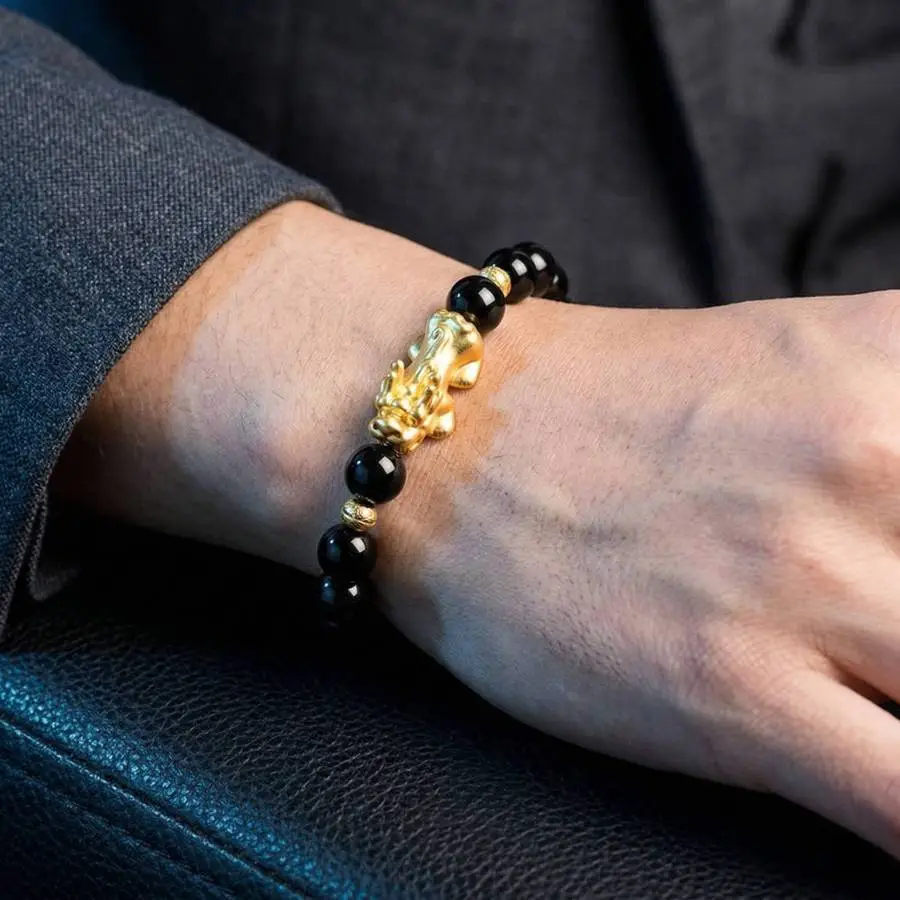
Authentic Feng Shui Pixiu Wealth & Protection Bracelet
$39.99 $59.99
The classic Chinese wealth charm in wearable form - a hand-carved obsidian Pixiu paired with cinnabar beads, tied on red string. Worn on the left wrist, the Pixiu is believed to gather wealth and prevent it from leaving. Adjustable, unisex, daily wear.
View Pixiu Bracelet →Materials: what bracelets are made of (and why it matters)
The material of a lucky charm bracelet is not the most important thing, but it is not nothing either. The most common materials and what they signal.
| Red String | The most universal lucky charm material. Cotton or silk. Cheap, replaceable, traditionally tied by someone else. Most traditions favor red, but white, black, and gold also appear. |
|---|---|
| Jade | Premium Chinese material for protection and longevity. Nephrite jade is traditional. Real jade is cool to the touch and slightly waxy. Avoid "jade" glass at high prices. |
| Gold | Used in Pixiu and Buddha bracelets. Gold is associated with wealth and the sun. 24K is too soft for daily wear - most Pixiu are 18K or gold-plated. |
| Sterling Silver | Common in mantra beads and Hamsas. More affordable than gold, durable, and works for sensitive skin. Often combined with stones. |
| Obsidian 黑曜石 | Volcanic glass. Strong association with protection and absorbing negative energy. Used in evil-eye and Pixiu bracelets. Heavy, smooth, cool. |
| Sandalwood | Fragrant wood used in Buddhist and Hindu beads. The scent is calming. Most "sandalwood" sold online is synthetic - real Mysore sandalwood is rare and expensive. |
| Rudraksha | Seeds from the rudraksha tree, traditional in Hindu mala beads. Each bead has "faces" (lines) with different spiritual meanings. Authentic rudraksha is dense, slightly rough. |
For most people, the right material is the one you can wear daily without irritation. The symbol matters more than the substance.
Which hand should you wear a lucky charm bracelet on?
The answer depends on the tradition the symbol comes from. Three of the most common guidelines.
| Chinese feng shui | LEFT for attracting (Pixiu, Wu Lou, wealth). RIGHT for releasing or giving away. |
|---|---|
| Hindu / Buddhist | Often RIGHT for sacred objects (mantra beads, rudraksha). Some traditions prefer the dominant hand. |
| Western convention | LEFT for protection and personal meaning (closer to the heart). RIGHT for outward-facing or fashion. |
The most useful rule of thumb: follow the tradition the symbol comes from. A Pixiu worn on the right wrist is, in feng shui terms, giving the wealth away. A Buddhist mala on the left wrist contradicts the traditional practice. When in doubt, the LEFT wrist is the safer default for attracting or receiving.
How to activate a lucky charm bracelet
"Activation" sounds mystical. It is not. It is a quiet, intentional ritual that turns a piece of string or metal into a charm you have committed to.
Three steps, no temple required:
- Hold the bracelet in both hands. Pause for a few seconds. Notice the weight, the texture, the temperature.
- State your intention clearly. Either silently or aloud. "I wear this for protection." "I wear this to attract wealth." "I wear this to remember my grandfather." The clearer the statement, the more the bracelet becomes a reminder.
- Tie it on (or close the clasp) while visualizing the intention taking hold. This is the moment the bracelet becomes yours. Some people say a small prayer, light incense, or simply breathe out slowly. None of these are required.
Reaffirm the intention every time you put the bracelet on. The "activation" is not a one-time event. It is a recurring moment of attention.
When to take a lucky charm bracelet off
Most traditions recommend removing bracelets during specific activities. The reasons are usually both practical and symbolic.
| Shower / Bath | Always remove. Soap, shampoo, and hard water degrade string, elastic, and even some metals. The bracelet also "rests" with the body. |
|---|---|
| Sleeping | Recommended for most bracelets. Tangles, sweat, and skin wear. Exception: a red string tied at birth is traditionally never removed. |
| Sex | Most traditions say to remove. The bracelet is a personal charm; intimacy is its own energetic space. Red strings from birth are the exception. |
| Swimming | Remove. Chlorine and salt water damage most materials. Cold-water shock can crack stones. |
| Hospital / Surgery | Remove. Metal can interfere with medical equipment. The charm can be recharged afterward. |
| Mourning | Most traditions say to keep wearing. The bracelet anchors you through grief. |
What to do when a lucky charm bracelet breaks
Most traditions interpret a broken bracelet as the charm having done its work - it absorbed an accident, an illness, or a misfortune that was heading your way. The break is the charm "completing" its purpose.
The standard practice is to thank the bracelet, remove the pieces, and either tie a new red string over the old knot (if the charm is reusable) or dispose of the broken bracelet respectfully. Do not throw it directly in the trash.
Three respectful options for disposing of a broken bracelet:
- Wrap in red paper and discard. The red paper signals respect and containment. Common in Chinese practice.
- Burn it (for natural materials only). Sandalwood, rudraksha, and cotton string can be safely burned. Do not burn metal, plastic, or stone.
- Bury it. Place the broken pieces in a small hole, ideally near a tree or in a quiet place. Return it to the earth.
Do not keep a broken bracelet in a drawer. The charm has finished its work. Honor it by letting it go.
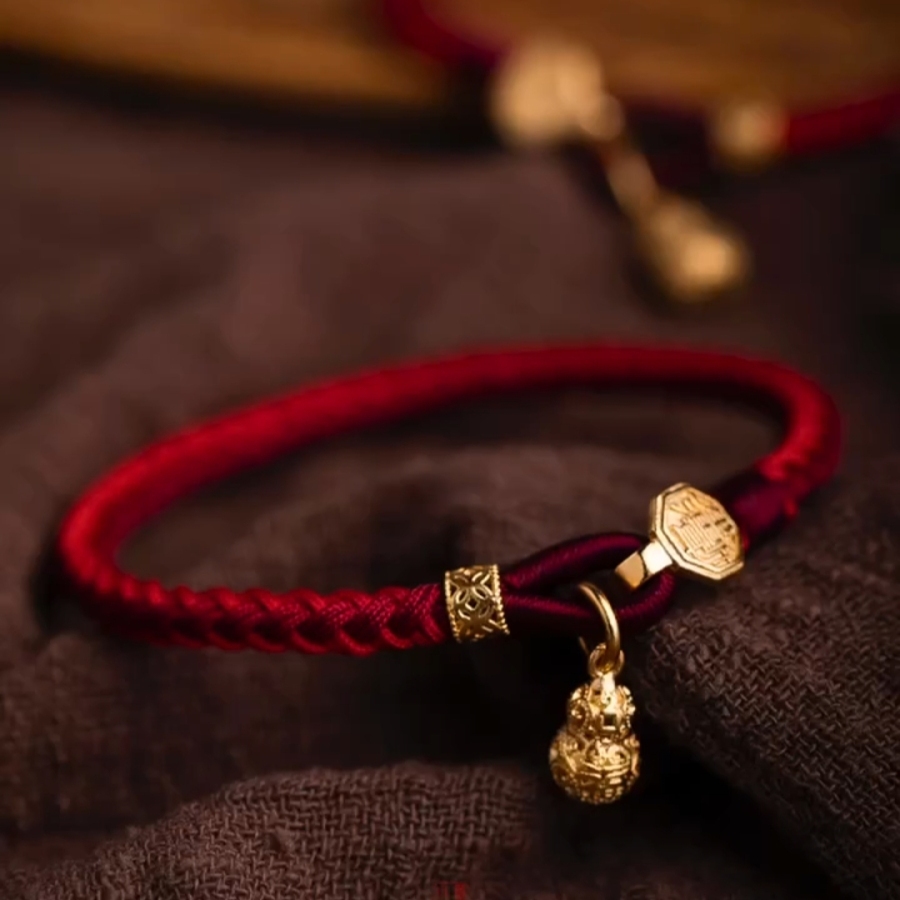
Wu Lou Gourd Red String Protection Bracelet - Fortune & Health
$34.99 $49.99
Two powerful symbols in one bracelet - a hand-carved Wu Lou gourd (the Daoist sage's medicine gourd) for health and longevity, paired with a hand-tied red string for protection and good fortune. A wearable combination of the two most traditional Chinese luck charms.
View Wu Lou Bracelet →How to choose the right lucky charm bracelet for you
The right bracelet is the one whose meaning matches the intention you actually have. Here is the decision tree most people should walk through.
🌟 The 3 Questions
1. What is your primary intention? (Wealth / Protection / Love / Health / Mindfulness / Spiritual practice)
2. How much time and care will you give it? (Daily wear vs. occasional)
3. Is the symbol appropriate for your beliefs? (Cultural / religious / universal)
Match symbol to intention
| Want wealth | Pixiu (Chinese), Lakshmi (Hindu), four-leaf clover, gold coin. Avoid if you are on a spiritual path that emphasizes detachment. |
|---|---|
| Want protection | Evil eye, Hamsa, red string, obsidian. Universal across cultures. |
| Want love / connection | Red string, double happiness knot, infinity symbol. Avoid symbols that emphasize separation. |
| Want health / longevity | Wu Lou (gourd), jade, sandalwood. Especially recommended for older wearers or those recovering from illness. |
| Want mindfulness / peace | Buddha beads, mantra beads, rudraksha. Best for daily meditation practice. |
| Want spiritual connection | Cross, rosary, prayer beads, mantra beads. Best for practitioners of a specific tradition. |
Avoid this common mistake
The most common error: buying a bracelet because it looks beautiful or because someone famous wears one, without knowing what the symbol means. A Pixiu worn without understanding the tradition is just an ugly lion on your wrist. A red string tied without intention is just a piece of string. The meaning is the charm.
How to tell an authentic lucky charm bracelet from a fake
"Authentic" is a slippery word. A real Pixiu from a souvenir shop is no more powerful than a faithful reproduction if both are worn without intention. But there are some tells.
- Red string - Real red string is hand-tied with a specific number of knots (often 7 or 9). Cheap versions are pre-tied with a clasp. Both "work," but the hand-tied version honors the tradition.
- Jade - Real jade is cool to the touch even in warm air, has a waxy luster, and is heavier than glass. If it is bright, light, and "perfect," it is probably dyed quartz or glass.
- Gold Pixiu - Solid 24K Pixiu are too soft for daily wear. Most real Pixiu are 18K or high-quality gold plate. Avoid anything that looks too bright and too light.
- Rudraksha - Real rudraksha beads have visible "faces" (lines from pole to pole). They are slightly rough to the touch. Smooth, perfectly round beads are usually fake.
- Sandalwood - Real sandalwood has a deep, sweet scent that persists for years. If it does not smell like anything, it is not sandalwood.
None of this matters more than the intention. A $5 red string worn with care will serve you better than a $500 gold Pixiu worn carelessly.
Common side effects, myths, and what to expect
"I felt strange when I first put it on"
Many people report a sudden awareness of their wrist, a sense of warmth, or a wave of emotion the first time they wear a new charm bracelet. This is normal. It is the activation moment. It fades within a day or two as the bracelet becomes familiar.
"Bad things kept happening after I put it on"
This is the "lucky charm backlash" myth. It usually means one of two things: the bracelet was made or sold without proper intention, or the wearer was already in a difficult period and is now noticing the difficulties more. Lucky charms do not manufacture bad luck. If you are having a hard time, the bracelet is for the hard time.
"I forgot to take it off in the shower and it got wet"
For red string: dry it and keep wearing. The string may need to be replaced sooner. For Pixiu or metal: dry thoroughly. The charm is not "broken." The material may degrade faster.
"My friend gave me a charm and I don't believe in it"
Wear it. The charm is a token of the relationship. That is its own kind of luck.
One more thing
A lucky charm bracelet is one of the oldest forms of wearable technology. For as long as humans have made string and metal, we have used them to carry meaning on our bodies. The meaning has not changed: a piece of the world you trust enough to keep close.
Choose a symbol whose meaning matches the intention you actually have. Wear it with attention. Take it off when you sleep. Replace it when it breaks. That is the whole practice.
Two charm bracelets we recommend
Both are handcrafted in our Hong Kong studio - the same ones our team wears daily.
Shop Pixiu Wealth Charm →10 questions people ask
What is a lucky charm bracelet?
Do lucky charm bracelets actually work?
Which hand do you wear a lucky charm bracelet on?
Can you wear multiple lucky charm bracelets at the same time?
What does it mean when a lucky charm bracelet breaks?
Should you sleep with a lucky charm bracelet on?
How do you activate a lucky charm bracelet?
Are lucky charm bracelets religious?
How long does a lucky charm bracelet last?
What's the difference between a lucky charm bracelet and a regular bracelet?
The shortest version
Pick a symbol whose meaning matches what you actually want. State your intention. Wear it daily. Take it off to sleep. Replace it when it breaks. The charm is the meaning you carry.
If you have read this far, you are probably ready to choose one. The two we recommend most often to people new to charm bracelets are the red string (for protection, universal across cultures) and the Pixiu (for wealth, traditional in Chinese practice). Both work, both last, both can be replaced when they break.
Last updated: October 14, 2026. First published: October 14, 2026.
0users like this.


Your cart is currently empty.