
Feng Shui

What Are the Eight Trigrams (八卦)? A Clear, Modern Guide
What Are the Eight Trigrams (八卦)?
A clear, modern guide to the 8 I Ching symbols - the building blocks of feng shui, the I Ching, and Chinese cosmology.
The Eight Trigrams (八卦, Bā Guà) are eight ancient Chinese symbols made of three stacked lines each - solid for yang, broken for yin. They are the building blocks of the I Ching, the foundation of feng shui, and a flexible symbolic language that has shaped Chinese thought for over 3,000 years.
The short answer: what are the 8 trigrams?
The Eight Trigrams (八卦, Bā Guà) are eight ancient Chinese symbols, each made of three stacked horizontal lines. The lines are either solid (representing yang, the masculine, active force) or broken (representing yin, the feminine, receptive force). With 2 choices per line and 3 lines per trigram, there are 2×2×2 = 8 possible combinations - which is exactly why there are 8 trigrams, and not 7 or 9.
Each trigram represents a fundamental natural force and a direction on the compass. Together, the 8 trigrams describe the whole of reality in a compact, memorable form. They are the building blocks of the I Ching (the Book of Changes), the foundation of feng shui, and a structural element in Chinese medicine, Chinese martial arts, and Daoist cosmology.
This article is the pillar guide to the trigrams. Below you will find what each of the 8 means, how they are structured, the two ways they are arranged (Earlier Heaven and Later Heaven), and how to start working with them in feng shui and the I Ching today.
What "八卦" actually means
The Chinese name 八卦 (Bā Guà) is built from two characters. 八 (bā) means "eight." 卦 (guà) means "trigram" or "symbol" - though the original meaning of 卦 is closer to "a divination mark" or "a knot in a counting rope." The ancient Chinese used knotted cords for divination long before they had writing; 卦 originally referred to those knots.
So 八卦 literally means "eight divination marks" or "eight symbols." The same two characters are also the source of the modern Chinese word for "gossip" (also pronounced bāguà) - which originally meant "idle talk about the eight directions" before drifting into its current slang meaning. Don't let the modern slang fool you: 八卦 in classical texts almost always refers to the Eight Trigrams themselves.
How to pronounce 八卦
八卦 is pronounced Bā Guà in Mandarin Chinese - both syllables are in the falling-then-rising tone. In English, you will also see the trigrams referred to as the Bagua (an older transliteration), the Pa Kua (Wade-Giles), or simply the Eight Trigrams. They all mean the same thing.
The 3-line structure: how a trigram is built
Each trigram is three lines stacked on top of each other. Each line is read from bottom to top - the bottom line is the most "grounded" or foundational, the top line is the most "elevated" or refined.
Yang (solid line) and Yin (broken line)
The two basic units are yang (a solid, unbroken line ─────) and yin (a broken line ─ ─ ─, with a gap in the middle). Yang represents the active, masculine, bright, outward force. Yin represents the receptive, feminine, dark, inward force. Together they are the two fundamental modes of reality in Chinese thought.
The 8 possible combinations
With 3 lines and 2 choices per line, there are exactly 23 = 8 combinations. Each of the 8 possible arrangements is one of the trigrams. There is no ninth trigram - the system is closed and complete by design. This is part of why the trigrams are so elegant: the number 8 is not arbitrary, it falls out of the structure.
The 8 trigrams at a glance
Below is the full list, with the Chinese name, the English name, the natural force, the direction, and the corresponding element. Each trigram is shown with its symbol made of three lines (you can copy the lines from the table).
| Trigram | Chinese | Natural Force | Direction | Element |
|---|---|---|---|---|
| ☰ | 乾 Qián | Heaven / Sky | Northwest | Metal |
| ☱ | 兑 Duì | Lake / Marsh | West | Metal |
| ☲ | 离 Lí | Fire / Flame | South | Fire |
| ☳ | 震 Zhèn | Thunder | East | Wood |
| ☴ | 巽 Xùn | Wind / Wood | Southeast | Wood |
| ☵ | 坎 Kǎn | Water | North | Water |
| ☶ | 艮 Gěn | Mountain | Northeast | Earth |
| ☷ | 坤 Kūn | Earth / Ground | Southwest | Earth |
The "Parents" and the "Children"
In traditional Chinese cosmology, the trigram Qian (Heaven, all yang) and the trigram Kun (Earth, all yin) are considered the "parents" of the other six. The other six trigrams are the "children" - each one is Qian or Kun with one line changed. For example, Zhen (Thunder) is Kun with the bottom line changed to yang. This parent-children structure is a key part of how the trigrams are taught in classical texts.
The two arrangements: Earlier Heaven and Later Heaven
The 8 trigrams can be arranged in two famous configurations, attributed to two legendary figures. The arrangement you use depends on what you are trying to do.
| Earlier Heaven (先天八卦) | Later Heaven (后天八卦) | |
|---|---|---|
| Attributed to | Fuxi (伏羲), the legendary first sage | King Wen of Zhou (周文王), ~1100 BCE |
| Represents | The cosmos in its primordial, balanced state | The cosmos in motion - the cycle of seasons and change |
| Structure | Opposites face each other (Heaven opposite Earth, Fire opposite Water) | Generative cycle - each trigram flows into the next |
| Used in | Cosmology, meditation, advanced feng shui | Feng shui bagua map, the I Ching divination method |
| Best for | Understanding the underlying pattern | Applying to real spaces and real questions |
For most modern feng shui and I Ching work, the Later Heaven arrangement is the one that matters. It is the arrangement on a bagua map, the arrangement used when you consult the I Ching, and the arrangement engraved on traditional bagua mirrors.
How the 8 trigrams become 64 hexagrams
Take any two trigrams and stack them - one on top, one on bottom - and you get a 6-line symbol called a hexagram. With 8 trigrams available for the top and 8 for the bottom, there are 8×8 = 64 possible hexagrams. These 64 hexagrams are the structure of the I Ching, the Book of Changes.
Each hexagram is a 6-line portrait of a moment in time - a state of relationships, a configuration of forces, a question being asked of the universe. The I Ching, which has been in continuous use for over 3,000 years, is a book of 64 short commentaries on these 64 patterns. When you "consult the I Ching" using coins or yarrow stalks, you are essentially building a hexagram by random selection, then reading the corresponding commentary.
The trigrams are the alphabet; the hexagrams are the words. Eight trigrams, sixty-four hexagrams, three thousand years of human thought.
The trigrams in 3 different traditions
The same 8 trigrams are used in three very different contexts. Understanding which tradition you are in matters - they have different rules, different uses, and different levels of difficulty.
1. The I Ching (divination and philosophy)
The oldest and most rigorous use. The I Ching uses the 64 hexagrams (built from the 8 trigrams) as a system for divination, decision-making, and philosophical reflection. The Later Heaven arrangement is the standard. Studying the I Ching seriously can take years.
2. Feng Shui (space arrangement)
In feng shui, the 8 trigrams are arranged in the Later Heaven pattern on a bagua map - an octagonal grid that you overlay on your home or office floor plan. Each trigram governs one of the eight cardinal directions and one of the eight life areas (wealth, family, fame, partnership, children, helpful people, career, knowledge). To use it, you need a compass, a printed bagua map, and the layout of your space. Most home feng shui requires only this level of knowledge - no hexagrams, no divination.
3. Chinese Medicine (the body as landscape)
In traditional Chinese medicine, the 8 trigrams map to the 8 organ systems, the 8 energy meridians, and the 8 emotional patterns. A skilled TCM practitioner reads the pulse and the symptoms through the trigram framework. For most people, this is the most advanced use of the trigrams and is best left to trained practitioners.
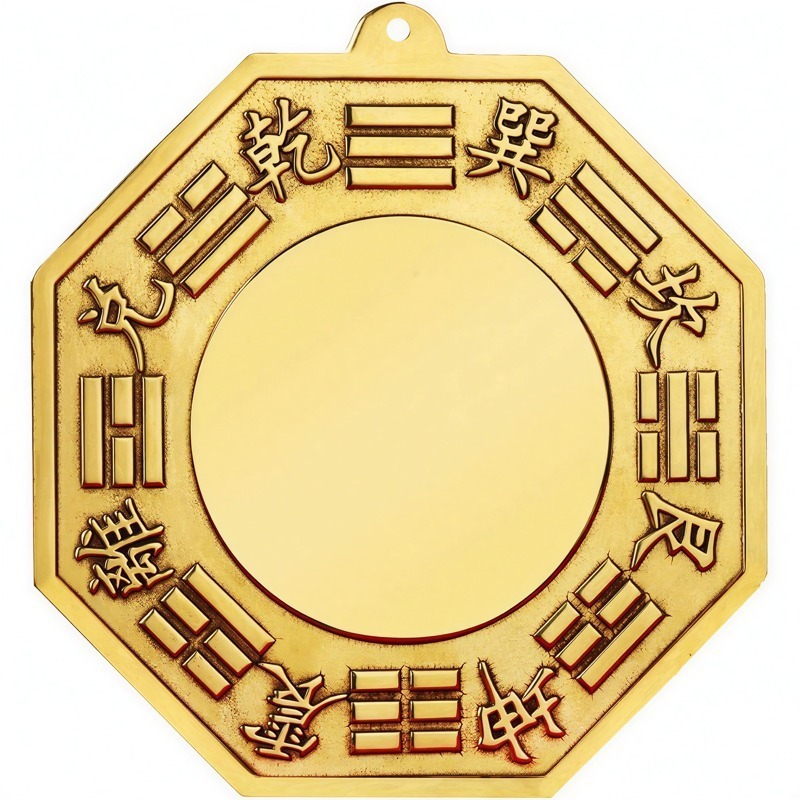
Brass Convex Bagua Mirror (Feng Shui) - All 8 Trigrams Engraved
$26.90
The most physical form of the Eight Trigrams: a solid brass convex mirror with all 8 trigrams and the Tai Ji symbol at the centre, hand-engraved. Hung outside the front door in classical feng shui to deflect negative energy (sha qi). A real, weighty object - not a sticker or print.
View Bagua Mirror →The relationship to Yin and Yang
Yin and Yang are the two fundamental forces. Yang is the solid line (─────), Yin is the broken line (─ ─ ─). The trigrams are made of three lines each - so each trigram is a unique 3-line combination of Yin and Yang. There are exactly 8 such combinations, which is why there are exactly 8 trigrams.
You can think of Yin and Yang as the material, and the trigrams as the structures built from that material. The trigrams are how Yin and Yang combine to produce the variety of the world. The Tao De Jing's famous line "The Dao that can be spoken is not the eternal Dao" sits above even Yin and Yang - the trigrams describe the visible world, Yin and Yang describe the forces, the Dao describes the source.
5 common misconceptions about the Eight Trigrams
1. "The trigrams predict the future."
No - the I Ching describes the present moment in symbolic terms. It does not predict a specific future. The hexagrams show the configuration of forces at the moment of the question; what you do with that information is up to you. The I Ching is closer to a mirror than a forecast.
2. "The trigrams are religious."
Not really. The trigrams are a symbolic system. They are used by Daoists, Confucians, Buddhists, and secular practitioners alike. Some Buddhist temples reject the trigrams as superstition; some Daoist temples treat them as sacred. The trigrams themselves are neutral - what matters is how you use them.
3. "You need to learn Chinese to use the trigrams."
Helpful, but not required. The names (Qian, Kun, Zhen, etc.) are Chinese, but you can learn the symbols, the directions, the elements, and the meanings in English. Most English-language feng shui books do this.
4. "The trigrams are only for feng shui."
No - feng shui is one of three major uses. The I Ching and Chinese medicine both use the trigrams heavily. And the trigrams show up in unexpected places: in Chinese martial arts (Bagua Zhang, the "Eight Trigram Palm"), in modern music theory, in decision-making frameworks, in Western Jungian psychology.
5. "All 8 trigrams are equal in importance."
Not in practice. Qian (Heaven) and Kun (Earth) are considered the "parents" of the other six, and the foundational pair. In feng shui, the trigram that falls on your front door is the most important for your space. In the I Ching, the hexagrams built from Qian-over-Kun and Kun-over-Qian are among the most consulted.
How to start learning the trigrams (3 approaches)
If you are new to the trigrams, the fastest way to start is to pick one of the three approaches below and commit to it for 30 days. Don't try to learn all 8 trigrams and all 64 hexagrams at once - that is the fastest path to giving up.
Approach 1: Learn the 8 directions first (Feng Shui path)
Memorize: Qian = Northwest, Dui = West, Li = South, Zhen = East, Xun = Southeast, Kan = North, Gen = Northeast, Kun = Southwest. That's the whole Later Heaven arrangement. With just this, you can read a bagua map and apply basic feng shui to your home.
Approach 2: Learn the 8 natural forces first (I Ching path)
Memorize: Heaven, Lake, Fire, Thunder, Wind, Water, Mountain, Earth. With just this, you can begin to read I Ching hexagrams and consult the oracle. Add the parent-children relationship (Qian and Kun are parents, the other six are children) and you are 60% of the way to reading the I Ching.
Approach 3: Learn Yin and Yang first (Philosophy path)
Before any trigrams, sit with Yin and Yang. The solid line and the broken line. The active and the receptive. The light and the dark. Once you can see Yin and Yang in your daily life, the 8 trigrams will come easily because they are just 3-line combinations of what you already understand.
Why the trigrams still matter today
After 3,000 years, the Eight Trigrams are still in active use. The I Ching is still consulted by philosophers, executives, and ordinary people facing decisions. Feng shui is still a global industry. Chinese medicine still maps the body through the trigrams. The trigrams are taught in universities. The symbols are on amulets, mirrors, jewelry, and architecture. The trigrams are not a museum piece - they are a living symbolic language.
What makes them durable is their flexibility. The trigrams are not a rigid belief system that demands faith. They are a small, elegant set of symbols that can describe any situation, any moment, any question. Whether you use them for feng shui, the I Ching, meditation, or just to think more clearly - the 8 trigrams are one of the most useful tools Chinese thought ever produced.
Continue learning: the trigrams cluster
This article is the pillar guide to the Eight Trigrams. The articles below cover specific aspects in more depth.
- 📜 The History of the Trigrams - How Fuxi, the Yellow River, and King Wen shaped the 8 trigrams over 3,000 years.
- 📊 The 8 Trigrams Explained: What Each One Means - A detailed article on each of the 8 trigrams.
- 🧭 The 8 Trigrams in Feng Shui: A Complete Beginner's Guide - How to use the trigrams in feng shui.
- 🗺️ The Bagua Map: How to Apply It to Your Home - Practical feng shui with the 8 trigrams.
- 🔮 Trigrams in Feng Shui: The 8 I Ching Symbols and How to Use Them - Deep dive into the personal Ming Gua trigram.
- 📖 What Is the Dao De Jing? - The 81-chapter Taoist text that sits above the trigrams.
10 questions people ask about the Eight Trigrams
What are the Eight Trigrams (八卦) in simple terms?
The Eight Trigrams (八卦, Bā Guà) are eight ancient Chinese symbols made of three stacked lines each - either solid (yang) or broken (yin). They are the building blocks of the I Ching (Book of Changes) and the foundation of feng shui, Chinese medicine, and Daoist cosmology. The eight trigrams are: Qian (Heaven), Dui (Lake), Li (Fire), Zhen (Thunder), Xun (Wind), Kan (Water), Gen (Mountain), and Kun (Earth).
How do you pronounce 八卦 (Bā Guà)?
八卦 is pronounced "Bā Guà" in Mandarin Chinese. Bā (八) means eight, Guà (卦) means trigram or symbol. The same characters are used for the Eight Trigrams, the Bagua map in feng shui, and the word "gossip" in modern Chinese - all derived from the original meaning of "eight symbols."
What is the difference between Bagua and the Eight Trigrams?
Bagua (八卦) literally means "eight symbols" and refers to the Eight Trigrams themselves. In feng shui, the Bagua map is the octagonal arrangement of these eight trigrams used to analyze the energy of a space. In the I Ching, the same eight trigrams combine in pairs to form 64 hexagrams. So the Eight Trigrams are the symbols; the Bagua map is one way they are arranged and used.
Are the trigrams the same as the I Ching hexagrams?
No - trigrams have 3 lines each, hexagrams have 6 lines each. The 8 trigrams combine in pairs (one on top of the other) to form the 64 hexagrams of the I Ching. Trigrams are the components; hexagrams are the combinations.
What is the difference between Earlier Heaven and Later Heaven arrangements?
The Earlier Heaven (先天八卦) arrangement is attributed to the legendary figure Fuxi and represents the cosmos in its primordial, balanced state - opposites face each other (Heaven opposite Earth, Fire opposite Water). The Later Heaven (后天八卦) arrangement is attributed to King Wen of the Zhou dynasty and represents the cosmos in motion, the cycle of seasons and change - used in feng shui and the I Ching divination method.
Which trigram is the most powerful?
In traditional Chinese cosmology, Qian (乾, Heaven, all yang) and Kun (坤, Earth, all yin) are considered the "parents" of the other six trigrams. Qian represents pure creative force; Kun represents pure receptive force. Together they are the "parents" of the other six "children" trigrams. In feng shui, the Later Heaven arrangement places Kun in the northwest and Qian in the northwest too, with both considered foundational.
What does each trigram mean for feng shui?
Each trigram corresponds to a direction, an element, a family member, and a life aspiration. Qian is the northwest and father. Dui is the west and youngest daughter. Li is the south and middle daughter. Zhen is the east and eldest son. Xun is the southeast and eldest daughter. Kan is the north and middle son. Gen is the northeast and youngest son. Kun is the southwest and mother. In the Bagua map of feng shui, each trigram governs one of eight areas of life (wealth, family, fame, partnership, children, helpful people, career, knowledge).
Why are the trigrams still relevant today?
The trigrams are still relevant because they are a flexible symbolic language, not a rigid belief system. They are used in modern feng shui consultations, in the I Ching oracle (over 3,000 years of continuous use), in traditional Chinese medicine (each trigram maps to body organs and energy meridians), in Chinese martial arts (Bagua Zhang), and increasingly in Western psychology and decision-making frameworks. Their compact 3-line structure makes them one of the most enduring symbolic systems in human history.
Do I need to memorize all 8 trigrams to use feng shui?
No. Most people using feng shui for the home only need to know the direction each trigram represents and the life area it governs - the rest can be looked up. The I Ching requires deeper knowledge because you need to interpret the 64 hexagrams. For home feng shui, a bagua map and a compass is enough to start.
What is the relationship between the trigrams and Yin-Yang?
Yin and Yang are the two fundamental forces - yin is the broken line, yang is the solid line. The trigrams are made of three lines each, so each trigram is a unique 3-line combination of yin and yang. There are 2×2×2 = 8 possible combinations, which is why there are exactly 8 trigrams. The trigrams are the building blocks; Yin-Yang is the material they are built from.
"The trigrams are not a belief. They are a language - and like any language, the more you use them, the more they give back."
0users like this.


Your cart is currently empty.