
Feng Shui

Wealth Corner Feng Shui: How to Find the One That Actually Works
Home Layout series · D37
Wealth Corner Feng Shui: How to Find the One That Actually Works
The wealth corner is not a corner. It is a position - and there are two of them, and they do not agree. Here is the five-test read that decides which one is yours, what belongs there, and what to avoid.
Ask two feng shui practitioners where your wealth corner is and you can get two different rooms. One points at the southeast. One points at the middle of the floor. Neither is lying, and it is not your fault - you have been handed two different systems and told to pick one without being told there was a choice.
There is a third possibility almost nobody mentions: both answers may be pointing at a dead spot.
A wealth position is not only a direction on a compass. It is a place that has to receive something - and the first thing a place has to do is be lit. A dark corner cannot hold wealth no matter what you put in it. That single fact will decide more for you than any bagua map, and almost no one checks it.
Key takeaway
- The wealth corner is a position, not a corner. Geometry is only one of five ways to find it - and rarely the most reliable one.
- Two legitimate methods disagree. Door-aligned (BTB) gives you the southeast. Compass-bearing (飛星) gives you the centre. Say which one you are using.
- Light outranks both. A corner with no daylight is a dead position. This is the test nobody runs, and it is free.
- Match the object to the problem. A tree grows, a toad pulls, a bowl holds. Buying the wrong one for your position is the most common expensive mistake.
- Most of the fix costs nothing. Clear it, light it, leave it alone. Three quarters of the work is free.
Why two experts will give you two different corners
Before you can find your wealth corner, you have to know which of two systems is going to point at it. They are not variants of the same thing. They are different tools, built for different eras and different buildings, and in a modern home they frequently disagree.
Door-aligned
BTB · Black Turtle / White Dragon
Where it points: the southeast corner of your main living space
You stand the bagua map with its bottom edge along the wall that holds your front door, and the eight sectors are assigned relative to the door's facing direction. This is the method behind almost every online bagua tool, and it is what you will find in nearly all English-language feng shui content.
- Easy to do - no compass, no plan drawing
- Follows how the household actually moves
- Disagrees with compass practice in rotated buildings
Compass-bearing
飛星 / 玄空 · classical flying-star
Where it points: the centre of the main living space, with the corners derived from the building's own axis
The building has a 坐向 - the direction it sits and faces, read from a compass. The sectors and the flying-star layers are derived from that bearing. In classical practice the wealth position is often read from the centre outward, which is why you get "the middle of the room" rather than a corner.
- Requires a floor plan and a compass reading
- Describes the building, not the household
- Disagrees with door-aligned in rotated buildings
The honest position
These two agree in the older housing they were both developed for, where the gate faces the way the building was deliberately oriented. They very often disagree in a modern subdivision with a rotated floor plan - where the developer set the street grid and the front door lands wherever the unit happens to sit.
When they disagree you get two answers for the same house, and the reason two practitioners gave you different answers is usually that each was using one method and did not say which.
So the practical rule for the rest of this article: run both, and then let the fourth test - light - break the tie. The full derivation of the eight sectors is in the Bagua Map guide, and the deeper background in the Eight Trigrams explainer.
The five tests, and the order to run them
Each test eliminates candidates. Run them in order, because a later test can disqualify a position that an earlier one approved - and there is no point refining a corner you are going to throw out.
Form · 形
Does the plan even give you a usable corner?
Most homes do not have a clean southeast corner. Concave plans, missing corners and open-plan layouts dissolve it. This test decides whether the geometry argument is even available to you.
Gate · 門
Run the two methods and see if they agree
One reading from the door, one from the compass. If they agree, you have a candidate. If they do not, keep both and move on - test 4 decides.
Movement · 動
Where does wealth already accumulate?
Money has a geography. Look at where your home already handles it - and where things pile up. This is the cheapest test in the article and the one most people have never run.
Light · 光
Does daylight actually reach the position?
The tie-breaker. A position that no daylight reaches cannot function as a wealth position, whatever the map says. This test overrides the other four.
Position · 位
Pick one and commit
Four candidates, four different remedies. Once you pick, the object you buy is determined by the problem you found - not by which piece looks nicest.
Read on and we run all five, in that order, on a real home.
Test 1 - 形 Form: does your plan even give you a usable corner?
Start here, because this test can end the conversation. Plenty of homes do not have a southeast corner to speak of.
Stand at your front door and look into your main living space. You are checking the shape of the floor plan, which in feng shui is read as 凸 (convex, bulging outward) or 凹 (concave, pulling inward). Convex plans are considered stable and gather well. Concave plans are considered to pull energy in and hold it - good for accumulation, harder to manage, and the reason a concave home can feel "tight" no matter how you furnish it.
Next, find the missing corner. Look at the four corners of your main space. A concave plan - an L-shape, a plan with a notch cut out of it, a plan where the living room wraps around an odd angle - has one corner that is not really a corner. It is open to another space. That is a 缺角, a missing corner, and in classical analysis it is the weakest of the four.
Why the missing corner matters here
If your southeast sector is one of the missing ones, then the most popular method does not give you a corner at all - it gives you a direction with no defined place to put anything. This is the single most common reason people place a wealth object "in the southeast" and it never feels right: they are aiming at a wall.
There is a fix, and it is in the tradition itself: the traditional cure for a missing 財 corner is to complete the shape with an object - a cabinet, a tall plant, a column of some kind that closes the visual corner and gives the sector a defined edge. It is not decoration. It is geometry you can build - and the same principle governs how you arrange a whole room, which we cover separately in our feng shui furniture guide.
Third case, and the most common in post-2000 housing: the open plan. If your living room, kitchen and dining area share one volume, the "corner" of the floor plate may belong to a hallway, a utility room, or the inside of a wall. This is the 傳統格局 versus 開放式 conflict running in the background of every open-plan home - the bagua map was drawn on rooms with walls, and the sector boundary will cut straight through your kitchen. If that is your house, say so out loud before you buy anything, because it changes which of the two methods you can trust.
Test 2 - 門 Gate: run both methods and see whether they agree
Two readings, and it takes ten minutes.
Reading A, door-aligned. Note which wall contains your front door and which way it faces. Lay the bagua map's bottom edge along that wall. The southeast sector falls where you would expect it to. Most people can do this without a compass and without a floor plan, which is exactly why it has become the default in Western content.
Reading B, compass-bearing. Step to the centre of your main living space and take a compass reading of the building's own axis - the direction it sits and faces, its 坐向. From the centre, the corners derive from that bearing, and the wealth reading is usually taken from the centre outward rather than from a corner. The technique itself is in how to read a feng shui compass.
Now compare them. If the two readings land on the same part of the room, you have a candidate with real confidence behind it - this is the easy case, and it means the traditional housing and the method agree, which is a good sign. If they land in different places, keep both candidates and do not buy anything yet. Test 4 is going to decide between them, and light is a much harder argument than compass doctrine.
One thing not to do
Do not average the two methods, and do not pick the one you like better. Averaging produces a location neither system supports, which is worse than either answer. Pick one, and if you later decide to switch, switch consciously - and then also move the object and re-check the light, rather than only changing your mind.
Test 3 - 動 Movement: where does wealth already accumulate?
This is the cheapest test in the article and the one most people have never run.
Feng shui was descriptive before it was prescriptive. The tradition did not invent the idea that money has a geography - it observed where wealth gathered in Chinese domestic architecture and described it. In the classical courtyard house, money gathered near the main door, in the back-left of the hall, close to the ancestral altar and the receiving room: where the household entered, worked, and stored things. Only later did anyone start saying "put a wealth bowl here."
So look at your own home, because your house already has this geography. It is just not labelled.
Where you handle money
The desk, the table, the counter
Where you open the laptop, pay bills, do the admin, sign things. In classical terms this is your 明堂 - the bright open hall where business is conducted and where the family's visible life happens. It is not a corner; it is a function. A wealth position that sits next to your working desk inherits the movement of the working desk.
Where things accumulate
The corner that keeps filling up
Every home has one spot that keeps collecting - the console by the door, the end of the sofa, the top of the filing cabinet. Objects drift there because that is where the movement of the house naturally settles. That is an accumulation point in the 動 sense, whether or not anyone chose it.
The two-week observation
Stop guessing, start counting
For two weeks, note every time you put something down "there for now." Where the majority of those things land is your movement point. It costs nothing, it takes no belief system to run, and it is more reliable than any map - because it describes your actual behaviour rather than a floor plan's geometry.
If the movement point and the compass or door reading land in the same place, you have a strong position. If they do not, you have found something genuinely useful: a place where energy already pools and which the map does not care about. That is usually the better position, and it is usually the one nobody on the internet will tell you to use.
Test 4 - 光 Light: the tie-breaker nobody runs
Here is the section that makes this article worth reading, and it is not about direction at all.
A wealth position is a place that is supposed to receive. Receiving requires three things that a compass cannot give you: light, airflow, and visibility - the position has to be somewhere you actually look at, and somewhere you actually walk past. A corner that is dark, sealed, and behind the sofa is not a wealth position. It is a cupboard. This is the practical version of what the tradition describes as a closed and still corner, and the underlying balance is set out in our guide to yin and yang in feng shui.
The conflict: 位 against 光
Classical feng shui wants a corner to be sheltered and held - 藏風聚氣, wind gathered and qi accumulated. A corner that is too open leaks. A corner that is too closed stagnates. The two requirements pull in opposite directions, and most published advice resolves it by silently favouring one.
The resolution that actually holds up: a position needs enclosure on one side and opening on the other. You want the back of the position against something solid - a wall, not a gap - and the front of it open to the room and to light. That is why a corner with one solid wall and one open side works, and a corner wedged between two walls or blocked by furniture does not.
The two-hour daylight test. Find the worst hour of daylight in your home - for most homes, that is late afternoon or early evening, but check. Stand at your candidate position and watch what happens for two hours. You are looking for three things:
- Does daylight physically arrive? Not reflected light from a white wall - direct sun or clear skylight, at least for part of the day.
- Does air move there? Is there an operable window, or a path to one? A still pocket of air is 閉, closed, and it holds nothing.
- Do you actually see it? From where you sit in the evening? If you never look at that corner, you are maintaining a position that cannot work, because you will never tend it.
If the candidate fails, you have three real options, in this order:
Option A
Move the position
The corner is dark, so use a different candidate from tests 1-3 that receives light. This is the cheapest and most common fix.
→ Use your Test 4 candidate list, take the best-lit one
Option B
Fix the light
Clear the obstruction, replace a heavy curtain with a sheer, move a tall cabinet, or bounce light off a pale wall. Cheap, often invisible, and it improves the whole room.
→ $0-$40, and it upgrades the space either way
Option C
Reconsider the position
If nothing in the house can be lit or moved, then the wealth position is not in the living space at all. It moves to the desk, the entry console, or the room you actually use.
→ A functional position beats a geometric one, every time
Test 5 - 位 Position: pick one, and let it determine the object
You now have up to four candidates and one that survived the light test. The last step is to stop treating this as a geography problem and start treating it as a diagnosis. Different positions have different problems, and the right object for one is the wrong object for another. Buying the piece you like instead of the piece the position needs is the single most common expensive mistake in this whole area.
Here is the decision table. Read the first column, find your row, and buy what the last column tells you.
| What you found | What it means | What the position needs | What to place |
|---|---|---|---|
| The corner is clean, lit, but feels inert | Good position, no movement in it. The corner is settled but not growing - usually because it holds one static item (a lamp, a plant that has stopped growing, a stack of post). | Upward and outward energy. Something that rises and spreads rather than sitting. | Crystal wealth tree - citrine for wealth, amethyst for career and study, rose quartz for relationship. |
| The position is lit but you want wealth drawn inward | The position is receiving light but the house is not receiving money from outside. You want an active pull, not a passive hold. | An object that faces into your space and actively draws. Usually a business entrance, a reception desk or a counter. | Golden toad / money frog - always facing into the room, never out through the door. |
| Money already arrives but it leaves | Income is fine, retention is not. You need the position to hold rather than invite - a holding function, not a pulling one. | A container. Something that keeps what is put into it. | Brass wealth bowl - filled with your own coins, a written goal, or clear quartz. |
| No clean corner exists at all | Concave plan, missing southeast, open plan. The geometric position is a direction with nowhere to put anything. | You have to build the geometry first, then place. | Build the corner with a tall cabinet or plant, then place a single object in the defined space. |
| The best position is not in the living room | For a home office, a rental, or a small flat, the living room may not be where money is handled. The position is functional, not formal. | A desk-adjacent or entry-adjacent position with a solid back and light. | The tree for desk work, the toad for a shop counter, the bowl for a business that handles cash. |
What to put there: three objects, three different jobs
All three of these are made for this job and none of them is a substitute for the others. The mistake is buying all three, or buying the wrong one. Each one below is matched to the row in the table above that calls for it. For the background on the plant and tree traditions, see our guides to the feng shui lucky bamboo plant and the feng shui money tree.
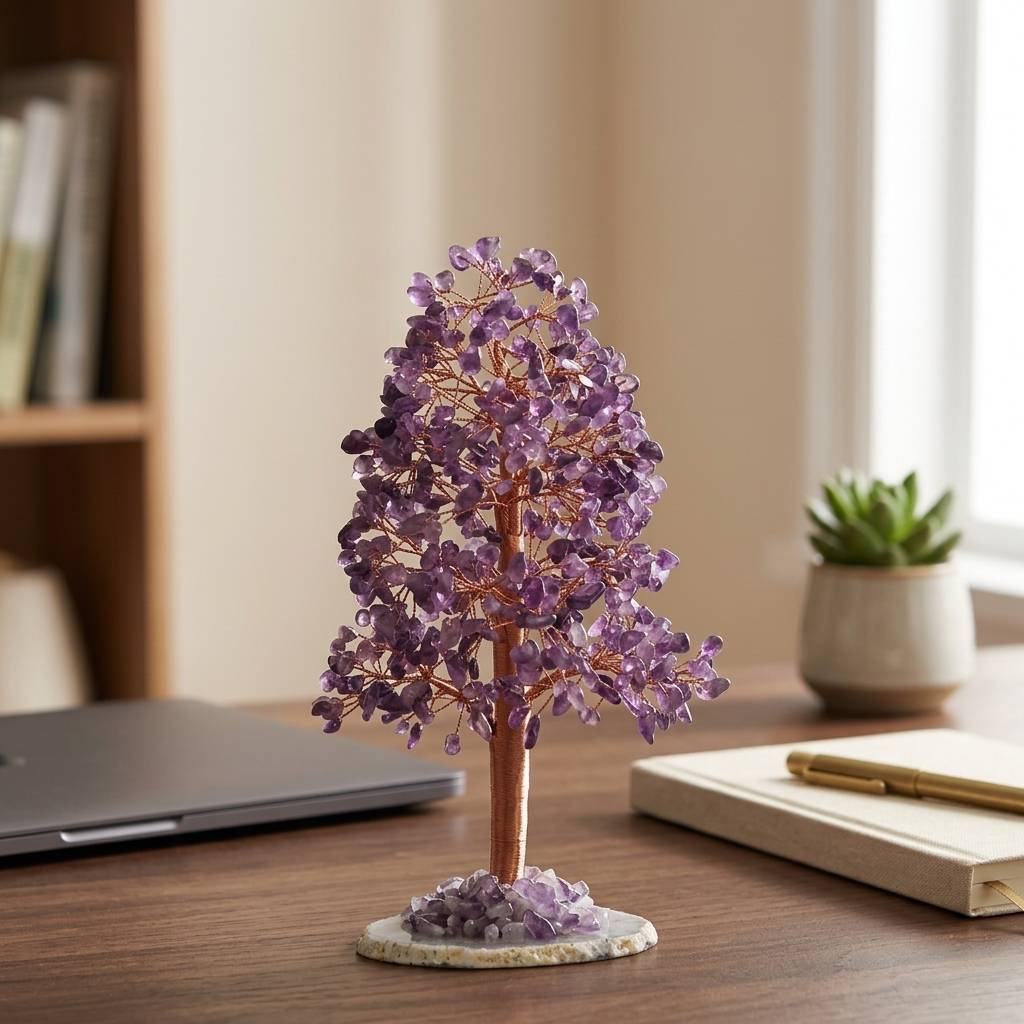
Crystal Wealth Tree
水晶聚财树 · Citrine · Amethyst · Rose Quartz
Use it when: the position is right and lit, but the corner feels static. A tree rises and spreads, which is what a settled-but-inert corner needs. Citrine for wealth, amethyst for career and study, rose quartz for relationship and calm.
$55.90
- 12 cm wide × 22 cm tall (4.7" × 8.7")
- Hundreds of individually wired natural crystal chips on a solid copper wire trunk, natural stone base
- Kai Guang blessed by a senior Taoist priest, with a certificate in a red envelope
- Fits a nightstand, desk or entrance console - SE for citrine, north for amethyst, SW for rose quartz
- Keep dry; wipe with a soft dry cloth only, never water on the copper
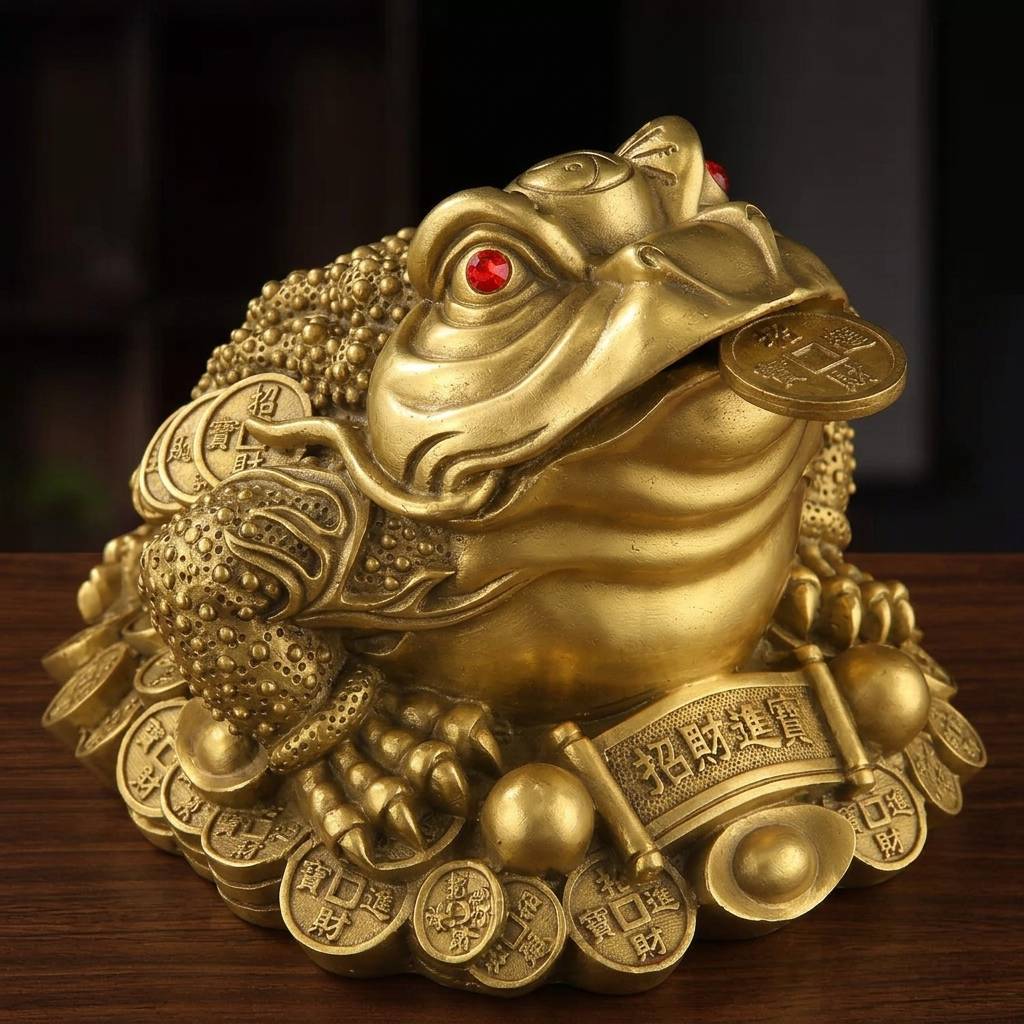
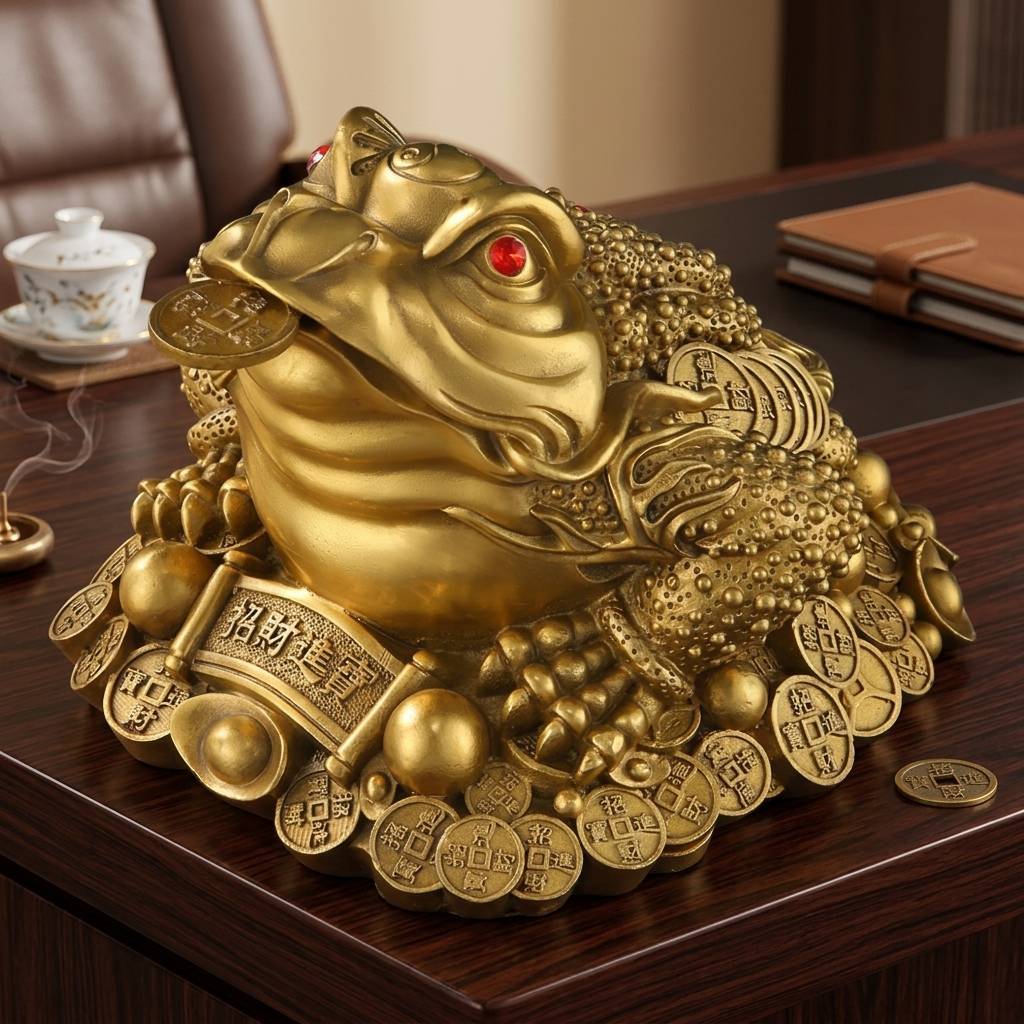
Golden Toad · Money Frog
金蟾 · 纯黄铜 · 20 cm
Use it when: you want wealth drawn inward rather than held. The toad faces into your space and never out through the door. Best at a shop counter, cash register, reception desk or a home entrance that is visible from the street side.
$79.99
- 20 cm statement piece in pure brass with an anti-tarnish finish
- Head must face into the space - never toward an exterior door
- Place at or above eye level; never on the floor
- Avoid the bathroom and kitchen; once placed, leave it alone
- Kai Guang consecrated by Taoist high-priest masters
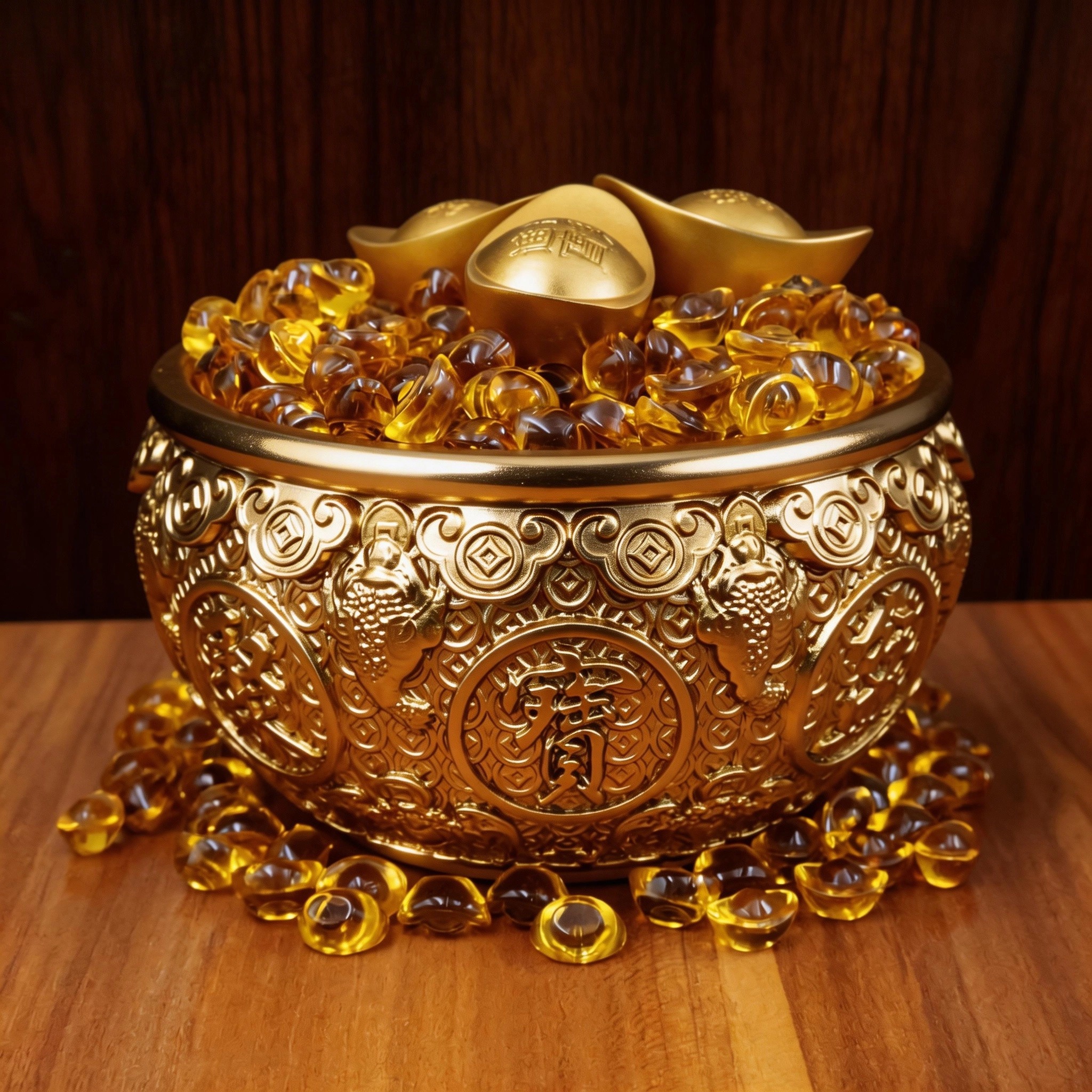
Brass Wealth Bowl
黄铜聚宝盆 · with gold ingots (元宝)
Use it when: the money arrives and then leaves. The bowl is a container, not a magnet - it is for retention, which is a different problem from attraction. Solid brass puts it firmly in the Metal element, and it arrives filled with ingots you can add to.
$168.00
- Solid brass, filled with traditional gold ingots (元宝)
- Add your own country's coins, clear quartz or citrine, or a paper with a written financial goal
- Place on a desk, beside a cash register, near a safe, or in the far corner diagonally opposite the main door
- Never in the bathroom and never on the floor
- Kai Guang consecrated - an unblessed bowl is a decorative vessel
For the wider range of wealth items and what each one actually does - including the ones that are decoration pretending to be function - see our guide to lucky feng shui wealth items and the breakdown of feng shui items for health, wealth and happiness. For what consecration does and does not do, read what Kai Guang actually means. And for how to work out which items belong in which part of a home, see feng shui items for the three areas of the home.
What not to put there
Six expensive mistakes, all of them common.
- Putting it on the floor.Fix: the floor is where things are stored, not where they are honoured. A wealth object on the floor is an object in storage. If the position is at floor level, build a low plinth or a console.
- Putting a second competing wealth object next to it.Fix: two wealth objects in one position split the function. One position, one job. If you want a tree and a toad, they go in two different confirmed positions.
- Moving it around.Fix: a position that gets relocated every few weeks is never allowed to settle. Place it once and leave it for a full season before judging it.
- Filling the position with unrelated "lucky" clutter.Fix: the position needs one clear object and nothing else. A cluttered corner cannot hold anything, because there is no single function for the energy to commit to. If you want a collection, it belongs on a shelf somewhere visible - not in the wealth position.
- Putting a mirror where it reflects the position back out of the room.Fix: a mirror bouncing energy off the position and back toward the door sends it out of the house. If you need a mirror in that room, angle it so it doubles the light rather than doubling the position. See our mirror placement guide.
- Fighting a dark corner.Fix: you cannot fix this with a $168 bowl. If the position fails the light test, the answer is test 4 Option A - a different, brighter candidate position - not a more expensive object in the dark.
What each layer actually costs to fix
The order matters more than the amount. Most people spend the money first and discover afterwards that the position does not work - and then own an expensive object in the wrong place.
$0
Before you spend anything
- Clear the candidate corner completely and leave it clear
- Move whatever blocks the daylight - a cabinet, a tall plant, a stacked box
- Swap a heavy curtain for a sheer one and see if the light arrives
- Run the two-week observation test on where money is handled
- Take down whatever is already fighting for the position
- Place one object you already own and leave it for a season
$0 - $60
When the position is confirmed and lit
- A single crystal wealth tree for a growth or career position
- A real piece of something over a decorative lookalike - the difference matters and it is visible in weight
- One object, not a set
$60 - $170
When you need an active pull or a container
- A golden toad for a counter, register or visible entrance that needs to pull inward
- A brass wealth bowl when the problem is retention rather than attraction
- One or the other. Not both in the same position
- If the position is a home altar rather than a shelf, our guide to setting up a Taoist home altar covers how to arrange it
The order rule
If you are still choosing between two objects, you have not finished test 4. Money spent before the light test is the most common way people end up with a beautiful, consecrated, correctly-priced object sitting in a dark corner that does nothing. Fix the corner first - it is free.
Renters, home offices and shops
Three situations where the standard answer has to be adjusted.
You rent
You cannot move a wall, but you can change almost everything that matters here.
- Run test 3 first. In a rental, the position is wherever you actually work - the desk, the dining table where the laptop lives. That is often the strongest position you have.
- Treat the SE corner as a candidate, not a command. If it is dim and awkward, a lit desk corner beats it.
- Fix what you can. A freestanding lamp, a pale wall, a sheer curtain and one clear surface will change the position more than any object.
- Do not drill. Wall-mounted fixes are how a deposit gets lost.
You work from home
Your desk is the position. This is the most common case in 2026 and nobody writes about it.
- The desk is a 明堂 - where the household's visible work happens. A wealth object on the desk is on a stronger position than one in a decorative corner.
- Solid behind, light in front. Your back should face a wall, and the light should come from the side or in front, not from behind a monitor.
- The tree is the right object for a desk - it stays out of the way and it does not block the screen.
- Do not put it in your peripheral vision to the point of distraction. A position you look at constantly gets resented; one you notice once a day gets maintained.
You run a business
The sector map is not where your money moves. The counter is.
- The register, counter or reception desk is the position. That is where money physically passes through your business.
- The toad belongs there, facing into the room - not toward the street door, which sends it back out.
- The bowl belongs near the safe, the back office or the accounts desk, where money is stored rather than transacted.
- Light the counter properly. A counter in a dim shop fails the same light test a dark corner fails.
For more on the specific problems of small homes and rental layouts, see our guide to feng shui for small apartments and feng shui for renters. For the desk itself, feng shui for the home office covers the rest.
Frequently asked questions
Where exactly is the wealth corner in my home?
That depends on which method you are using, and it is the reason this topic is confusing. Under the door-aligned (BTB) method it is the southeast sector of your main living space, measured from the wall with your front door. Under the compass-bearing (飛星) method it is usually read from the centre of the space outward, and the answer often lands on the middle of the room rather than a corner. The honest answer is that both are legitimate, and you should run both, then apply the light test to break the tie. A position that receives daylight and moving air beats a geometrically correct one that sits in the dark.
What is the difference between the southeast corner and the centre of the room?
The southeast corner is a corner - a defined point where two walls meet. The centre of the room is a location, not a boundary. Classical flying-star practice reads the wealth position outward from the centre of the space, which is why the centre has to be the starting reference, and why the answer is expressed as an area rather than a corner. Door-aligned practice uses the walls as the reference and the corner falls out of that. You are not choosing between two answers to the same question so much as two different instruments pointed at the same house.
Do I need a compass to find my wealth corner?
Only for the compass-bearing method. For the door-aligned method you need nothing but your front door and a floor plan, which is why it became the default in Western content. If you do want to run both - and you should, so you know whether they agree - you need a floor plan plus a compass or phone compass app to establish the building's own bearing. There is a fuller explanation of why the two methods disagree in rotated modern buildings in our home design feng shui guide, and the compass technique in how to read a feng shui compass.
What if my home has no southeast corner?
Then the door-aligned method gives you a direction with no defined place to put anything, and this is one of the most common reasons people place a wealth object in the southeast and it never feels right. The traditional cure is to complete the shape - use a tall cabinet, a column or a large plant to close the visual corner and give the sector a defined edge. You are building geometry, not decorating. If the home is an open plan, the sector boundary may cut straight through your kitchen, and the more useful answer is usually the desk or the entrance console where the money is actually handled.
Is the wealth corner the same thing as the commanding position (主位)?
No, and confusing them is a common error. The commanding position is the seat of authority - the sofa, the head of the table, the owner's chair. It is about who leads and who is honoured. The wealth position is about where value accumulates and is stored. They often overlap in a well-arranged home, which is part of why the two get merged, but they answer different questions. A commanding position facing a door is a problem because it puts you in a stream of incoming energy; a wealth position facing a door is a problem because it sends the value back out. We cover the commanding position in detail in command position feng shui.
Does the wealth corner change for the Year of the Horse in 2026?
The 2026 annual changes apply to the annual flying-star layer and to the colour and element recommendations for the year - they do not move the structural wealth position of your home, which is fixed by the building and the gate. What does change each year is what you add to it and how you activate it. If you want the 2026-specific recommendations, our 2026 wealth sector activation guide covers that layer, and lucky colours for 2026 covers the colour side of it, and the underlying principle is in our guide to colours in feng shui. The structural read in this article does not need updating every January.
How often should I change what is in my wealth corner?
As rarely as possible. A position that gets relocated every few weeks never settles, and you lose the ability to judge whether it is working. Place it once, leave it through a full season - a financial quarter at minimum - and then evaluate. If you are inclined to move something every time you feel a bad month, that instinct is itself the thing worth examining: the position responds to consistency and to what you actually do with your money, not to your mood about it.
What is the best wealth object for a small apartment or a rental?
A single crystal wealth tree, and specifically because it is small, vertical, and does not need floor space or wall fixing. Citrine for wealth, amethyst if the position is on or near your work desk. In a rental, the light test and the clutter test matter more than the object choice - a corner that is dark and crowded cannot be rescued by what sits in it. And use your deposit safely: freestanding objects only, no drilling, no adhesive fixtures on the walls.
Should the wealth corner be in the living room or the bedroom?
Whichever one you actually use for money and for decisions - which is usually the living room in most homes and the desk in a home office. The traditional advice puts the wealth position in the main hall because that is where a classical house received visitors and conducted family business. In a modern home, money is handled at a desk or a kitchen counter far more often than in the living room, so the functional position frequently beats the formal one. If you can only do one: run test 3, count where money is handled for two weeks, and use that room.
Keep reading
Home Design Feng Shui: the complete layout guide
The six-constraint framework this article is built on - form, gate, movement, light, position, objects - applied to every room in the house.
How to activate the wealth sector in 2026
The annual layer: what changes each year, and what does not.
Bagua Map: a beginner's guide
How the eight sectors are derived, and the two ways of orienting them.
10 fatal room layout mistakes
The layout errors that undermine every other correction you make.
How to declutter with feng shui
Why clearing the corner comes before buying anything for it.
The money frog in feng shui
The full history and lore of the three-legged toad, and why it faces inward.
The wealth corner is not a corner. It is a position - and it has to be lit, open, and somewhere you actually look at.
Find the position first. Choose the object second.
TaoFlow Feng Shui · written from the classical framework, checked against modern floor plans
0users like this.


Your cart is currently empty.