
Feng Shui

Red String Bracelet: Which Hand to Wear It On (The Complete Guide)
Red String Bracelet: Which Hand to Wear It On (The Complete Guide)
A practical answer to the most common red string bracelet question - left wrist vs right wrist, and the 7 cultural systems that decide.
Which Hand Should You Wear a Red String Bracelet On?
⚠️ If unsure, the left wrist is the safest default. It is the receiving side and is the most universal recommendation for first-time red string wearers.
🎯The 30-Second Answer
The short answer: wear your red string bracelet on the LEFT wrist for protection (you are drawing protective energy inward) and on the RIGHT wrist for action, sending, or attracting (you are projecting your intentions outward).
This convention is the most consistent recommendation across three major traditions - Kabbalah (Jewish mysticism), Taoist practice, and general feng shui - and it works on a simple principle: the body has a receiving side and a giving side, and the red string's placement tells the universe (and your subconscious) what you want to do with the energy.
If you have no specific purpose beyond "I want protection," left wrist is the safest default. It is the convention used in the majority of red string bracelets sold worldwide for protective purposes.
🌱 Practical takeaway
If you're wearing a red string bracelet for the first time and don't know which wrist to choose, pick the left wrist. You can always switch wrists later if you develop a specific intention that calls for the right wrist (e.g., attracting a romantic partner, building personal confidence, or sending protective energy to someone else).
🌀The Universal Principle: Left = Receive, Right = Give
Almost every tradition that uses red string bracelets agrees on one underlying principle, even when their specific recommendations differ:
This principle shows up across cultures:
- Kabbalah (Jewish mysticism): The left hand receives energy from the universe; the right hand gives (or acts in the world). Red string on the left = receiving protection from above.
- Taoist / feng shui: Yin (receptive, inward) corresponds to the left; Yang (active, outward) corresponds to the right. Red string on the left = drawing in Yin protection; on the right = activating Yang personal power.
- Traditional Chinese medicine: Qi (vital energy) enters the body through the left side of the chest and exits through the right. Red string on the left = regulating incoming Qi.
- Hindu and Ayurvedic tradition: The right side is generally auspicious for receiving blessings; some practitioners favor the right for auspicious bracelets. (Note: this is one of the few traditions that diverges from the left-receive principle.)
- Thai Buddhist: Monks tie the sacred string (sai sin) on the right wrist specifically because the right side is the sacred direction.
🌏 Why the small differences across cultures matter
Different cultures have slightly different reasons for choosing one wrist over the other. The Chinese and Kabbalistic traditions share the "left = receive" principle. Hindu and Thai Buddhist practice can prefer the right for different sacred reasons. The good news: there is no universally "wrong" choice. The intent behind wearing the bracelet matters more than the exact wrist. Pick the side that matches what you want to do with the energy.
🌐7 Cultural Traditions (And What Each Recommends)
Here is what each major tradition that uses red string bracelets actually says about which wrist to wear them on.
🌱 How to choose if you have mixed cultural influence
If you're influenced by multiple traditions (e.g., you practice yoga, feng shui, and meditation), pick the wrist that matches your primary intent. For protection, left. For sending out love or confidence, right. Don't overthink it - most traditions agree on the underlying principle, even if their specific recommendation varies.
🎯Which Wrist for Which Purpose
The wrist you choose should match your intention. Here are the most common purposes and the recommended wrist for each.
📍 The "switching wrists" rule
If you start wearing your bracelet on one wrist and later want to switch (e.g., from protection to love), there is no ritual requirement to remove or re-tie. Simply take off the old string, hold it with gratitude, and tie a new one on the new wrist with your new intention. Most traditions consider this a normal transition.
🎀How to Wear a Red String Bracelet Properly
Beyond which wrist, there are a few practical considerations that make a red string bracelet more comfortable, more effective, and longer-lasting.
The tightness
A red string bracelet should be snug but not tight. You should be able to slide one finger underneath, and the string should not leave marks on your skin or restrict your circulation. Most importantly: when the string gets wet, it shrinks slightly. If you tie it too tight when dry, it may become uncomfortable or constrictive after showering or swimming.
If the string is too loose, it will slide around your wrist and is more likely to catch on things or fall off. If too tight, it can cause skin irritation. Find the balance.
How to tie the seven knots (traditional method)
The most common traditional method for tying a red string bracelet involves making seven knots while stating an intention or mantra. This practice is found in Kabbalah, Taoist, and general feng shui traditions.
- Hold the red string in your dominant hand, leaving about 6 inches loose at the end.
- Wrap the string around your wrist (left wrist for protection, right wrist for love/action) once.
- Make the first knot while stating your first intention (or mentally: "I am protected").
- Make the second knot while stating the second intention (or: "from negative energy").
- Continue for a total of seven knots, allowing your intention to develop with each knot.
- Cut any remaining loose string close to the last knot.
- Tuck the loose end under one of the existing knots to secure it.
🌱 Variations across traditions
Some traditions use three knots instead of seven. Some have specific mantras for each knot (e.g., the Kabbalistic Priestly Blessing, or a specific Taoist prayer). Some practitioners simply tie one knot with a clear intention. The exact ritual matters less than the intent behind it.
When you can wear it
You can wear your red string bracelet 24/7 if you wish. Most practitioners keep it on during sleep, exercise, and most daily activities. There are three situations where it's common to remove it:
- Bathing and swimming: Prolonged water exposure can weaken the string and cause skin irritation (the string shrinks when wet).
- Medical procedures: Remove for IV lines, blood pressure cuffs, surgical procedures, or MRI scans.
- When the string falls off naturally: This is traditionally interpreted as the bracelet completing its purpose (see next section).
There is no rule against removing the bracelet for any other reason. The most important thing is that your intention for wearing it remains clear in your mind.
⚠️7 Common Mistakes to Avoid
Here are seven errors I should mention that practitioners sometimes make with red string bracelets.
- 1. Buying a non-consecrated bracelet for serious protective purposes. A factory-made red string is a beautiful accessory, but if your intent is serious spiritual protection, the tradition calls for a consecrated or blessed bracelet (Kai Guang 开光, sai sin, etc.). If you want serious protection, see our Ultimate Guide to Taoist Talismans and Protection Jewelry.
- 2. Wearing it on the wrong wrist for your stated intent. If you want protection, the left wrist is the universal recommendation. If you want to attract love, the right wrist is more common. Mismatching wrist and intent dilutes the symbolism.
- 3. Tying it too tight. Strings shrink when wet. A dry fit that feels snug can become painful after a shower. Leave room for shrinkage.
- 4. Cutting it off when it feels uncomfortable. If the bracelet becomes uncomfortable, loosen it rather than cutting it. If it really doesn't fit, remove it with gratitude rather than cutting it abruptly.
- 5. Treating it as a fashion accessory only. The red string bracelet has a 3,000-year history across multiple cultures. Wearing it as a fashion accessory is fine, but if you want to honor the tradition, have an intention behind it.
- 6. Believing it has unlimited power. A red string bracelet is a tool for focus and intention - not a magic talisman that overrides free will or fate. It works alongside your actions, not in place of them.
- 7. Wearing multiple red strings without clear intentions for each. If you wear two or more, know what each one is for. A bundle of red strings without intent is just decoration.
🔄 Removing or replacing a red string bracelet
You can remove a red string bracelet at any time. There is no ritual requirement to "release" it. If you want to retire one, hold it for a moment, mentally thank it for its service, and dispose of it in the trash or burn it (if tradition calls for that). Some practitioners bury old red strings with gratitude. The most respectful way is whichever feels right to you.
🛒TaoFlow Protectors: Two Red String Bracelets That Actually Work
Below are two TaoFlow red string bracelets that combine the protection tradition described in this article with consecrated Taoist symbols. Both can be worn on the left wrist for protection following the convention outlined above.
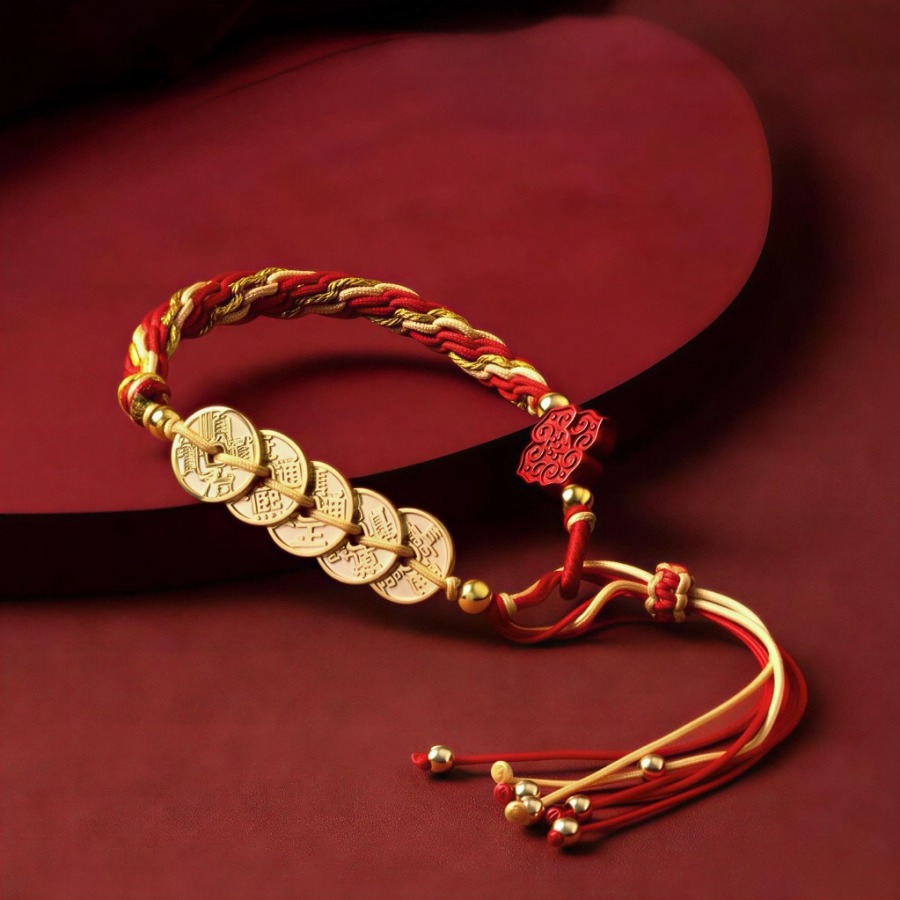 Five Emperor Feng Shui Coin Red String Protection Bracelet
Five authentic Qing Dynasty coins tied on consecrated red string - the Five Emperor (Wu Di Qian) arrangement is the most powerful protective charm in Chinese feng shui. The five emperors (Shunzhi, Kangxi, Yongzheng, Qianlong, Jiaqing) together ward off evil, dispel sha qi (煞气), and protect the wearer. For maximum protective effect, wear on the left wrist (receiving side).
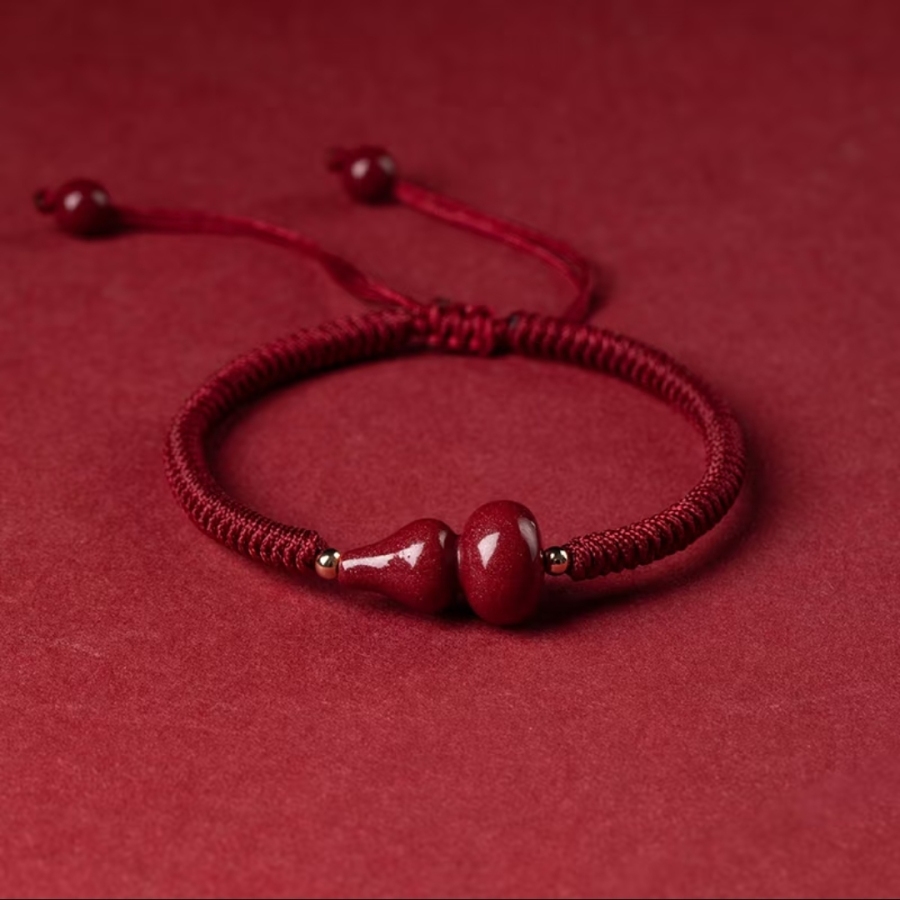
Cinnabar Gourd Red String Bracelet - Protection & Fortune
A natural cinnabar-painted Wu Lou (葫蘆) - the gourd shape is the universal Taoist symbol for absorbing negative energy and protecting health. Combined with consecrated red string, this bracelet is the traditional Taoist "double protection" - gourd absorbs, red string repels. Wear on the left wrist for protection + fortune.
🌿 TaoFlow recommendation logic: These two bracelets were selected because they combine (1) the red string tradition described above, (2) an authentic consecrated Taoist protective element (Five Emperor Coins or Cinnabar Wu Lou), and (3) a price point that respects the seriousness of the tradition without becoming an heirloom investment. Both can be worn on the left wrist for protection, the standard Kabbalah-Taoist-feng shui recommendation. For more options, see our complete talisman jewelry guide.
🍂When (and Why) a Red String Bracelet Falls Off
One of the most common questions about red string bracelets is: what does it mean when the bracelet falls off on its own? Here are the three traditional interpretations.
1. It has absorbed its intended negative energy
This is the most common interpretation in Kabbalah and Taoist practice. The red string is believed to absorb evil eye, sha qi (煞气), or negative energy that was directed at the wearer. Once the string has absorbed its full capacity, it falls off to signal that its work is done.
This interpretation doesn't necessarily mean you are now unprotected - it means the specific energy the bracelet was designed to absorb has been deflected or absorbed.
2. The intention has manifested
In some practices, the red string is tied with a specific intention (love, protection, luck). When the bracelet falls off, it is interpreted as the intention having manifested - the bracelet is no longer needed because the underlying wish has been fulfilled.
3. Natural wear and tear
Most practically: red strings are made of cotton, wool, or silk, and they wear out. A string that gets wet repeatedly (especially in chlorinated pools or saltwater), that catches on things, or that is worn for many months will eventually fray and fall off. This is normal and doesn't carry deep spiritual meaning in every tradition.
The takeaway: don't panic if your red string falls off. If you want to continue with the practice, tie a new one. If not, dispose of the old one with gratitude (or simply in the trash - it's a piece of string, and the power was in the intent, not the material).
Right wrist for love, action, confidence, and personal power.
Tie with intention - the wrist is the amplifier, the intent is the engine.
Snug but not tight - leave room for shrinkage when wet.
Wear until it falls off - or replace when the intention changes.
The string is a tool. The intent is the power.
FAQs
Which hand should I wear my red string bracelet on?
Wear your red string bracelet on the LEFT wrist for protection (you are receiving energy inward) and on the RIGHT wrist for action, giving, or sending energy out. This is the most common convention across Kabbalah, Taoist, and general feng shui traditions. Exceptions exist: in Thai Buddhist tradition, the red string goes on the right wrist as the sacred side; in Hindu tradition, the right wrist is considered more auspicious. If unsure, the left wrist is the safest default.
Why is red string bracelet worn on the left wrist?
The red string bracelet is worn on the left wrist because the left side of the body is traditionally considered the receiving side - energy flows IN through the left. Kabbalah tradition specifically: the left hand is closer to the heart, and the evil eye (ayin hara) is repelled before reaching the wearer. Taoist tradition: left = receptive Yin energy = drawing in protection, luck, and blessings. Most feng shui practitioners follow the same principle.
What does it mean to wear a red string on the right wrist?
Wearing a red string on the right wrist typically means you are giving or sending energy outward - confidence, action, asserting your intentions to the world. Some traditions interpret it as "I am protected and projecting that protection." In Taoist and feng shui practice, right-wrist wear is less common for protection but more common for: attracting love (sending out to find a partner), personal power, career action, and self-confidence. In Thai Buddhist tradition, monks tie the red string on the right wrist because the right is the sacred side.
Can I wear red string bracelets on both wrists?
Yes, you can wear red string bracelets on both wrists. Many practitioners wear one on each wrist - the left for receiving, the right for giving - to create balanced energy flow. This is especially common in Tibetan Buddhist and Taoist meditation practices. However, some traditions advise against this for beginners because the symbolism can blur; start with one wrist (left is safest), and add the second wrist when you have a clear intention for each.
Should you wear red string on left or right for protection?
For protection, wear the red string bracelet on the LEFT wrist. This is the consistent recommendation across Kabbalah (anti-evil-eye protection), Taoist (yin-receptive protection drawing in spiritual shielding), and general feng shui traditions. The left wrist is considered the receiving side of the body - where protective energy flows in to surround you. If you wear it on the right, you're "sending protection outward" which is a different intent and not the standard for protective bracelets.
Should you wear red string on left or right for love?
For love (especially attracting a romantic partner), the red string is traditionally worn on the RIGHT wrist in some feng shui traditions - sending out the intention of love to attract a match. In Chinese culture, the right side is sometimes considered more visible to others, making it the "showing" side for attracting partnership. However, other traditions recommend the LEFT wrist for love because the heart is closer to the left. The convention varies; pick the one that matches your intent (receive vs. attract).
How tight should a red string bracelet be?
A red string bracelet should be snug but not tight. You should be able to slide one finger underneath, and the string should not leave marks on your skin or restrict circulation. If the string is too loose, it can slide off and is more likely to catch on things. If too tight, it can cause skin irritation, especially when the string gets wet (it shrinks slightly). The traditional recommendation is to tie it with enough tension to stay in place but enough room to move with your wrist naturally.
Can I take off my red string bracelet?
Yes, you can take off your red string bracelet. There is no religious prohibition against removing it. The most common reasons to remove it: bathing, swimming, sleeping (some practitioners keep it on; others remove it for comfort), medical procedures (so it doesn't interfere with IV lines or blood pressure cuffs), and when the string naturally falls off or frays (traditionally this means it has absorbed its intended negative energy and done its work). Many practitioners keep it on for months or until it falls off naturally.
What happens when a red string bracelet falls off?
When a red string bracelet falls off naturally (without being cut or pulled), it is traditionally interpreted in three ways: 1) It has absorbed the negative energy or evil eye it was meant to absorb and has "completed its work." 2) The intention behind it has manifested and the bracelet's purpose is fulfilled. 3) In Kabbalah tradition, when the red string (worn to ward off the evil eye) falls off, the evil eye has been deflected and the bracelet is no longer needed. Some practitioners bury or burn the fallen string with gratitude; others simply discard it. The bracelet itself doesn't carry lasting power; it's a temporary protective tool.
Who can tie a red string bracelet on you?
Traditionally, a red string bracelet is tied on you by someone who wishes you well - a loved one, a spiritual practitioner, a monk, a priest, or a Taoist master. In Kabbalah, it is often tied on the left wrist at Rachel's Tomb or by someone who has visited there. In Tibetan Buddhist and Taoist traditions, monks or masters tie the string with specific mantras or intentions. If you're tying one on yourself, the recommendation is to do so with clear intention: state your wish or purpose aloud (or silently) while making the seven knots (common practice), and the string is "self-blessed." Many practitioners tie their own red strings successfully.
0users like this.


Your cart is currently empty.