
Feng Shui

Feng Shui Money Frog: Meaning, Placement, and Mistakes to Avoid
Feng Shui Wealth · Placement Guide
Feng Shui Money Frog:
Meaning, Placement, and the 7 Mistakes
There is one rule that decides whether this object works or actively works against you. It is not the material, the price, or where you found it. It is which way the mouth is pointing - and most people get it backwards.
Read this first
The money frog has one decisive variable: which way its mouth faces. Facing outward, it spits money away from you. Facing inward, it bites money into your space. Every other variable - material, size, colour, price, consecration - is secondary to this one. Get the direction wrong and no amount of quality in the object rescues the placement.
Below: what the object actually is, where the wealth is supposed to come from, how high and how far away it should sit, and the seven mistakes that reverse the effect.
1. What the money frog actually is
The English name "money frog" is a translation of 招財蟾 (zhāocái chán, "the wealth-attracting toad") and it is a poor one. It flattens a Chinese object that carries three separate meanings into one word: "frog."
Start with the characters. 蟾 (chán) is not the ordinary word for frog - that is 蛙 (wā). 蟾 is specifically the moon toad, yuèchán (月蟾), the creature of the lunar palace. In Chinese mythology the moon holds Chang'e, the Jade Rabbit, and a three-legged toad. 蟾 carries all of that: lunar, yin, cool, associated with the watery dark rather than the sunny day.
金 (jīn) is metal. Not "gold" in the bullion sense - metal in the Five Elements sense, the jin that corresponds to autumn, the west, clarity, contraction, and the coin itself. The word for an ancient Chinese coin is jin too.
So 金蟾 is not "gold frog." It is lunar toad made of the metal of coins. That is a considerably more specific object than the retail version implies, and the specificity is where the placement rules come from.
The origin: Liu Hai
The money frog does not appear in Chinese art until the Ming dynasty, and it arrives attached to a specific person. Liu Hai (劉海, conventionally dated to the Tang-Five Dynasties period) was a figure associated with wu you - fulfilment of wishes - and in folk tradition he became one of the Five Great Blessings (五大福神, wǔ dà fúshén) of wealth, alongside Bi Gan, Fan Li, Zhao Gongming, and Li Guizu.
The signature image is 劉海戲金蟾 - Liu Hai playing with the golden toad. Liu Hai is depicted laughing, bent over a three-legged toad, with a string of coins in his hand or mouth. It is one of the most recognisable auspicious motifs in Chinese folk art, painted on scrolls, carved on door lintels, and embossed on the brass bedwarmer fittings and coins of the late Qing.
"Liu Hai plays with the toad; the toad spits coins. He is laughing, not worried - because the wealth has already arrived."
Standard caption to the Liu Hai plays with the golden toad motif (刘海戏金蟾), Ming-Qing folk painting
Three details in that motif matter more than they first appear:
- Liu Hai is laughing. Not grasping, not anxious, not praying. The wealth deity in this lineage is relaxed about money. The image contradicts the anxious posture most people bring to money rituals.
- The toad is below him and he is bent toward it. The human is not above the wealth. He is at its level, playing.
- The coins come from the toad, not from heaven. This is a mechanical claim: there is a specific object in the room, and it has a mouth, and the mouth's direction is the mechanism.
The toad that doesn't croak
There is one detail in the Liu Hai tradition that is consistently left out of retail descriptions, and it is the most interesting thing about the object.
Ordinary frogs are noisy. The three-legged toad in Liu Hai's hands is depicted silent - 不鳴之蛙, bù míng zhī wā, "the frog that does not croak." This is not a stylistic accident. The contrast with an ordinary croaking frog is the point: this creature takes in money without announcing it.
The practical instruction hiding inside the image: the wealth you arrange should accumulate without being discussed. A money frog that gets pointed at, explained to guests, photographed, and posted about has been converted from a quiet collector into a display. This is the tradition's own reason for the unremarkable shelf.
What it is not
Three distinctions that matter commercially and conceptually:
| Object | Chinese | What it actually is | Relationship |
|---|---|---|---|
| Money Frog | 金蟾 · 招財蟾 | Lunar toad of the Liu Hai tradition. Silent, three-legged, mouth-directional. | - |
| Pixiu 貔貅 | 貔貅 / 辟邪 | A qilin-type beast that devours wealth and refuses to let it escape. No directional mouth - it is omnivorous. | Opposite function. Pixiu absorbs; the toad is directional. |
| Golden Cicada 金蟬 | 金蟬 | Not a wealth object. A cicada - rebirth, transformation, shedding the old skin. Frequently confused in export listings because 蟬 and 蟾 are near-identical. | Different meaning entirely. |
The Pixiu confusion is the commonest retail error and it has a practical consequence: if you are choosing between a pixiu and a toad for the same spot, they are not substitutes. A pixiu works by hoarding in all directions and does not care where it faces. A toad works by direction and needs you to get the orientation right. Put them together without planning and you can end up with a toad spitting directly into a pixiu that is eating it.
2. Why three legs, and why one of them is up
Ordinary frogs have four legs. The money frog has three. The tradition is not decorative about this.
Three is completeness. 三才 (sāncái) - heaven, earth, and humanity - is the classical triad through which everything in the world manifests. Three legs is the whole cosmos standing on three points. A four-legged toad is a toad. A three-legged toad is a complete structure.
Three is the number of flow, not number. Two is stillness (yin-yang as a pair). Three is where movement enters - the third point is what allows a circle. This is why 三 is the count for the wealth gods themselves: three-legged toad, three stars of fortune (三星), three officials (三官).
One leg is raised. In the Liu Hai motif the rear leg is lifted, not planted. The conventional reading is blunt and correct: the toad is ready to leap away. It does not want to stay.
This is the whole placement problem in one image
A creature with one foot up is not resting. It is loading to jump. Whether it jumps into your space or out of it is decided entirely by which way its head points - and which way its head points is decided by which way the door is.
Where this lands in Five Elements
金蟾 is a metal object in a metal-related animal form, so it inherits metal's position in the generating cycle: 金生水 - metal produces water. This has two concrete design consequences you will see in every well-made money frog.
Water is required, not optional. The classic configuration places a small vessel of water directly in front of the toad's mouth, usually with a coin in it. Metal feeds water; water is where the "bite" lands. A metal money frog with no water element is a set-up with a missing stage. Dry placement is the reason many people report "nothing happened," and they usually do not revisit the water question.
Place metal where metal is needed. In the Eight Mansions (八宅) system, a person born into the west group (西四命) - Qian, Kun, Dui, Xun homes - has metal as their own element. A toad in a west-group chart strengthens what is already strong. Placed in an east-group chart, where wood is the person's element, it is a supporting actor rather than a lead one.
| Situation | Toad effectiveness | Why |
|---|---|---|
| West-group chart (乾 坤 兌 巽 命) | Strong | Metal is the person's own element - the toad amplifies the governing cycle rather than feeding someone else's. |
| East-group chart (震 坎 艮 離 命), placed in the west | Strong | Metal feeds water, which feeds wood - the toad supplies the element the chart is short of. |
| East-group chart, toad placed in the person's own wood position | Weakened | Metal controls wood (金克木). Weakens the governing element of the chart. |
| No chart knowledge at all | Neutral | Still functional - direction is doing most of the work. Chart placement is refinement, not the mechanism. |
3. The one rule: which way does the mouth face?
Everything else on this page is commentary on this one decision.
The toad's mouth is described with two different verbs, and the difference between them is the entire mechanism.
- 咬錢 (yǎo qián) - biting money. Mouth facing into your space. The toad takes money in. This is the working configuration.
- 吐錢 (tǔ qián) - spitting money. Mouth facing out of your space, toward the door, toward the street. The toad expels what is inside. This is the failure configuration, and it is the single most common placement error in the West.
The rule generalises as a single sentence: the mouth faces the direction wealth arrives from, so that it catches rather than returns it.
✓ Working orientation
- Mouth facing inward, toward the room's interior
- Mouth angled toward the person who brings you money
- Angled, not aimed - 20° to 45° off the door axis reads better than dead-on
- Line of sight to the entrance unobstructed
- Water vessel in front of the mouth
✕ Reversing orientation
- Mouth facing out, toward the street or the doorway
- Mouth pointing away from where money physically arrives
- Aimed directly at the exit - reads as expulsion, not collection
- Placed with its back to the entrance and mouth to the far wall
- No water element in front of the mouth
How to identify the mouth
Worth stating because it trips people up: many money frogs are sold with a coin in the mouth. The coin is in the mouth - it does not replace it. You identify the direction of the head, not the position of the coin. The coin is held between the jaws; the head is what points. On most castings the mouth is the low front of the face, below the eyes, with the coin or the open jaw at the lowest point.
If your toad is symmetric and you genuinely cannot tell which way the mouth faces, it was poorly made. A good casting has an unmistakable front.
4. Where the money actually comes from
"Place it facing the door" is the standard instruction and it is only sometimes right. It is right when customers, clients, or visitors physically walk in. It is wrong for a lot of people's actual financial situation, which is where the more useful categories come in.
| Category | Chinese | Where wealth comes from | Where the toad goes |
|---|---|---|---|
| Direct wealth | 正財 | Salary, primary income, regular employer | The 正財位 - the interior diagonal corner of the room from the main door |
| Indirect wealth | 橫財 | Side income, commissions, investments, an unexpected windfall | The 橫財位 - the corner on the balcony/exterior side, between the door and the window |
| Customer wealth | 客財 | People who come to you | Facing the main entrance, on a low surface inside |
| Desk wealth | 案頭財 | What you earn at your own table | On the desk, lower left or lower right, never dead centre, mouth angled toward you |
| Shop wealth | 店財 | Foot traffic | Low, inside the door line, angled at the entrance - never blocking it |
Which one is yours?
Work it out in this order:
- Does anyone walk through your door for money-related reasons? Colleagues, clients, customers, a landlord, family. If yes → customer wealth, facing the entrance.
- Do you earn at a desk or table? If yes → desk wealth, and it goes on the desk. A money frog on a shelf twelve feet away is decorative; one on the desk is adjacent to the transaction.
- Do you mostly want the salary? → the interior diagonal corner of the room from the door. This is the classical 正財位 and it is deliberately the farthest point from the entrance, which is exactly why Western placements fail - people put things near the door.
- Side income, commissions, anything irregular? → the exterior-facing corner, the 橫財位.
Most households are running a blend. A toad near the entrance facing in handles customer wealth; a second toad on the desk handles earned wealth. Two toads for two channels is traditional - but see mistake six on pairing, because two is a limit and not a starting point.
5. Height, distance, and the details nobody tells you
Direction decides whether the object functions. Height and distance decide whether you can function around it. These are the practical constraints that retail descriptions skip.
Height: low, always
The toad should sit low - floor level, a low shelf, a low cabinet, a desk. Not on top of a wardrobe. Not on a high shelf. Not above eye level.
Two reasons, one symbolic and one practical. Symbolically: a toad with its rear leg up is looking for somewhere to jump down into. A money frog on a high shelf has nothing to jump down into and the whole image inverts. Practically: high-shelf placement is exactly how the object ends up covered in dust and forgotten, and an object you have to climb a chair to dust is an object that will be dusty within a month.
The exception that proves the rule: in a shop, a low plinth or a display riser near the door is often the traditional position, and it is still low in absolute terms.
Distance from the door
Close enough to see it, far enough that it is not in the walkway. Roughly one to three metres from the entrance in a domestic room. Not on the door itself, not in the door swing, not where a coat or a shoe rack will land on it.
The water element
金生水 - metal produces water. A small, still vessel of water in front of the toad's mouth is the standard completion of the set-up. Traditionally a coin sits in the water.
Four practical requirements, all of which people skip:
- Still water. A fountain or bubbler is a different instrument. Calm, level, no movement.
- Small. A shallow dish, not a basin. The point is presence, not volume.
- Clean, changed weekly. This is not optional. Standing water in a small dish is a hygiene problem and an insect problem, and it is the fastest way to have a family member quietly remove the whole arrangement.
- Dry cloth only. The traditional instruction is to wipe the toad with a dry cloth and never rinse it. This is a folk rule rather than a metallurgical one, but it is harmless and it is consistent across sources.
Light
The Liu Hai motif is a laughing figure over a toad - a warm, open, lit image. The toad does not need a spotlight, but it does need to be visible and not in permanent shadow. A dark corner of a hallway is a poor location even if the direction is correct.
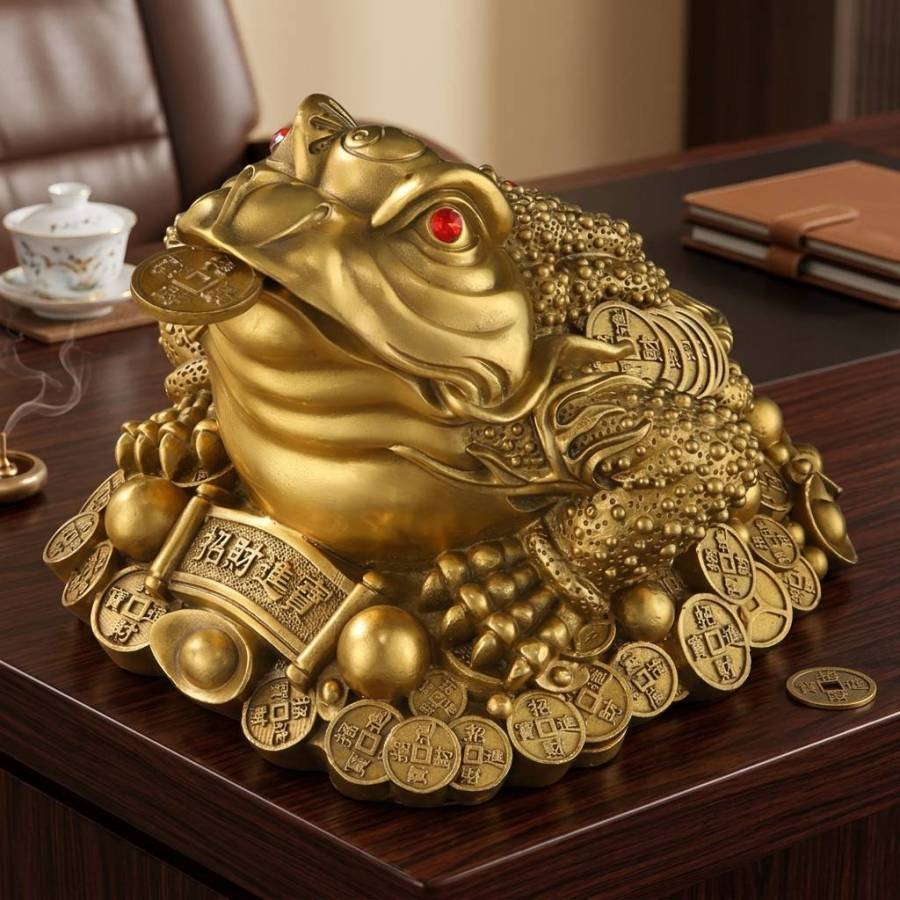
TaoFlow Feng Shui
Pure Brass Golden Toad - 20 cm
A cast pure-brass three-legged toad in the Liu Hai tradition - heavy enough to stay where it is put, large enough for the direction to be readable from across a room. The raised rear leg and the open mouth are the two features you should be able to identify before you buy anything.
- MaterialPure brass (纯黄铜)
- Length20 cm
- FormThree-legged, rear leg raised
- PreparationTaoist kai guang consecration
- ShippingFree worldwide
At 20 cm the toad is large enough that its facing direction is visible from the doorway - which matters, because the mouth direction is the one thing you must be able to check from where you stand.
6. The seven mistakes
Every one of these is common, every one of them reverses or neutralises the effect, and every one of them survives because the arrangement still looks right from the doorway.
The mouth faces outward
Placed so it looks out of the front door or out of the window. This is 吐錢 - spitting money. You have put the mechanism in reverse and the toad is now doing the opposite of what it is for. It is the most common error and it is invisible in a photograph.
Fix: Stand where you enter the room. If you cannot see which way the mouth points, move the toad until you can. Then angle it 20°-45° so it is catching the flow rather than aimed down the axis of the door.
It is too high
On top of a wardrobe, a high shelf, or the top of a bookcase. A toad with its rear leg raised needs something to leap down into. Up high, the image inverts, and in practice the object gets dusty and abandoned within weeks.
Fix: Floor, low shelf, low cabinet, or desk height. If your only available space is high, choose a different object for that space rather than the toad.
It faces the bathroom
In most households the nearest low surface with a water feature is the bathroom. Placing a wealth object there is a direct contradiction: the position drains and cleans, and 財 does not belong in the drain. Placing a coin in the toilet to "activate" it is the crudest version of this and appears in a lot of advice online.
Fix: The toad goes where money is handled - entrance, desk, or the interior wealth corner. If you want the water element, use a small dish in front of the toad, not the bathroom.
It is placed directly in the doorway
On the threshold, in the door swing, or centred in the entry path. Blocking the entrance reads as obstruction - 阻 - and a toad that people step over is being treated as an obstacle, which is the opposite of a vessel for receiving.
Fix: Offset to one side, one to three metres inside, low, with a clear walking route past it.
No water element
Metal produces water (金生水). A metal money frog on a dry shelf is a set-up missing its final stage. This is why a great many correctly-oriented, properly-placed, genuinely well-made money frogs produce no reported effect.
Fix: A small, still dish of clean water in front of the mouth, with a coin in it. Change the water weekly. Wipe the toad with a dry cloth, never rinse it.
Two toads facing each other
Doubling up is traditional when the two serve two different wealth channels - one at the entrance for customers, one on the desk for earned income. But two toads pointed at one another is a different arrangement: in the classical reading they are each intercepting the other's flow, and the result is obstruction rather than collection.
Fix: Two toads is fine if both face the same general direction and serve different channels. Two toads facing each other is not. Three is the practical ceiling in a domestic space.
It is presented rather than placed
On a mantelpiece in the middle of the room, spotlit, where guests see it and ask about it. This is the Liu Hai detail that nobody explains: 不鳴之蛙, the frog that does not croak. The wealth in the motif accumulates quietly and without announcement. An object on display has been converted into a conversation piece.
Fix: A shelf where you pass daily and guests mostly do not. Correct direction, correct water, no spotlight.
Two more that are not on the list, for completeness
- Facing a mirror. The classical objection is that the reflection "doubles" the arrangement ambiguously - sometimes read as doubling the income, more often as a false image, since the toad is a creature that is meant to be silent and a mirrored toad faces both ways at once. Either reading says the same thing: put it somewhere you do not have to see it reflected.
- Letting it fall or get knocked. A dropped and dented toad is traditionally replaced rather than repaired. This is mostly practical - the direction becomes unreadable - but the replacement convention is worth following anyway, because it is also the cheapest way to keep the object in good condition.
7. Combining it with the rest of a set-up
Read in isolation, "place the toad facing the door" is incomplete advice. In a real household it interacts with everything else you have placed.
Toad and pixiu together
Recall from section one: a pixiu hoards omnidirectionally and does not care where it faces. A toad is directional. Do not aim the toad's mouth into the pixiu. The conventional arrangement is the two side by side on the same low surface, both angled toward the same incoming flow, with the toad's mouth on the open side. If they are on opposite sides of the room, that is also fine - two collectors working two channels is traditional.
Toad and the 8 trigrams bagua mirror
These are opposing instruments and are usually not combined. A bagua mirror reflects and repels; a toad receives. Putting a toad where a bagua mirror is reflecting is like putting a bowl under a sprinkler.
Toad and the other 4 wealth objects
| Object | Function | Relationship to the toad |
|---|---|---|
| Wu Lou Absorbs | Holds wealth in; traditionally no rank, no mouth | Compatible. Often paired on the same shelf. The Wu Lou takes it in; the toad aims where it should arrive. |
| Pixiu Absorbs | Devours wealth and will not release it | Compatible with care about orientation - never mouth-into-pixiu. |
| Zhenshui Beast Repels water | Guards the entrance against external water qi | Often at the door, facing outward. Keep it out of the toad's mouth line. |
| Talisman scroll Documents | A written order; no directional mouth | Compatible at any height above the door. Does not conflict. |
| Water bowl with coin Completes | The water stage of 金生水 | Required, not optional. In front of the mouth, not elsewhere. |
The household version that works
A low shelf or cabinet near the entrance. Toad on one side, mouth angled into the room at 30°. Small water dish with a coin directly in front of the mouth. Wu Lou or pixiu on the other side, facing the same flow. Nothing above it, nothing spotlit, nothing in the walking path. Then a second toad on the desk if the desk is where the income actually happens.
That is the whole arrangement. Everything above it is optional and most of it works against the arrangement.
8. Choosing a money frog that will actually work
The market is full of objects that cannot fulfil the function, because the identifying features were not part of the manufacturing brief.
- Find the mouth. It must be unambiguous and directional. A casting with a symmetric, expressionless head is not a money frog, it is a frog-shaped ornament.
- Count the legs. Three, with the rear one raised off the base. A four-legged "money frog" is not in the tradition.
- Check the weight. Brass at any useful size will be heavy. An object light enough to be knocked over by a door or a cat will not survive the year, and a damaged toad loses its readable direction.
- Check for a casting seam and solidity. Hollow, seam-heavy castings are decorative hollowware. Look for a solid base and a clean mouth cavity.
- Size to the position, not to the price. A 10 cm toad on a high shelf fails on placement regardless of quality. A 20 cm toad on a low shelf reads correctly from the doorway.
- Treat consecration as optional, not decisive. Kai guang (開光, "opening the light") is a real and widely-practiced preparation rite performed by Daoist clergy. It is a religious act and it is meaningful to those who perform it. It is not what makes the object function - the direction is. Buy it if the rite matters to you; neither require it nor be talked out of it.
On price
The traditional materials - brass, gold, jade, ceramic - all work in the Liu Hai lineage. There is no correct metal and no threshold at which it starts working. What you are paying for at the top of the range is casting quality, size, finish, and the ability of the mouth to be read from a distance. Below that, you are paying for the same three features in different quantities. There is no version of this where the cheap one does nothing and the expensive one works, provided the mouth points the right way.
9. What this is actually doing
It is worth being plain about the mechanism, because the honest version is more useful than either the pseudoscientific version or the dismissive one.
Feng shui has no demonstrated causal mechanism in which a toad moves money. No study has isolated an effect of this object on financial outcomes, and no traditional cosmology offers physics. Anyone who tells you there is scientific proof that a brass toad alters your bank balance is selling something.
What feng shui practice demonstrably does is change behaviour, and the money frog is unusually well designed for that:
- It forces a direction to be chosen. "Where does money come from in my life?" is a real question with a real answer for most people - customers, salary, side work, investments. Deciding it and putting an object facing the answer is a commitment device. You have now stated, physically, which channel you are working on.
- It creates a recurring low-friction touchpoint. The water gets changed weekly. That is once a week you look at what you are working toward, for ninety seconds, without having to schedule it.
- It is near the transaction. The desk placement puts it in the visual field during the work rather than in a room you walk past once a day.
- It changes posture toward money. Liu Hai is laughing. The iconography does the work: it depicts someone at ease with money, which is the opposite of the anxious posture most people bring to the subject. This is the most underrated part of the tradition and it is a genuine behavioural intervention.
- It externalises an intention into an object you do not have to summon. Objects work as reminders because they require no willpower to perceive. A written goal in a drawer does not. A toad on the shelf does.
None of this requires believing anything about lunar toads or metal producing water. It requires buying the object, putting it in the right direction, and changing the water. If that sequence changes what you attend to, the effect is real regardless of the cosmology attached to it - and the cosmology is what most people find worth keeping, for reasons that have nothing to do with financial returns.
10. Going deeper
- The 8 Trigrams (Bagua)The Five Elements framework that determines whether a metal toad strengthens or weakens your chart.
- What Is the Dao De Jing?Why Liu Hai - laughing, unhurried - is the correct image for a wealth practice.
- Taoist Self-Cultivation (修煉)The broader discipline this object sits inside - five steps, twenty minutes a day.
- Zhuangzi: The Second Founder of DaoismThe satire of valuing the wrong things - the relevant warning when buying objects.
- Coarse Sea Salt (粗盐净化)The other half of a household set-up - clearing stagnation rather than attracting flow.
The full set, if you are building one room
Clear - coarse salt in the corners, changed monthly. · Guard - zhenshui beast at the entrance facing out, talisman scroll above the door. · Collect - Wu Lou or pixiu for hoarding, toad for direction, both angled at the same incoming flow. · Complete - water dish in front of the toad's mouth. · Sit - an incense seal on the altar, burning for an hour. The room is then doing four jobs at once: clearing, guarding, collecting, and slowing you down. That combination is worth more than any single object in it.
"Liu Hai plays with the toad; the toad spits coins."
劉海戲金蟾,金蟾吐錢。
The motif in one line - the human plays, the creature works, and the direction it faces decides where the coins go.
Face it in. Keep it low. Put water in front of it. Then leave it alone - 不鳴之蛙, the frog that does not croak.
Frequently asked questions
How should a money frog be placed?
Low - floor, a low shelf, a low cabinet, or a desk. One to three metres inside the main entrance, offset to one side and never blocking the walkway. The mouth angled 20°-45° into the room rather than aimed straight down the door axis. A small, still dish of clean water with a coin in it directly in front of the mouth. Never high up, never in the bathroom, never in the door swing.
Should the money frog face the door?
Only if people physically enter your home for money-related reasons - clients, customers, colleagues, a landlord. In that case face it toward the entrance with the mouth angled inward, so it catches the flow rather than spitting back out the door. If you work at a desk, put it on the desk instead. If you mostly want salary rather than customers, the classical position is the interior diagonal corner of the room from the door - the 正財位, deliberately the farthest point from the entrance.
Should the money frog face in or out?
In. This is the single decisive variable. Facing inward is 咬錢, "biting money" - the working configuration. Facing outward is 吐錢, "spitting money" - it expels what is inside your space. It is the most common placement error and it is not visible in a photograph, which is why it survives. If you cannot tell which way the mouth points while standing in the doorway, move the toad until you can.
Why does the money frog have three legs?
Three represents 三才 (sāncái) - heaven, earth, and humanity - the classical triad through which everything manifests. Three is also the number of flow rather than of number: two is stillness, three is where movement enters a circle. In the Liu Hai motif one leg is raised off the ground, and the conventional reading is that the toad is ready to leap away. That is why the direction matters so much - it is the difference between leaping into your space and leaping out of it.
What is the difference between a money frog and a pixiu?
Function, and in a practical sense whether they can substitute for each other. A pixiu (貔貅) hoards omnidirectionally - it devours wealth and does not release it, and it has no directional mouth to aim. A money frog (金蟾) is directional: the mechanism is the mouth's facing. Choosing between them depends on whether you want an undirected hoard or a directed catch. If you use both, place them side by side on the same low surface angled toward the same incoming flow, and never aim the toad's mouth into the pixiu.
Do I need a water bowl with the money frog?
In the classical set-up, yes - metal produces water in the Five Elements cycle (金生水), so the water is the stage that completes the arrangement, and a small still dish with a coin in it directly in front of the mouth is standard. Use a small shallow vessel with still, clean water, change it weekly, and never use a fountain. Many people who place a correctly-oriented toad report no effect, and a dry shelf with no water element is one of the most common explanations.
Can I have more than one money frog?
Two is traditional and works well when they serve two different wealth channels - one near the entrance for customer wealth, one on the desk for earned income. What does not work is two toads facing each other: in the classical reading each intercepts the other's flow and the result is obstruction rather than collection. Three is a practical ceiling in a domestic space. Whichever number you use, all should face roughly the same general direction.
Is a golden toad the same as a golden cicada?
No, and the confusion is common in export listings because 蟬 (cicada) and 蟾 (toad) look nearly identical. They are entirely different objects. 蟾 is the lunar toad of the Liu Hai tradition - a directional wealth symbol. 蟬 is the cicada - a symbol of rebirth, transformation, and shedding the old skin, used in feng shui for ideas, renown, and getting over something, not for attracting money. If a listing describes the object as a cicada, it is not a money frog.
Does the material matter - brass, gold, jade, ceramic?
No, not for function. All of these appear in the Liu Hai lineage and all of them work. What the top of the price range buys you is casting quality, size, weight, finish, and the readability of the mouth from a distance. What matters functionally is far simpler: you can identify which way the mouth faces, the object is solid enough to stay where you put it, and it is placed low, facing inward, with water in front of it. Brass is a reasonable default because it is heavy, durable, and reads clearly.
Does the money frog need consecration (kai guang)?
Kai guang (開光, "opening the light") is a real and widely-practiced preparation rite performed by Daoist clergy, and it is meaningful to those who perform and receive it. It is not, however, what makes the object function - the facing direction is. Buy a consecrated piece if the rite matters to you and you have the budget for it. Do not treat an un-consecrated toad as inert, and do not let anyone tell you a consecration can compensate for a toad pointed the wrong way.
What should I do if the money frog falls or gets dented?
Replace it rather than repair it. Partly this is traditional, but the practical reason is stronger: a dented casting usually loses the readable definition of the mouth, and the mouth direction is the mechanism. While you are between objects, note that this is a good moment to re-evaluate the placement itself - particularly the height, which is the second most common error after orientation.
Where should a money frog go in an office?
On the desk, low and to one side - traditionally the lower left or lower right, never dead centre where it obstructs the work - with the mouth angled toward you rather than pointed at a colleague. If your income depends on people visiting you or walking in, add a second near the entrance facing in. Keep the water dish on the desk if you can maintain it, or skip the water rather than setting up a dish you will forget to change.
0users like this.


Your cart is currently empty.