
Feng Shui

Remote Work Feng Shui: 5 Desk Rules for Focus and Career Luck
TaoFlow Feng Shui
Feng Shui · Remote Work · Home Office
Remote Work Feng Shui: 5 Desk Rules for Focus and Career Luck
The office did not close. It folded itself into a corner of a flat and started following you around the house. A desk that is also a dining table, a bed and a nightstand now has to do the job that a whole building used to do.
Key takeaway
- Home office feng shui is about the chair, not the charm. Five physical anchors decide whether a desk works: a wall behind you, light on your face, a door you can see without turning, a clear surface, and one object you chose on purpose.
- Remote work added a rule the old books never had to write. The camera. A window behind you is lovely in the room and disastrous on a call, because it turns your face into a silhouette.
- Position beats objects. Moving a chair thirty degrees costs nothing and changes more than anything you can buy for the desk.
- One focal point, not nine. A desk with a single chosen object reads as a workspace. A desk with nine reads as storage.
- Give the day two edges. A start and an end, two minutes each, is what turns a corner of a room into a workplace.
What Changed When the Office Came Home
The desk is the workplace now
In most working lives the office solved a lot of problems quietly. There was a door you could see. There was a wall behind your chair. There was a lamp on your side of the desk and a window that was not on top of you. There was a table that nobody ate dinner on, and a workday that started when you arrived and ended when you left.
Remote work moved all of that into a room that already has three other jobs. The table is also the dining table. The window is also the glare on the screen at six in the evening. The door is the bedroom door, open because of the cat. The sofa is where you read, and it is also where the laptop ended up at ten at night.
That is why home office feng shui has to be treated as its own subject rather than a footnote to the study. The classical books assume a room with one purpose and a door that closes. Very few remote workers have that. What they have instead is a corner, a timetable, and the fact that the room never tells them when the working day is over. An office feng shui layout is therefore mostly a question of relationships rather than of direction, which is fortunate, because a rented room cannot easily be turned around.
What has not changed is the method. Feng shui has always been a way of reading a room as a working system - where the light falls, where the air moves, where a person sits and what is in front of their face. It has never been much interested in your promotion or your revenue. What it offers is far more practical than that: a way to make the space you already have behave like a workplace instead of a corner with a laptop on it.
What this article is not
It will not tell you to buy a lucky object to rescue a badly arranged desk, and it will not pretend that a charm rearranges a career. It will not repeat the rules for the house as a whole either - the front door, the colours, the direction map of the whole house - because those belong to the home, not to the desk. What follows is five anchors, the mistakes that break them, and one ritual that holds the day together.
The Five Anchors of a Working Desk
The frame: back, face, door, light, surface
Every arrangement of a desk, good or bad, is a version of the same five questions. Where is your back? Where is your face? Where is the door? Where is the light? And what is actually on the surface in front of you? Get those five answers and the rest of the room stops being random.
The traditional language for this is position and support. A person seated in a good position has their back to something solid, their face toward something open, and a route to the door that does not require turning their whole body. That is the command position, and it is not mystical: it is the seating arrangement of someone who can concentrate and still know who just came in.
| Anchor | What it is | Why it matters | What goes wrong | First move |
|---|---|---|---|---|
| Back | A solid wall or closed surface behind the chair | Support, and a reason to stop turning round | An open doorway behind you, a radiator, a glass wall | Move the chair so the wall is behind you |
| Face | What you look at for eight hours | Attention follows the eyes, and the eyes tire | A monitor at the edge of the desk, a window in the middle of it | Centre the screen, raise it to eye level |
| Door | The way in and out of the room | Awareness, and an uncluttered route to the kettle | Sitting with your back to the door, or facing it all day | Turn the chair so the door is in peripheral vision |
| Light | Where the daylight falls, and from which side | Energy, eye strain, and how you look on camera | A window behind the screen, a bare overhead bulb, a dark desk | Move the desk so the light falls across your face |
| Surface | The actual working area, cleared | Attention has a limited stage, and clutter steals it | Six half-finished tasks, a charger, a lunch plate, a stack of paper | Empty the desk down to what you used today |
Notice what is not in that table. No lucky object, no special colour, no direction, no charm. Five physical relationships, each of which can be checked in ten seconds with your own eyes. This is the same structure as the classic three-point kitchen: the points that are fixed by the building come first, and everything else is maintenance.
Why anchors beat objects
Objects are the last step, not the first. A brass burner on a desk that faces a bright window at your back is still a desk that tires your eyes and ruins your video calls. Fix the anchors first, and only then decide whether the desk needs something standing on it at all. Most desks never do - and a desk that does not need anything on it is much easier to keep clear.
There is a practical reason for this order. The anchors are free and reversible: a chair moves in a minute, a screen moves in five, a lamp costs one afternoon. Objects accumulate and multiply, and each one you add needs a reason to stay. Start with the free corrections and let the object earn its place afterwards.
Rule 1: Take the Command Position
How to find it in a small room
The command position comes straight out of the sitting rooms of old houses: sit so that you can see the door without turning your head. You are not guarding the entrance. You are simply not being startled by it, and not spending a third of your working day swivelling to check who is in the kitchen.
In a flat, where the room is small and the door is close, this turns out to be the easiest of the five anchors and the one people most often fail, because it requires moving the desk rather than the chair. If you sit in the corner furthest from the door, you have your back to the only way out. That position is the old reading of sha qi draining away behind you, and the modern reading of a person who never relaxes.
The practical version: turn the chair until the door is in your peripheral vision. If the desk is against the wall, you cannot do that - then turn the desk instead, or move it a foot out from the wall. Ninety degrees of chair rotation solves it in a room where the desk is fixed to the wall, which is to say in most rented flats.
The three positions to avoid
Back to the door. The classic mistake. You feel it as a small restlessness you cannot name, and on a video call it shows as the moment you turn to look at something behind you.
Facing the door head-on. Less common and subtler. The old books treat the door as the mouth of the room, the point where outside air and outside attention arrive. Sitting square in front of it means the room's main opening is directly in your line of sight all day. Diagonal placement keeps the door visible without pinning you to it.
Sideways to the window, back to a blank wall, nothing behind but a radiator. Not fatal, but restless. If your chair is at the end of the desk with the wall on one side, you spend the day looking at a surface instead of a view, and the wall behind you is doing no supporting work.
Rule 2: Put a Wall Behind Your Back
If you have no wall
Support is the second anchor, and in a flat it is the one most likely to be missing. A rented room often gives you a desk in the middle of the floor with a window on one side and nothing at all behind you.
What the wall does is simple: it stops the room from pulling at your back. The classical description of a supported seat is that qi gathers behind a person and settles there instead of drifting off into the open room. Strip the poetry out and the practical version is that a person with something solid behind them holds still longer, and a person with open space behind them keeps half an ear turned towards it.
You do not always need a brick wall. A tall bookcase, a wardrobe, a curtain hung on a rail, a headboard, even a folding screen behind the chair does the same job, because the point is a surface that ends the space behind you. The modern version of the same idea is a wall of books; the older version was a screen, and screens were called ping for exactly this reason - they were furniture for sitting behind.
What does not work is a window, a radiator, or an open doorway. A window behind you fights the light on your face and ruins the video call. A radiator behind you pulls heat away from your back all winter. An open doorway behind you is the same problem the command position was meant to solve.
If none of those are possible, the next best thing is to make the space behind you visually quiet. A plain wall, a curtain, a blank board, a plant that is tall and dense. Anything that stops the eye from travelling out of the room behind your shoulders.
Rule 3: Light the Face, Not the Window
Side light, not overhead and not backlight
Light is the anchor people argue about most, because the traditional rule - light from the left, the window on the left - was written for paper and daylight. Screens changed the conditions, and the change is not small: a screen is a light source that sits about half a metre from your face for eight hours, and the room has to work with it rather than against it.
The old preference for light from the left still holds, and for the usual reason. In feng shui the left is the qin position, the receiving side of the room; in the body, the left is the receiving side too, and the right is the giving side. A task lamp on your right means the light arrives from the giving side and the writing hand is lit, not shadowed. This is practical advice that happens to have a classical name, which is why it survived.
What matters more in a remote office is where the light comes from relative to your face. Three setups: light from the side is right; light from directly above is flat and tiring, because it drops shadow into your eye sockets; light from behind you is the worst, because the screen competes with the window and your face goes into shadow. That last one is not a feng shui point at all. It is simply how a camera works.
The camera rule
Remote work added one rule the old texts never had to write down: your face needs light, not a view. A bright window behind your head is the single most common thing that ruins a video call, and it looks like a lighting mistake rather than a feng shui one. The fix takes ninety seconds and no money.
Sit with the window to your side, not behind you. If your desk faces the window because the room is narrow, turn the chair forty-five degrees so the light crosses your face from one side. If the window is behind and cannot move, hang a plain light-coloured sheet or a thin curtain over the top half of it - it turns a glare into a soft box, and you keep the daylight without the silhouette.
Add one lamp on the opposite side from the window, at about shoulder height, aimed at the side of your face rather than at the screen. This is the old desk-lamp rule with one modern correction: the lamp is not there to light the paper, it is there to light you. A warm lamp low and close does more for a face on camera than a bright ceiling fitting does for a room.
Rule 4: Fix the Sightline and Kill the Glare
The monitor, the mirror and the glass
The fourth anchor is what is in front of your face all day. In a house that is rarely a window; it is a screen, and often a mirror as well.
Put the monitor where you can sit square to it. A screen pushed to the edge of the desk makes you twist all day, and a twisted neck is a tired neck before lunch. Raise it until the top of the display is at, or just below, eye level. The classic desk advice - a screen slightly below the eye line - still holds, because the eyes look slightly downward all day and that is the position they were built for.
Now the mirror. In the feng shui vocabulary a mirror is tofu qian, the thing that turns qi, and the old rule is that it should not face a door, a bed, or a person at their most exposed, because it throws movement back at them. Applied to a desk, the practical version is narrower and simpler: a mirror directly in front of you doubles the work on the screen and puts your own face in your eyes for eight hours. If you have a mirror opposite the desk, cover it while you work, or move the desk.
The same applies to a window in front of the screen. The classic rule about a window facing a work desk is about light and movement crossing what you are doing; the modern version is glare, and it is fixable in a minute with a blind or a curtain on the upper half of the glass. A desk facing a window also means you spend the day looking at the brightest thing in the room instead of at your work.
And glass. A glass wall, a mirror cabinet, a screen door with a wooden frame behind it - anything reflective in your forward view - multiplies the visual noise in the same way. The rule is not that mirrors are unlucky. It is that the surface in front of your face should be quiet, so that your attention is not spent fighting it.
Rule 5: Keep One Focal Point on the Desk
What earns desk space
The fifth anchor is the surface itself, and it is the one people argue about most fiercely, usually in the wrong direction. The instinct is to add things: a plant, a figure, a crystal, a lucky object, a bowl, a stack of notebooks. The tradition has the opposite instinct. One deliberate object on the desk, and everything else earns its place by being used.
Why one? Because the working surface is not a display shelf. The old rule of a clear altar or a clean counter is not about purity, it is about what a surface means when something is standing on it. A table with one chosen object reads as a place where something is done. A table with nine chosen objects reads as a place where things are stored, and the person sitting at it starts looking for a place to put their hands.
The modern version of the same idea is attention. A screen, a notebook, a keyboard, a lamp - each of these asks for a little of the mind, and a desk that asks for nine pieces of attention before the work starts will take nine pieces back all day. There is a practical limit to what a person can hold in working memory, and a cluttered desk spends it before the day begins.
So the rule is a subtraction. Clear the desk down to what you used in the last week. Everything else goes into a drawer, a shelf, or a box. What stays should be three things: the tool you work with, the light you work by, and one object you chose on purpose. If you want that object to be a feng shui item, make it a deliberate one rather than a random one - and give it a job.
The desk is also where the day's smell lives, and smell is the one sense that writes straight into memory. A small desktop incense burner on the corner of the desk, used once in the morning, gives the working hours a scent that nothing else in the house has. That is the whole justification for an incense burner in an office: not that it changes your fortune, but that it marks the start of the day with something you can smell. The old practice of lighting incense before a piece of work was doing exactly that - the smell was the signal.
The Daily Desk Ritual
Everything above is arrangement. What turns an arrangement into a habit is a ritual, and a ritual for a home office only has to do two things: mark the start of work and mark the end of it. Both are short. Both are free.
In the morning, two minutes. Open the curtain. Wipe the surface. Put the day's one object where you can see it. Light something - a stick, a cone, or a meditation incense burner you only use at the start of the day - and let it burn out while you make the first call. The smoke is not doing any work on your career. It is giving the day a smell that is different from the smell of the evening, and a sound that is different from the sound of the kettle.
In the evening, two minutes. Put the papers in one place, not five. Close the laptop on the same square of the desk you started with, so tomorrow's chair is already pulled out. Let the ash bed stay in the burner if you use seals - it is the base you press into next time. Then close the door of the room if you have one, and you have done something almost nobody does in a home office: you have finished work.

TaoFlow Pure Copper Incense Burner - Zen Style, for Cone, Coil and Incense Seals
$29.99
A heavy copper burner that holds a cone, a coil or a pressed seal, and that also works as a plain holder for a daily stick. Copper conducts heat and cools slowly, so the metal stays warm in the morning and cool by evening. The classic incense burner desk arrangement: one burner, one corner, used once at the start of the day. Place it on a heatproof surface, never on paper, and never unattended in a room with children or animals.
View the copper incense burnerIf you want the ritual to have a shape rather than a smell, the pressed seal is the older version of the same idea. An incense burner desk ritual takes about ten minutes: press a flat bed of ash, fill the mould with powder, scrape it level, lift the mould, and light the character at one corner. The fire follows the line and the shape appears in smoke for an hour, then goes. It is the only daily object in feng shui that is designed to disappear, which is why it marks a day so well.
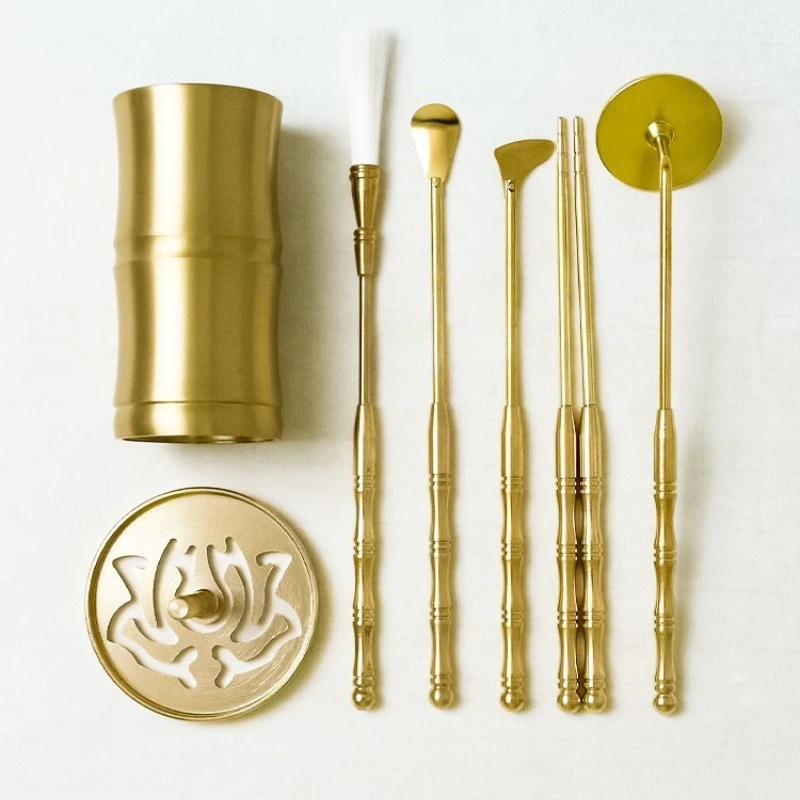 Pure Brass Incense Seal Starter Kit - Complete Xiang Zuan Tool Set
$29.99
Six solid brass tools: the mould that carries the character, the ash press that levels the bed, a scoop, a level scraper, a tray, and the burner itself. Solid brass takes heat without warping and darkens with age instead of rusting. Buy the white seal ash and a powder to go with it - the ash is the base you press into, and skipping it is why most first seals come out soft at the edges.
View the brass seal kitNone of this is a promise. A meditation incense burner does not improve your focus the way a machine improves a lens; it gives you a signal that your body can learn, and what you do with the rest of the morning is still up to you. The tradition is careful about this, and so is this article: the incense is a marker, not a mechanism.
And here is the part that matters most in a room that has to work seven days a week. The ritual is not for you. It is for the room. A desk that has been opened and closed with the same two actions every weekday stops being a table with a laptop on it, and starts being a workplace with a door, an arrival and a departure.
A composite, not a single customer
Three setups come up again and again when people write to us about working from home, and they are worth naming because they are the three most common ways a home office fails. The first is the spare-room desk with no wall behind it and a doorway on the left: the person turns their head every twenty minutes for eight hours and finishes the day with a stiff neck. The second is the kitchen table, which is bright, has no door and has a bin in the corner: the person works at the edge of the family, and the kitchen never becomes a room. The third is the sofa, which has a window behind it and no surface at all: the person works with a laptop on their knees and a bright rectangle behind their head on every call.
None of those three is fixed by buying anything. The first is fixed by putting the desk against the wall. The second is fixed by clearing the table, giving it one object, and closing the kitchen door at nine. The third is fixed by a table, a chair, a side light and one sheet over the window. That is the whole method, and it is why it is worth doing before anything is bought.
Five Mistakes Remote Workers Make Every Week
These five account for nearly every complaint we get about a home office that never feels like work. None of them are about money.
| Mistake | What it feels like | Why it happens | The fix |
|---|---|---|---|
| Sitting with your back to the door | A low, constant alertness you cannot explain | The desk went in the only free corner | Turn the chair or the desk until the door is in peripheral vision |
| The window behind the screen | Tired eyes by four, a silhouette on every call | The desk was put where the view was nice | Desk to the side of the window; half-height curtain if that is impossible |
| A mirror facing the desk | Restlessness, and a screen you keep avoiding | The wardrobe mirror and the desk were installed independently | Cover it while you work, or move the desk |
| The surface as storage | You start every day by tidying instead of working | There is nowhere else in a flat to put things | One box outside the room; everything unused goes in it |
| No end to the day | Evenings gone, and the room never switches off | The laptop is on the sofa, so the work follows you | Close the laptop on the same spot you opened it; one ritual for the end |
Notice that four of the five are solved by moving something and one is solved by putting something away. Not one of them requires a new desk, a new chair, or a new room. That is the first honest thing to say about home office feng shui: the expensive part is usually the furniture you already own, and the free part is the part that decides whether it works.
A home office is not a small office. It is a workplace with no building around it, so everything a building used to do for it - give you a wall, a door, a light, a surface and an ending - has to be done by one chair, one lamp and two minutes of attention.
That is the whole of remote work feng shui. It is smaller than the classical books and more practical than most of the modern advice, because it deals with five anchors that anyone can check tonight and one ritual that anyone can start tomorrow. The tradition dressed this up in elements and directions because it was writing for a court. Stripped back, the method is: put your back to something solid, keep the door where you can see it, let the light fall on your face and not behind you, keep the surface clear and the view in front of you quiet, and give the day an opening and a closing.
None of that needs a special object, a special day, or a large budget. It needs a chair, a curtain, a box, and a smoke that smells like the beginning of something.
Your Five-Step Desk Setup, and the Nine Questions Everyone Asks
Everything above collapses into five actions. Do them in this order and the rest of the article becomes a reference rather than a checklist.
- Sit in the command position. Turn the chair so the door is in your peripheral vision without turning your head, and put a solid wall behind you.
- Move the screen and the light. Centre the monitor, raise it to eye level, and move the desk so daylight falls across your face and never behind it.
- Clear one surface. Empty the desk down to what you used this week. Everything else goes in a drawer, a shelf, or one box outside the room.
- Choose one focal object. Put one thing on the desk that was chosen on purpose. A burner with a morning job is better than a display of objects.
- Set a start and an end. Two minutes to open the room and light the marker, two minutes to clear the desk and close the laptop. The ending is the part people skip.
The nine questions we are asked most
Is feng shui for a home office the same as for a real office?
Mostly yes, with one rule the old books never had to write. The anchors are identical: support behind you, a door you can see, light from the side, a clear surface. What is new is the camera, because a window behind you now spoils a call as well as your eyes. Everything else in this article applies to a rented desk in a spare bedroom exactly as it would in a proper office.
What is the command position?
Sitting so that you can see the door without turning your head, with something solid behind you and your face toward the open part of the room. It is the seating arrangement of someone who can concentrate and still know who has come in. In a home office it usually means turning the chair or the desk ninety degrees, which costs nothing and can be done today.
Does it matter which way my desk faces?
Direction matters less than relationship. The classical texts talk about facing the door, keeping your back to a wall and taking light from the left, but what they are really describing is whether you are supported, whether you can see movement, and whether the light is on your work. The command position for a bed is a different arrangement and a different subject; here it is about a chair and a desk.
Is a window behind me bad for video calls?
It is the most common remote work mistake there is. A bright window behind you turns your face into a silhouette, because the camera exposes for the window instead of for you. Sit with the window to your side instead. If it cannot move, hang a plain light sheet or a thin curtain over the top half of the glass, and add a lamp at shoulder height on the other side of your face.
Should I avoid mirrors in my home office?
Not for the sake of a rule. A mirror opposite the desk doubles the visual work on your screen and puts your own face in your eyes for eight hours, which is a genuinely tiring arrangement. A mirror to your side, or a wardrobe door you close while you work, is not a problem. The old warning about mirrors was never about mirrors; it was about movement being thrown back at a person who cannot move away from it.
What should I put on my desk?
Three things: the tool you work with, the light you work by, and one object you chose on purpose. Everything else goes into a drawer or a box outside the room. If the chosen object is a feng shui piece, give it a job - a burner that marks the start of the day is better than a figure that only collects dust.
Do I need incense in a home office?
Not need, but it has a use that has nothing to do with luck. Incense is the one smell that can separate working hours from the rest of the day, which matters most in a room that is also your living room. A small desktop burner used once in the morning, with a stick or a cone rather than a permanent cloud, is enough. Never leave it unattended, never on paper, and never on a synthetic desk surface.
What if my desk is in the bedroom or the kitchen?
Then you need one thing more than a desk arrangement: a closing. The problem with a kitchen table is not the light, it is that the room never switches off. Wipe the surface, put the laptop away in the same spot, and close the door at the end of the day. If the desk is in the bedroom, keep the working objects on a tray you can lift away - a surface you can clear is a surface you can stop working on.
How long before it feels different?
The arrangement changes within a day - a chair in a new position is felt the same morning. The habit takes a week or two. What people usually notice first is that they stop dreading the first call, because the light is right and nothing is in the way of the screen. The tradition is careful here too: the room is not going to hand you a promotion, it is going to stop getting in your way.
0users like this.


Your cart is currently empty.