
Feng Shui

Entryway Feng Shui: The First 3 Steps, In Order
Home Layout series · D27
Entryway Feng Shui: The First 3 Steps, In Order
The entryway is the only room in the house that was built to answer a question, and almost nobody asks it. Three looks, in a fixed order, tell you what to fix first - and most of the time they cost nothing.
The 30-second version
- Look at the axis (對景). Open the front door fully, stand at the threshold, look straight out. If you can see a toilet, a stove, a bed, a drain or a second door, that is your first problem. Everything else waits.
- Look at the escape line (藏風). From the same spot, can you see a window or the back door? If yes, your house is a wind tunnel. Break the line - do not seal the room.
- Look at the light (引光). Your entryway should be dimmer than the room it leads into, never dark, and you must be able to see your own front door lock.
There is no room in the house with more feng shui objects per square metre than the entryway. Console table, rug, bowl, plant, mirror, salt, bell, gourd - a typical one is dressed like an altar. And in most of those houses, none of it is doing anything.
That is not because the objects are wrong. It is because of the order. Almost every entryway article, and almost every entryway owner, starts with the objects and works backwards. Buy the mirror, buy the plant, buy the incense burner, then wonder why the room still feels like a corridor between the car and the sofa.
Here is the thing about the entryway that the object-first approach misses entirely: the entryway is the only room in the house whose primary feng shui problem is a line, not a position. Every other room is about where something sits. The entryway is about what the front door points at, and what the front door looks straight through to.
If this is your first home feng shui for beginners project, this is the single most useful idea to carry: the room you inherit is not the room you decorate. Start from the line, then place the objects. Reverse that and you will spend a fortune fixing a wall that was never the problem.
The entryway is the house's first breath
In the classical system, the front door is the first of the 陽宅三要 - the Three Essentials of the Yang House: 門 (the gate), 廳 (the hall) and 床 (the bed). Door, hall, bed: the three places a life actually happens, in the order they happen.
Why is the gate first? Because the gate is the only one of the three that you do not choose. You are born into a family, you inherit a body, but the door of the house you live in is the first thing the building offers you each day. The house takes its first breath at the threshold. Whatever that breath lands on becomes the starting condition for everything behind it.
This is why a 門煞 - a door sha - is treated more seriously than a similar problem anywhere else in the home. A stove facing a door in the middle of the house is a nuisance. A stove facing the front door is a problem at the source, because it is the first thing the house meets.
Now the second half of the answer, and the part that usually gets skipped.
The classical Chinese entryway - the 玄關 - was not a room. It was a device. A screening vestibule, a small lobby between the street and the hall, whose entire job was 藏風: to receive the wind and hold it, so the house did not breathe straight through in one gulp. You stepped in, the door shut, and the air had to turn a corner before it reached the living space. That turn was the point.
Then the vestibule disappeared. Building codes got tighter, footprints got smaller, cars got wider, and the 玄關 was cut out of the plan. What stayed was the space and the function was gone. So we filled the space - with a console, a rug, a bowl, a plant, a mirror, and the mail.
That is where most entryway feng shui advice goes wrong, and it goes wrong in a specific, nameable way. It is called 物先於位 - objects before position. You decide what to put in the entryway, and then you look for a rule that justifies the thing you already bought. It is the same error as buying a money frog and then working out where the wealth corner is. The money tree that gets placed before the position is found is a very expensive paperweight.
So this article gives you three looks, in a fixed order, and nothing else. No list of eleven things to put in your foyer. Three questions you can answer in thirty seconds, standing in your own doorway, before you buy anything at all.
The Three Looks (三看玄關)
All three are done from the same spot: standing at the open front door, on the threshold, looking into the house. That is deliberate. A feng shui check that requires you to walk around the room is a check most people will not do, and one that requires you to kneel on the floor with a compass is a check that only gets done once a year and then never again.
Each look answers one question, and each maps to one constraint from the six-constraint home design framework: the axis (門), the path (動) and the light (光). The bagua map tells you which direction a sector sits in. The three looks tell you whether the front door is actually working.
| Look | The question | Classic term | If the answer is bad |
|---|---|---|---|
| 1 · 對景 the axis | What does the open door point at? | 門 - the gate, first of the Three Essentials | The door is aimed straight at a toilet, stove, bed, drain or second door. That is a 門煞 at the source of the house. |
| 2 · 藏風 the escape line | Can you see a window or the back door from here? | 藏風 - hold the wind | Your air goes in one side and out the other without ever turning. Fix the line, not the room. |
| 3 · 引光 the light | Is this room dimmer than the one it leads into - but never dark? | 引光 - draw the light | Either it is a black hole at the front of a bright house, or it is lit like a shop and the house behind it dies. |
Why these three, and why in this order
Three reasons, and all three are practical rather than mystical.
Each is cheaper to fix than the next. The axis is often a free fix - you close a bathroom door, you move a laundry basket, you turn the bed. The escape line is a $30 screen or a tall plant. The light is a $15 bulb and a switch. If you start at the bottom of that list, you will spend your effort and your money on the most expensive layer first and never learn whether the cheap layers would have solved it.
Each look changes what the next one means. This is the part that gets missed. If the door points at a toilet, you cannot honestly evaluate the lighting in that room, because the lighting is being read through a 煞 condition. If the air is running straight out the back of the house, a brighter entryway just means you are making the draught more visible. Fix the axis and the escape line, and the light question becomes answerable. Fix the light first and you will spend a weekend on a room that still does not work.
They are cheap to repeat. Thirty seconds, standing still. You can do this walk-through once a year, or after any renovation, or before you redecorate. A check you can repeat is worth more than a rule you can only read once.
The order mistake, named
Most entryway guides and most people buying their first feng shui object go: objects → position → light. The order that works is position → path → light → objects. That is not a preference. It is the same ordering the wealth corner method uses, and it exists for one reason: a fix applied to a layer above the problem is a fix that shows up in a photograph and not in the room.
Step 1 - 看對景: what the front door points at
The first look takes ten seconds and it is the one that matters most, because it happens at the source.
The test
Open the front door all the way. Stand in the doorway, on the threshold, and look straight out along the axis the door points down. Then do the version almost nobody does: sit down on the floor of the doorway and look out again.
Sitting down is not a gimmick. Standing, your eye line is about 1.6 m up and you see over a low console. Sitting, your eye line drops to about 0.5 m and suddenly you can see the toilet bowl, the burner ring, the bed, the drain in the floor - because from that height they are no longer hidden behind furniture. It is the line a child or a cat sees, and it is the line the 煞 travels along. If a thing is only visible from a seated position, it is still on the axis.
What you are looking for is five things, and only five. If you can see none of them, look one is done and you move on.
| What you see | Why it is a problem | Severity |
|---|---|---|
| The toilet 門對廁 | Classic door sha. The reason is not symbolic. The toilet is the only fixture in the house with a drain and a downward pull, and it sits on the strongest line of flow in the building. A door aimed at an open toilet bowl is a pull straight down the axis, into the house. | High |
| The stove or oven 門對灶 | Fire is the fastest of the five phases - it travels an open line faster than any other energy. A door pointed at a live burner puts the fastest-moving thing in the house directly on the front door's axis. It also means a draught across the flame every time the door opens. | High |
| The bed 門對床 | The most private part of the home sitting on the first line of sight. You wake toward it, the light switch is on the axis, and the one room in the house that should be enclosed is the one the house points at first. Also a privacy problem before it is a feng shui one. | Medium |
| A floor drain or waste pipe | Water leaving the house, on the way in. Rare, but in older properties the utility drain is sometimes right inside the door. A drain on the axis pulls the entryway's energy downward and out. | Medium |
| A second door, or an altar 門對門 · 門對神位 | Two doors on one axis make a tunnel - which is Look 2's problem as much as Look 1's, and the command position of the house. A household shrine on the door axis means you walk into the house past the altar every single time. | Medium |
One more, outside the house: if your front door faces another front door across the street, or a neighbour's gate, that is 門見門. The practical version of this one is easier to fix than people think - a gate, a screen, a row of planting, anything that breaks the two-door corridor.
One door position to rule out completely
If the door is at the very end of a long straight corridor and the corridor runs through the middle of the house, that is 穿心門 - a door that walks you through the heart of the plan. It is a more serious version of Look 2 and it is worth fixing before anything else in this article. Our guide to the ten worst feng shui room layout mistakes covers the other side of the same problem.
The fix ladder: four options, and the one everybody buys first is the worst one
Almost every entryway guide on the internet tells you not to hang a mirror opposite the front door. Five of the six most-read ones do. And almost all of them then recommend a mirror anyway, just somewhere else - without ever saying why the mirror is a fourth choice rather than the first.
Feng shui mirrors are the most over-prescribed object in this room. They are sold as a fix for the door, and the door is the one problem a mirror is worst at fixing. That is why the order below matters more than the choice.
Here is the ladder, best to worst. Work down it and stop at the first one you can actually do.
Option 1 · Free
Move or close the thing
- Close the bathroom door. Most doors can simply stay shut.
- Move the laundry basket, the bin, the shoes, the drying rack out of the axis.
- Turn the bed 90° so it is no longer on the line.
- Change which burner you use, or put a screen in front of the range.
This is the only fix that solves the problem rather than negotiating with it, and it costs nothing. If it is available, nothing below this line is worth buying.
Option 2 · $0-40
Break the line
- A slatted screen, a console with a tall back, a plant with real height, a curtain on a rail.
- The object must be tall enough to interrupt the sightline at standing eye level, and it must not narrow the walking path.
- A hanging set of coins or a gourd does the same job from above the door frame, which is why door-conflict sets exist at all.
This is the best fix when you cannot move the object - a small apartment bathroom is not going anywhere.
Option 3 · $20-40
Offset the mirror to 90°
- Move the mirror off the door axis and onto a side wall, at 90 degrees to it.
- At 90° it reflects the inside of the house - usually the brightest, best-lit part - back into the entryway, instead of bouncing the street back out the door.
- It also widens a narrow hall, which is a side benefit people notice immediately.
- One practitioner measurement guide puts the centre of the mirror at 58-64 inches (about 1.5-1.6 m) from the floor, high enough to catch the light without you having to look up.
Option 4 · Last resort
The mirror on the axis
- A mirror hung directly opposite the front door creates a second door on the same line. The house now has two openings where it should have one.
- It amplifies whatever it reflects. A mirror opposite a toilet is not fixing the toilet; it is putting a second toilet on the axis.
- And it pushes the incoming 氣 straight back out of the opening it just came through. The five major guides that warn against it are all pointing at the right rule - they just rarely rank it below the other three options.
A mirror on the axis is not a cure for a door conflict. It is a decoration that has been marketed as one for two hundred years.
There is more on the mirror question in our complete mirror placement feng shui guide, and if you are buying one specifically to handle a door conflict, read convex versus flat and Shan Hai Zhen versus a standard bagua mirror first - they do completely different jobs, and a bagua mirror is not always the right cure for a door.
One question before you buy any door cure
Ask yourself: is this a problem with an object, or a problem with a line? A gourd, a coin set, a bell, a talisman - these are all object cures. They work by adding weight, sound and intention to a place. If the actual problem is that your front door points at a toilet, an object hung near the door adds a second thing to the axis rather than removing the first. Are bagua mirrors dangerous answers the safety and feng shui limits of that kind of cure honestly.
Step 2 - 看藏風: the line the air escapes along
The second look uses the same doorway, the same stance. Different question.
The test
From the threshold, can you see a window, or the back door, from where you are standing?
If yes, your house is a wind tunnel. Air comes in the front, runs the length of the plan without turning, and goes straight out the back. The room never settles. You get a cross-draught you can feel on one side of your face, dust that never settles anywhere, and a hall that is cold in winter and hard to keep at a comfortable temperature in summer.
This is why the classical entryway existed. The 玄關 was not a corridor with a coat rack. It was a screening vestibule whose only job was 藏風 - to catch the wind and make it turn a corner before it reached the hall. The classical literature treats the vestibule as a device, and the whole reason it was built is the one most modern houses lost.
藏風 is not 閉氣 - this is the distinction every other guide skips
Do not seal your entryway. A modern closed mudroom with an inner door shut is 閉氣 - closed, stagnant, unventilated air with nowhere to go. It is not better than a wind tunnel; it is a different problem.
The correct goal is 藏風聚氣: hold the wind and gather the air. The air does not have to stop. It has to turn. That is the whole idea, and it is why the fix is a screen and not a brick wall. (If you want the mechanism behind 聚氣 itself, it is set out in our explainer on yin, yang and the five phases.)
Once you understand that, the fix list gets much shorter, because turning an airflow needs far less than stopping it.
| What you see from the threshold | What it means | How to turn it |
|---|---|---|
| Nothing - a wall, a coat closet or a bend in the plan | Already good. The line is already broken. | Leave it. Do not add a second screen for symmetry. |
| A window at the far end | Straight-through air. Mild in a single-storey house, strong if the window is on the opposite wall to the door. | A slatted screen or a tall plant placed sideways to the line, not in it. |
| The back door | 門對門. The strongest version of this problem - two doors, one corridor. | Turn the inner door's swing, or hang a screen across the corridor. A hanging set above the door frame also works. |
| The far corner of the living room | Open-plan with no buffer. The house never has a front. | A console, a console-plus-plant, or a change in where the sofa sits. |
The height test - the fix most people get wrong
Here is where a genuinely expensive mistake happens, and it happens because the idea of the fix is right and the dimensions are wrong.
You stand at the door. You see straight to the back window. You buy a console table. You put it against the wall. You feel better. The air still goes straight through, because a 90 cm console does not interrupt a 1.6 m sightline.
The screen has to be tall enough to break the line at standing eye level, or deep enough to make you walk around it. That usually means one of three things: a plant that is genuinely tall and bushy rather than a small pot on a stand, a slatted screen at roughly chest-to-head height, or a piece of furniture with a back. A low console and a tall plant beside it can do it between them - the plant is doing the work, and the console is only there to make the plant look deliberate.
And the thing the screen must not do is narrow the walking path. This is a feng shui room, but it is also a hallway that people use with a full hand and a bag. A screen that makes you turn sideways to get past is a screen that gets moved within a month.
Two smaller adjustments that cost nothing:
- Change the door's swing. A door that opens 90° to the side already turns the air - you step in and the line you were looking down is no longer the line you walk down. Where the door swings is part of Look 2.
- Offset the console, don't centre it. A console placed flat against the wall directly opposite the door does nothing. The same console placed a metre to the left, angled slightly, breaks the line and still gives you a place to put your keys.
For a small apartment where none of this fits, the five adaptations that work in small apartments cover the versions of this problem that need no floor space at all. And for the object that does the most work with the least room, a hanging set above the door frame is worth understanding properly - our guide to which feng shui items earn their place is blunt about which ones do and which do not.
Step 3 - 看引光: the light, and the one rule everybody gets backwards
Here is where this article parts company with essentially every other entryway guide on the internet, and it is worth being clear that this is a disagreement, not a variation.
Every one of them says: make your entryway bright. All six of the most-read entryway guides we checked - including the two written by working practitioners - say brighten it, light it, flood it with daylight, use a bright overhead fixture. Four of them say "a bright entryway is one of the strongest feng shui enhancers."
Most lighting feng shui advice for an entrance has exactly one instruction in it, and it is the wrong one. Feng shui lighting at a threshold is a gradient problem, not a brightness problem - and solving it as if it were a brightness problem is why so many entryways feel like a shop at 8pm.
That is half the rule. The other half is the part they leave out, and it is the half that makes the room work:
The rule nobody prints
Your entryway should be dimmer than the room it leads into - and never dark.
Not as bright. Dimmer. The brightness should climb in steps as you walk deeper into the house, ending with the brightest room in the back. That gradient is what makes a house feel like it has a front and a back instead of being one undifferentiated space.
Why dimmer is correct, and not just different
Three reasons, and none of them are arbitrary.
It is a transition space, and transitions need contrast. The entryway is the space between outside and inside. Its job is to let your eyes and your body adjust - from street brightness to house brightness, from walking to standing still. If the entryway is as bright as the room behind it, there is no threshold, no arrival, and no sense of having crossed into a different kind of space. You get a hallway that is bright and anonymous.
Light is what the eye follows. In a house, brightness is the strongest directional signal there is - stronger than colour, stronger than objects, stronger than decoration. The brightest room in a house is the room everything in the house points toward. The classical term for that bright, open, commanding space in the centre of the home is the 明堂, the bright hall, and in a well-arranged house it is the living room, not the front door. How the living room earns that role is worth reading, because the entryway and the living room are the two ends of the same gradient.
A bright entryway steals from the room it leads into. This is measurable in ordinary language: if the light in your hallway is the same brightness as the light in your living room, then when you stand in the hallway you cannot tell which way the house wants you to go. Make the hallway slightly darker and the living room pulls you forward every single time.
Three tests for the light
Test 1
The lock test
- Can you see your own front door lock, clearly, without turning on a light?
- If not, the entryway is too dark - and this is a safety problem before it is a feng shui one. You fumble for keys, you miss the keyhole, you let strangers in half a metre before you see them.
- If you can see the lock from across the street through the glass, it is too bright.
Test 2
The gradient test
- Walk from the front door to the far end of the house. Brightness should increase in steps.
- If the front of the house is brighter than the back, the gradient runs the wrong way and the house feels backwards, even to people who know nothing about feng shui.
- A living room that is dimmer than the hallway leading to it is the most common version of this.
Test 3
The switch test
- The entryway light should be on its own switch, ideally with a dimmer.
- At night, at 20% - not off, not full. A dim, warm glow at the threshold is what tells a house someone is home, without lighting the whole ground floor.
- Not one of the six guides we checked mentions a switch. It is the cheapest and most effective thing on this entire list.
The two details that make it feel right
Warm light, not cool light. 2700-3000K. Warm white reads as a home; cool white (4000K and above, the default in most new-builds) reads as a hospital corridor, a shop, or an office at 9pm. This is not a subtle preference - cool light in an entryway is one of the fastest ways to make a house feel unwelcoming, and it is a ten-minute change if you have a dimmer, or a thirty-dollar change if you do not.
Light the walls, not the floor. A single bright ceiling downlight in the middle of a small hall makes a bright spot on the floor and dark corners at the skirting. A wall sconce or a lamp on the console throws the light up the wall, where it bounces. The wall is what reflects; the floor just absorbs.
And this is where the 90° mirror from Step 1 comes back as a light tool rather than a protection tool. A mirror on the side wall, at 90° to the door, faces the interior - so it takes the living room's light and throws it back into the entryway. That is the whole reason our bronze bagua mirror is made to transmit light rather than block it: it is a light source that also happens to be an object. On a dark wall it does nothing, so paint behind it light, or leave it off the wall.
For the wider picture of how light behaves in a house, read our guide to balanced room design and to using the five elements in colour - because the colour temperature of your entryway light and the colour of your entryway walls are the same decision taken twice.
The order of operations, in one table
Everything above reduces to a sequence. If you do nothing else, do these four things in this order, and stop when the first one is done.
| # | Layer | Do this | Typical cost | Effort |
|---|---|---|---|---|
| 1 | 位 Position | Look at the axis. Close the door, move the object, turn the bed. | Free | 5 min |
| 2 | 動 Movement | Break the escape line. Screen, plant, offset console, change the door swing. | $0-40 | 1 hr |
| 3 | 光 Light | Put the entryway on its own dimmer. Warm bulb. Check the lock test at night. | $0-20 | 20 min |
| 4 | 物 Objects | Now - and only now - put something on the shelf. One thing, not five. | $20-40 | 10 min |
Layer 4 last is not a rhetorical flourish. It is the reason the first three layers are free. Put the object first and you have spent $40 on a decoration for a problem you have not diagnosed - and you will not go back and look at the axis, because the shelf looks finished.
What it actually costs, in order of what to buy first
Most people come to this article wanting a shopping list. Here is one, ordered by return on money.
$0 · 30 minutes
The free tier - and it fixes most entryways
- Open the door, sit on the floor of the doorway, look out. Write down what you see.
- Close any door on the axis. Move any bin, basket or drying rack off the line.
- Walk the length of the house from the front door and note where the straight sightline ends.
- Check the lock at night with the hall light off.
- Put the entryway on its own switch. Warm bulb. Dimmable if you have one.
Five of the seven feng shui problems in a typical entryway are on this list. If you stop here, you have still done most of the work.
$15-40 · one object
The one-object tier
- A slatted screen or a tall, bushy plant to break the escape line.
- A hanging set above the door frame if the problem is door-facing-door and you have no floor space.
- A convex mirror for the side wall, at 90°, if the real issue is that the hall is dark.
- A small ceramic holder for one stick of incense if you want the threshold to be used rather than skipped.
One object, chosen because it fixes the specific problem you found. Not three objects because the shelf looked empty.
Skip
The skip tier - and it is a real tier
- Do not buy a mirror to go opposite the front door. It is the third-most-popular purchase in feng shui and the least useful one in this room.
- Do not buy a large flat or concave mirror to cover a whole wall. It will reflect the clutter, double the noise, and flatten the room.
- Do not fill the entryway with a full altar because it felt empty. The entryway wants one considered object, not a shrine.
- Do not spend on a compass before you have done the three looks. A compass tells you which direction a sector sits in. It does not tell you whether your front door is aimed at the toilet.
Our guide to whether a bagua mirror or a Wu Lou is the right cure is the fastest way to stop yourself buying the wrong object, and the lucky bamboo guide covers the one plant that reliably works in a dim entryway.
Which of the three looks is your problem?
If you rent
You cannot move a toilet, repaint a wall, or drill a screen into a partition. You are working with the free tier almost entirely.
- Look 1 → you can still close doors, move bins, and turn a bed. All free.
- Look 2 → a folding screen, a tall plant, or a hanging set above the door frame - no fixings, no deposit lost.
- Look 3 → a lamp you plug in, a warm bulb, a switch you test with a friend.
The full list of what you can and cannot change as a tenant is in feng shui for renters.
If you own
You can change the plan, which changes everything. The three looks are a diagnostic for a bigger job.
- Look 1 → a swing door, a relocated laundry, a bathroom that faces the wrong way.
- Look 2 → a proper vestibule, a re-hung internal door, a change of layout.
- Look 3 → a skylight, a wider opening, a re-planned lighting circuit.
The six-constraint home design framework is the version of this for whole-house work.
If you work from home
Your entryway is a gateway you walk through eight times a day, and it is often where the shoes, the post, the bags and the coat live.
- Look 1 → the axis matters more here than anywhere. It is the first thing you see and the last thing you see.
- Look 2 → if the hall is your path to the back door, the draught follows you all day.
- Look 3 → you need to see your lock - a dim entryway behind you is a security gap, not a mood.
Related: feng shui for the home office.
Seven entryway mistakes, ranked by how much they cost you
1. Buying the object before you look at the axis
The most expensive mistake, because it is the one that stops you looking. A gourd, a mirror, a coin set, a bell - bought on a feeling, placed on a shelf, and then the axis is never examined.
Fix: do the thirty-second look first. Keep the receipt. If the problem turns out to be a bathroom door, you have saved the money and learned something.
2. The mirror opposite the front door
A second opening on the same line, amplifying whatever it reflects, pushing the incoming air straight back out. Five of the six most-read entryway guides tell you not to do it, and it remains the default in most feng shui product advertising.
Fix: 90° onto a side wall, high enough to catch the light, on a light-coloured wall behind it. If there is no side wall, buy no mirror.
3. A low console used as a screen
A 90 cm console does not block a 1.6 m sightline. The line still runs, the air still goes, and you have spent the money and gained a shelf.
Fix: check the height against your own eye line before you buy. Tall plant, slatted screen, or a console-plus-plant combination that adds up past shoulder height.
4. Making the entryway the brightest room in the house
It flattens the gradient, kills the 明堂 in the living room, and makes the front of the house compete with the back. It is the single most repeated piece of bad advice in this category.
Fix: dimmer than the room beyond, never dark. Run the gradient test at night with the front lights off.
5. Ignoring which way the door swings
A door that opens inward and hits the console on a busy evening is a 動 problem every single day. It also decides where the air turns.
Fix: open it fully, all the way, and walk past. If you have to turn sideways, something is wrong with the layout and no object will fix it.
6. A mirror on a dark wall, or a mirror that reflects clutter
A mirror on a dark wall is a black rectangle that gets worse at night. A mirror opposite a pile of shoes multiplies the pile.
Fix: paint behind it light, or skip it. And never point a mirror at the messiest corner of the room - what a mirror reflects is what it multiplies.
7. Turning the entryway into a second altar
Five objects, a bowl, a plant, a mirror, a gourd and a bell, all competing. Each one individually defensible; together they produce visual noise, and none of them is doing the work the three looks identified.
Fix: one object. Clear the rest. The emptier the shelf, the more the single chosen object can do its job.
Five objects for this room, and the order to buy them
Five, and only after the three looks. The first three map one-to-one onto a step - the axis, the light, and the object layer. The last two are conditional: one is for a threshold you want to cleanse at the turn of a season, the other for the specific case where the problem is the door rather than the dark.

TaoFlow Feng Shui
Five Emperors Coins & Gourd Hanging Set
For a door conflict you genuinely cannot move - a bathroom you cannot close, a neighbour’s door you cannot screen, a layout you are not changing. It hangs above the door frame, so it works in a hallway with no floor space to spare, and it adds weight and intention to the frame the air crosses.
- MaterialPure brass (纯黄铜)
- MountAbove the door frame
- UseDoor conflicts
- ShippingFree worldwide
A coin set adds weight and intention to the frame - it does not move the thing on the axis. If the thing can be moved, move it first. The free fix is always better than the hanging one.

TaoFlow Feng Shui
Handmade Mini Convex Bronze Bagua Mirror
The one mirror argument this room actually needs, and it is not about protection. This one is made to transmit light, so a convex face on a side wall throws the living room’s brightness back into a dim entryway instead of bouncing the street back out of the door. A light source that happens to be an object.
- Diameter8 cm
- MaterialBronze, mirror face
- EffectTransmits light
- MountSide wall at 90°
Never opposite the front door. A mirror on the axis creates a second opening and pushes the incoming qi straight back out of the house.

TaoFlow Feng Shui
Ceramic Wu Lou Incense Holder
The one object worth putting on an entryway shelf, because it is two objects. A gourd form is the most widely used feng shui shape for absorbing sha qi and holding good fortune, and a ceramic gourd that holds a burning stick of incense also gives you a reason to stand in the entryway for a moment instead of walking through it at speed. If you want the practical side of that, our guide to incense holders for sticks covers it.
- MaterialCeramic, glazed
- FormGourd (葫芦)
- UseIncense or shelf object
- PlaceRaised, off the axis
The gourd shape (葫芦) is one of the most widely used forms in feng shui for absorbing sha and holding good fortune. Raised, in the open, and off the door axis. For the full picture of where it goes, read the Wu Lou placement guide.

TaoFlow Feng Shui
Coarse Sea Salt for Purification
For a threshold you want to cleanse at the turn of a season, not for a problem you could fix by moving a bin. A shallow dish of coarse salt just inside the door, changed every few weeks, is the oldest entryway ritual that still makes sense: a physical act of clearing the ground at the exact point where the house begins.
- MaterialCoarse sea salt
- UseThreshold cleansing
- ChangeEvery 2-3 weeks
- PlaceInside the swing
Never underneath the doormat - salt under a mat cannot dry out. Do it at the turn of a season, not every week.
TaoFlow Feng Shui
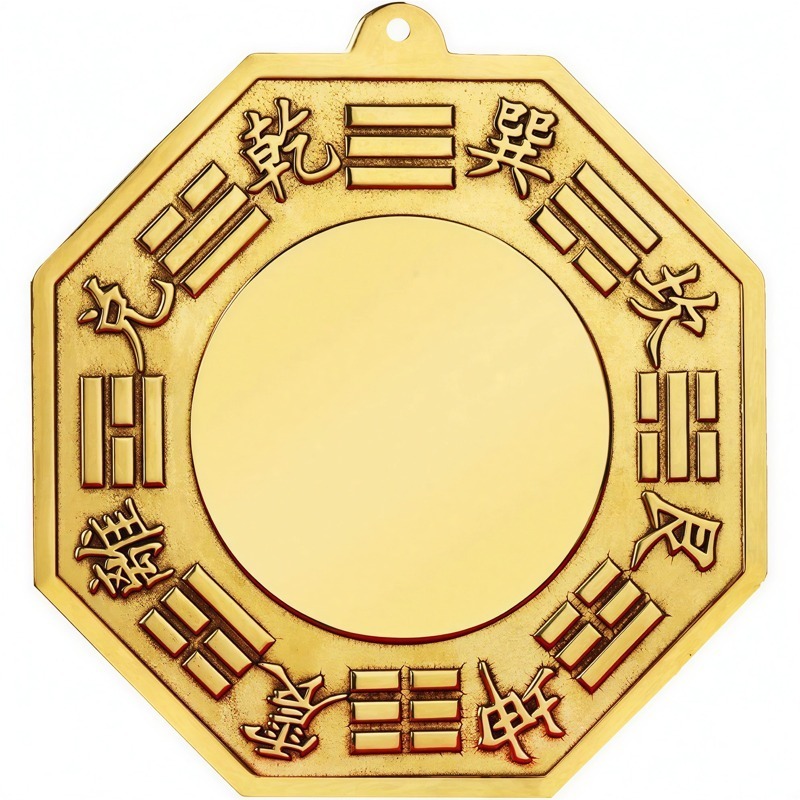
Chinese Feng Shui Brass Convex Bagua Mirror
The protection mirror, for when the diagnosis is a door conflict rather than a dark hall. Note carefully what it does not do: it does not cancel a 門煞, and it does not turn the air. It works by giving the line something to meet, and like every mirror in this room it belongs on a side wall at 90°, not opposite the door.
- MaterialBrass, convex
- FaceEight trigrams
- MountSide wall at 90°
- ShippingFree worldwide
Buy this if the problem is the door; buy the light-transmitting mirror if the problem is the dark. They are not interchangeable.
Not one of them is a general-purpose feng shui purchase. If your three looks came back clean, you do not need any of them - and the cheapest object in this list is still the one you move a bin to make room for.
Frequently asked questions
What should I fix first in feng shui at my entryway?
The first thing to fix is the axis - what your open front door points at. Stand in the doorway, look straight out, and check whether you can see a toilet, a stove, a bed, a drain or a second door. If you can, fix that before spending anything, because it is usually free and it changes what the other two checks mean.
The order is always position, then path, then light, then objects.
Is it bad to have a mirror opposite the front door?
Yes, and it is the most common entryway feng shui mistake there is. A mirror directly opposite the door creates a second opening on the same axis, amplifies whatever it reflects, and pushes the incoming air back out of the opening it just came through.
The correct position is on a side wall at 90 degrees to the door, high enough to catch the light, so it reflects the interior of the house rather than the street. If there is no side wall, the right number of mirrors in that room is zero.
Should my entryway be brighter than my living room?
No - it should be slightly dimmer than the room it leads into, and never dark.
Most entryway advice says "make it bright," which is only half the rule. The other half is that brightness should climb as you move into the house, ending in the brightest room. A bright entryway competes with the living room for attention and flattens the house. What you need is enough light to see your lock, your keys and anybody at the door - not a showroom.
What does 藏風 mean for an entryway?
藏風 means "to hold the wind." The classical entryway, the 玄關, was a screening vestibule built so that air entering the front door had to turn a corner before it reached the hall, instead of running straight through the house and out the back.
It is not about sealing the room - that is 閉氣, closed and stagnant air, which is a different problem. The goal is to interrupt the straight line while keeping the air moving. A screen, a console, a tall plant or a door that swings to the side all turn the air without stopping it.
Do I need a feng shui object in my entryway at all?
No. If your three looks come back clean - the door does not face anything bad, the line is broken, the light gradient works - then the entryway is already doing its job and an object on the shelf adds nothing.
If you do want one, choose it because it fixes the specific problem you found, and choose one. Five objects in an entryway is visual noise. Our guide to which feng shui items earn their place goes through the criteria honestly.
Is an entryway with no window bad feng shui?
Not by itself. An interior entryway with no natural light is extremely common in apartments, and it is a light problem rather than a feng shui verdict.
Two things make it work. First, the brightness gradient: an entryway with no window can still be dimmer than the room it leads into, and the room beyond it can still be the brightest in the house. Second, the entryway needs its own warm light on its own switch - ideally dimmable so you can run it at 20% at night. A windowless hall with good artificial light and a broken sightline is in better shape than a sunny hall where you can see straight through the house.
What plants work in a feng shui entryway?
Two requirements, and the second one catches people out. The plant must be genuinely tall - tall enough to interrupt a sightline at standing eye level, which usually means well above head height, not a small pot on a stand. And it must be alive and healthy: a dying plant in a feng shui entryway is worse than no plant, because it puts decay on the first line of sight.
Round, soft leaves are preferred over spiky or thorny ones, and the lucky bamboo is the most reliable choice for a dim entryway because it tolerates low light. Pair them if you use one, and read the lucky bamboo placement guide before you pick the spot.
Should I light incense at the front door?
It is a genuinely good habit, and the reason is not the smell. Lighting a stick in the entryway means you stop in the entryway. You stand at the threshold, you let the room be a room, and you walk in at a human pace instead of a commute pace. The room gets used, and a room that gets used is a room that gets looked after.
Practically, a small ceramic stick holder on a console is enough. If you want to go further, our guide to choosing an incense burner and to incense holders for sticks cover the practical choices, and the five-minute morning ritual is the same logic applied to the start of the day.
How do I do entryway feng shui in a small apartment?
Start with the free tier, because in a small apartment almost everything that matters is free. Close the door on the axis. Move the bin. Walk the length of the flat and find where the straight line ends.
Then use the two fixes that need no floor space: a hanging set above the door frame for a door conflict, and a folding screen or a tall plant for the escape line. Skip anything that needs a wall drilled or a wall painted - as a tenant you lose that at the end of the lease.
Our five adaptations that actually work in small apartments and feng shui for renters cover the rest.
Read next
Home Design Feng Shui
The six-constraint framework this article is one spoke of: form, gate, movement, light, position, objects.
Living Room Feng Shui
The other end of the brightness gradient - where 明堂, the bright hall, is supposed to live.
Wealth Corner Feng Shui
The same position-first logic, applied to the sector people actually want to find.
What Is Feng Shui?
The complete beginner's guide, if any of the classical terms above are new to you.
Mirrors in Feng Shui
Where to hang one, where not to, and why 90 degrees is the number that matters.
How to Declutter With Feng Shui
The entryway is the room where decluttering changes the most, fastest.
Feng Shui Furniture
Why a console in the right place does more than any object on top of it.
The Bagua Map
Once the three looks are done and the axis is fixed, this tells you which directions matter.
Stand in your doorway. Sit down. Look out.
Three looks, thirty seconds, and most of what you would have bought is not needed.
TaoFlow Feng Shui · tao-flow.com · Home Layout series, article D27
0users like this.


Your cart is currently empty.