
Feng Shui

The Bagua Map: How to Apply It to Your Home (Beginner)
The Bagua Map: How to Apply It to Your Home (Beginner)
The bagua map (八卦图) is the central operational tool of feng shui. It divides any space into 9 sectors, each corresponding to a specific life area, element, and trigram. This is the complete beginner's guide — the 9 sectors explained, the two bagua systems compared, the 4-step mapping process, the 5 most common mistakes, and how a traditional bagua mirror applies the map in practice.
Last updated: August 26, 2026 · ~14 min read · TaoFlow Feng Shui ResearchThe 30-second answer: The bagua map is a 3×3 grid that divides any space into 9 sectors. Each sector corresponds to a life area (wealth, family, career, relationship, etc.), an element (wood, fire, earth, metal, water), a colour, a shape, and a trigram symbol. To apply it: (1) draw a floor plan of your home, (2) find the centre, (3) overlay the bagua with the bottom row aligned to the wall containing the front door, (4) walk through each sector and apply the 5 elements. The bagua map is the central tool of feng shui — it is what the practitioner uses to translate the abstract principles of qi and the 5 elements into specific adjustments in specific rooms. You do not have to believe in qi to use the bagua map. It is a sophisticated diagnostic tool that helps you see the correlation between the state of your home and the state of your life.
What the Bagua Map Is
The bagua map (八卦图, bāguà tú) is the central organisational tool of classical feng shui. The word bagua (八卦) literally means "8 trigrams." A trigram is a three-line symbol, each line either solid (yang) or broken (yin), representing a fundamental quality of reality. There are 8 trigrams in the I Ching, the ancient Chinese book of changes, and the 8 trigrams together represent all possible combinations of three lines. The bagua map is the application of these 8 trigrams to the built environment, plus the centre (Tai Ji, 太极, "supreme ultimate") which connects all 8 trigrams.
The 8 trigrams are: Qian (乾, heaven), Kun (坤, earth), Zhen (震, thunder), Xun (巽, wind), Kan (坎, water), Li (離, fire), Gen (艮, mountain), and Dui (兌, lake). Each trigram corresponds to a life area, an element, a colour, a shape, a season, a family member, and a specific quality of reality. Together with the centre (Tai Ji, sometimes called the 9th sector), the 8 trigrams form the 9 sectors of the bagua map.
The bagua map is not a static diagram. It is a dynamic framework for understanding how the space you live in relates to the life you are living. A cluttered, dark, unused wealth corner correlates with struggles in the wealth area of life. A bright, well-arranged, activated relationship corner correlates with healthy relationships. The map does not create the correlation — it reveals it. The bagua map is most useful as a diagnostic tool, not as a magical instrument.
The bagua map at a glance: The standard Western bagua map is a 3×3 grid. The bottom row contains the relationship corner (right), the centre, and the wealth corner (left). The middle row contains family (right), health/centre, and creativity (left). The top row contains mentors (right), career, and knowledge (left). The bottom row is aligned with the wall that contains the front door. The top row is the wall furthest from the front door. The two side rows are the side walls. The grid is divided based on the floor plan, not on compass directions (in the Western system).
The 9 Sectors in Detail
The 9 sectors are the operational units of the bagua map. Each sector corresponds to a specific life area and has a specific set of properties. The grid below shows the standard Western BTB bagua layout (viewed from above, with the front door at the bottom).
Each sector explained in detail below. The properties listed for each sector are the correspondences used in the standard Western bagua system. The Chinese name is followed by the English life area.
1. Relationship (Kun 坤)
The relationship sector governs partnerships, marriage, and close personal relationships. The element is earth, the colours are pink, red, and earth tones, and the shape is square or paired. To activate: place a pair of objects (cushions, candles, figurines) symbolising partnership. Add a ceramic, a stone, or a piece of clay. Keep the sector clean, well-lit, and uncluttered. If you are in a relationship, place a current photo of you and your partner here. If you are seeking a relationship, place a single rose or a pair of mandarin ducks.
2. Health / Centre (Tai Ji 太极)
The centre sector governs the overall health of the home and the people in it. The element is earth, the colours are yellow and earth tones, and the shape is square. To activate: keep the centre clean, well-lit, and uncluttered. Place a ceramic, a stone, or a piece of clay here. Avoid using the centre as a storage area. The centre is the most important sector of the bagua map because it connects all the other sectors. A cluttered, dark, or unused centre correlates with overall stress and disconnection in the household.
3. Wealth (Xun 巽)
The wealth sector governs abundance, prosperity, and the flow of resources. The element is wood, the colours are green, purple, and red, and the shape is tall, vertical, or columnar. To activate: add a plant or a green object. Add a wealth symbol (a citrine crystal, a wealth tree, a golden toad). Keep the sector clean, well-lit, and uncluttered. The wealth corner is the most commonly activated sector in feng shui practice because wealth is the most commonly desired outcome.
4. Family (Zhen 震)
The family sector governs family relationships, ancestors, and the health of the household. The element is wood, the colours are green and teal, and the shape is tall and columnar. To activate: add a plant or a green object. Add a wooden piece of furniture. Add a family photo or a family heirloom. Keep the sector clean and well-lit. The family sector is closely related to the relationship sector — a healthy family sector supports healthy relationships within the family.
5. Creativity / Children (Dui 兌)
The creativity sector governs creativity, children, completion, and joy. The element is metal, the colours are white, grey, and metallic, and the shape is round or curved. To activate: add a metal object (a frame, a lamp, a sculpture). Add a round or curved object. Keep the sector clean and well-lit. The creativity sector is closely related to the children sector in the traditional interpretation — a healthy creativity sector supports healthy children and healthy creative projects.
6. Fame (Li 離)
The fame sector governs reputation, visibility, passion, and being seen. The element is fire, the colours are red, orange, and bright purple, and the shape is pointed or triangular. To activate: add a candle, a lamp, or a piece of art. Add a red object. Add a triangular or pointed object. Keep the sector well-lit. The fame sector is the most public of the 9 sectors — it is about how the world sees you, your work, and your contribution.
7. Career (Kan 坎)
The career sector governs life path, career, deep work, and the wisdom that comes from sustained effort. The element is water, the colours are blue and black, and the shape is wavy or free-flowing. To activate: add a water feature (a small fountain, an image of water) or a blue object. Add a glass or a mirror. Keep the sector clean and uncluttered. The career sector is closely related to the knowledge sector — a healthy career sector supports both life path and the deep learning that sustains it.
8. Knowledge (Gen 艮)
The knowledge sector governs learning, study, contemplation, and stillness. The element is earth, the colours are yellow, brown, and dark blue, and the shape is square and low. To activate: add a stone, a ceramic, or a piece of clay. Add a small mountain or a piece of earth-toned art. Keep the sector clean and uncluttered. The knowledge sector is closely related to the career sector — a healthy knowledge sector supports both learning and the wisdom that comes from it.
9. Mentors (Qian 乾)
The mentors sector governs mentors, helpful people, travel, and the support that comes from outside the household. The element is metal, the colours are white, grey, and metallic, and the shape is round. To activate: add a metal object (a frame, a lamp, a sculpture). Add a round or curved object. Place a photo of a mentor or a person who has helped you. Keep the sector clean and well-lit. The mentors sector is the most supportive of the 9 sectors — it is about the help that comes from outside the home.
The Two Bagua Systems: Western BTB vs Classical Chinese
There are two main bagua systems in modern feng shui practice. The choice between them depends on your goal.
| Feature | Western BTB Bagua | Classical Chinese Bagua |
|---|---|---|
| Origin | Developed by Lin Yun, 1980s | Derived from the I Ching and Luo Pan, 3,000+ years |
| Orientation | Front door = bottom of map | Compass direction of the back of the home = bottom of map |
| Compass needed? | No | Yes (a reliable compass or smartphone app) |
| Best for | Beginners, renters, quick assessment | Classical practitioners, new construction, detailed analysis |
| Strengths | Simple, accessible, easy to learn | Accurate, traditional, accounts for site orientation |
| Weaknesses | Ignores site orientation to compass | Complex, requires training to apply correctly |
| Use when | You are a beginner or want a quick home assessment | You are buying a home or doing a detailed consultation |
For most beginners reading this article, the Western BTB bagua is the best starting point. It is the system most commonly taught in Western feng shui schools, the system most often described in English-language feng shui books, and the system that produces useful results without requiring a compass or extensive training. Once you are comfortable with the Western system, you can learn the classical system as a deeper level of analysis.
The single most important thing to know about the two systems: They use different orientations. In the Western BTB system, the front door is at the bottom of the map. In the classical system, the compass direction of the back of the home is at the bottom of the map. If you mix the two orientations, the wealth corner can be in the wrong place. The remedy is to choose one system and stick with it. For most people, the Western BTB system is more practical because it does not require knowing the exact compass direction of the home.
How to Map Your Home in 4 Steps
The 4-step process for applying the Western BTB bagua to your home.
- Step 1: Draw a simple floor plan. On a piece of paper, draw the floor plan of your home (or the room you want to map). Include all walls, doors, and major features (stairs, closets, bathrooms). Mark the front door clearly. The plan does not need to be to scale, but it should be roughly accurate. The bagua map divides the space based on the floor plan, not the address, so the plan must reflect the actual layout of the home.
- Step 2: Find the centre of the home. The centre is the geometric centre of the floor plan. For a rectangular home, this is easy — find the midpoint of the longest dimension and the midpoint of the perpendicular dimension, and mark the point where the two lines cross. For an irregularly shaped home, calculate the centre based on the entire footprint. The centre is the Tai Ji sector of the bagua map.
- Step 3: Overlay the bagua map. Draw a 3×3 grid over the floor plan, with the centre of the grid at the centre of the home. The bottom row of the grid (relationship, centre, wealth) should be aligned along the wall that contains the front door. The top row (mentors, career, knowledge) is the wall furthest from the front door. The middle row (family, health, creativity) is the wall perpendicular to the front door, halfway between the front and back walls.
- Step 4: Walk through each sector. Walk through your home sector by sector. For each sector, ask: (1) Is this sector cluttered, dark, or unused? (2) Is the element associated with this sector present or missing? (3) What life area does this sector correspond to in my life, and how is that life area going? (4) What specific adjustment can I make in this sector to support the corresponding life area? Write down your observations. The map is most useful as a written diagnostic, not as a mental one.
Pro tip: the written diagnostic is the most useful output. After walking through the 9 sectors, write down for each sector: (a) the current state, (b) the desired state, (c) one specific adjustment to make this week. The written diagnostic is what turns the bagua map from a diagram into an action plan. Most people find that they can identify 3-5 sectors that need attention, and the rest are already in good shape. The 3-5 sectors are the priority list for the next 30 days.
5 Real Mapping Examples
Five common scenarios and how the bagua map applies. Each example shows a typical layout and the specific adjustments that the practitioner would recommend.
Example 1: The Apartment with the Front Door in the Center of a Long Wall
The most common apartment layout in modern construction. The front door is in the middle of one long wall, and the home extends back from there. The bagua map divides this layout into 9 sectors, with the front-door wall as the bottom of the map. The wealth corner is the far left corner of the apartment (looking in from the front door), and the relationship corner is the far right corner. The career sector is the wall directly opposite the front door. The remedy for this layout: identify which of the 9 sectors contains the master bedroom, the home office, the kitchen, and the wealth corner. Apply the 5 elements to each.
Example 2: The Home with a Missing Wealth Corner (L-Shaped)
The home has an L-shape, with the bottom-right corner of the rectangle missing. In the Western BTB bagua, this means the wealth corner (Xun sector) is in the missing part of the home. The remedy: place a wealth symbol (a wealth tree, a citrine crystal) in the nearest intact sector — often the wall that bounds the missing corner. Alternatively, hang a convex bagua mirror on the outside wall that bounds the missing corner, to "fill" the absence symbolically. The L-shape is one of the most common feng shui challenges in modern construction.
Example 3: The Home with the Wealth Corner in the Bathroom
The home is a rectangle with the front door on one of the short walls. The wealth corner (far left from the door) happens to be the bathroom. This is one of the most common feng shui challenges in modern apartments. The remedy: keep the bathroom door closed and the toilet lid down when not in use. Place a small plant or a green object on the bathroom counter (wood element controls water). Keep the bathroom clean and well-ventilated. The wealth energy is "drained" by the bathroom, but the remedy is to slow the drain and add the controlling element.
Example 4: The Home with the Relationship Corner in the Kitchen
The relationship corner (far right from the door) is the kitchen. The kitchen is a fire-and-earth space, while the relationship corner is governed by earth. The remedy: keep the relationship corner of the kitchen clean and well-lit. Add a ceramic, a stone, or a clay object on the kitchen counter in this area. Avoid placing the stove directly in the relationship corner if possible — the stove represents fire, which can over-activate the relationship area. If the relationship corner is the stove, balance the fire with a small ceramic, a stone, or a piece of wood nearby.
Example 5: The Home with the Centre Sector in a Hallway
The geometric centre of the home falls in a hallway or a circulation area, not a defined room. This is one of the trickiest scenarios for the bagua map. The remedy: treat the centre of the hallway as the Tai Ji sector. Keep the hallway clean, well-lit, and uncluttered. Place a small piece of art, a plant, or a ceramic in the centre of the hallway. Avoid using the centre of the hallway as a storage area for coats, shoes, or miscellaneous items. The hallway is the energetic centre of the home, and a clean, well-arranged hallway supports the overall health of the household.
For renters: The bagua map is fully applicable to rental homes. You cannot change the floor plan, but you can change the arrangement, the colours, the lighting, and the objects in each sector. The bagua map is most useful for renters as a diagnostic tool — it tells you which sectors of your rental need attention, and what specific adjustments are within your control. Most rental feng shui adjustments are about the small things: a plant here, a candle there, a colour change in a cushion, a piece of art moved from one wall to another. The 5 elements and the bagua map give you a vocabulary for these adjustments.
How a Bagua Mirror Applies the Map
The bagua map is a diagnostic tool — it tells you where to apply feng shui principles. The bagua mirror (八卦镜) is one of the most direct applications of the bagua map in physical form. A traditional bagua mirror is a convex mirror with the 8 trigrams engraved around the edge and the Tai Ji symbol at the centre. It is a literal representation of the bagua map made into a physical object.
The bagua mirror is traditionally used for one specific purpose: to deflect negative energy (sha qi, 煞气) coming from outside the home. The most common placement is over the front door, on the outside of the home, facing the street or whatever the door is facing. The convex shape of the mirror disperses the energy rather than concentrating it, which is the desired effect for a deflecting tool.
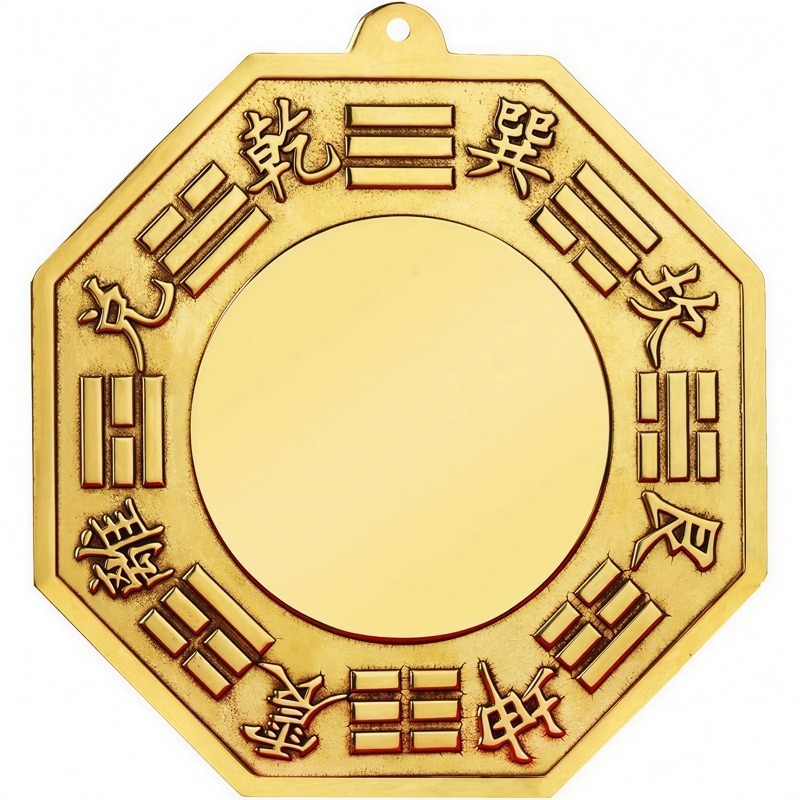
Brass Convex Bagua Mirror (Feng Shui)
Traditional convex bagua mirror, hand-finished solid brass with all 8 trigrams and the Tai Ji symbol at the centre. Used over the front door (outside) to deflect negative energy (sha qi) from streets, T-junctions, sharp corners, and other confrontational arrangements. The convex shape disperses energy rather than concentrating it. Hand-engraved by TaoFlow Feng Shui.
$26.90
View Bagua Mirror →The bagua mirror is the most iconic feng shui object, and it is also the most misunderstood. It is not a "magical" object that "reflects evil." It is a practical tool that applies a specific feng shui principle: the bagua map is the diagnostic, the bagua mirror is one of the remedies. Used correctly, in the right placement, with the right intent, a bagua mirror can be effective. Used incorrectly — over the front door when the door is in a perfectly calm position, or in a flat (non-convex) shape that concentrates energy rather than dispersing it — the bagua mirror can create more problems than it solves.
For more on the correct use of the bagua mirror, including the difference between convex and flat, the correct placement, and the most common mistakes, see the related articles in this cluster. The bagua mirror is a tool, not a cure-all. Use it when the diagnostic calls for it, and avoid it when the home is in good shape.
Three rules for the correct use of a bagua mirror: (1) Use a convex mirror, not a flat or concave mirror — the convex shape disperses energy, which is what you want for deflection. (2) Place it on the outside of the front door, not inside — the mirror is for deflecting external sha qi, not for circulating internal qi. (3) Use it only when the front door is in a confrontational position (facing a T-junction, a sharp corner, a hospital, a cemetery, or another source of negative external energy). A bagua mirror over a calm, well-placed front door is unnecessary and can create imbalance. The bagua mirror is a remedy, not a decoration.
5 Common Mistakes When Using the Bagua Map
Five common mistakes beginners make when first applying the bagua map. Avoiding these will make the practice much more effective.
Mistake 1: Mixing the Western and Classical Orientations
The mistake: the practitioner uses the Western BTB system but applies the compass directions from the classical system (or vice versa). The result: the wealth corner is in the wrong place, and the adjustments miss the actual sector. The fix: choose one system and stick with it. The Western BTB system uses the front door as the bottom of the map. The classical system uses the compass direction of the back of the home. Once you choose a system, use it consistently throughout the home.
Mistake 2: Forcing All 9 Sectors to Be Activated
The mistake: the practitioner tries to activate all 9 sectors at once, placing 9 different objects in 9 different areas of the home. The result: the home becomes cluttered with feng shui objects, and the practitioner feels overwhelmed. The fix: identify the 2-3 sectors that need the most attention, and focus on those. The bagua map is a diagnostic, not a to-do list. Most homes have 2-3 sectors that are problematic, and the rest are already in good shape. Address the 2-3 first, then move to the next priority.
Mistake 3: Ignoring the Existing State of the Sector
The mistake: the practitioner places a wealth symbol in the wealth corner without first cleaning, decluttering, and arranging the space. The result: the wealth symbol is placed on top of clutter, in a dark corner, with poor light and no flow. The wealth energy is not activated. The fix: clean, declutter, and arrange the sector first. The bagua map works through the environment, not through the objects. A clean, well-lit, uncluttered wealth corner with no wealth symbol is better than a cluttered, dark wealth corner with a citrine crystal.
Mistake 4: Treating the Bagua Map as a Magical Instrument
The mistake: the practitioner believes that placing a wealth symbol in the wealth corner will magically increase their income, regardless of the rest of their life. The result: disappointment when the wealth corner is activated but the income does not change. The fix: the bagua map is a diagnostic and a framework for intentional arrangement, not a magical instrument. The map correlates the state of the home with the state of the life, but it does not create the correlation. Action in the physical world (career development, financial planning, relationship work) is still required.
Mistake 5: Placing a Bagua Mirror Without a Reason
The mistake: the practitioner places a bagua mirror over the front door because "it is what you do in feng shui," even when the front door is in a calm, well-placed position. The result: the bagua mirror becomes a decoration, and the practitioner misses the actual feng shui issues in the home. The fix: place a bagua mirror only when the front door is in a confrontational position (T-junction, sharp corner, hospital, cemetery, etc.). If the front door is calm, the bagua mirror is unnecessary. The bagua mirror is a remedy, not a decoration.
The Bottom Line: What to Do With the Bagua Map
The bagua map is the central operational tool of feng shui. It gives you a way of dividing any space into 9 sectors, each corresponding to a life area and a set of properties. The map is most useful as a diagnostic — it helps you correlate the state of your home with the state of your life, and it gives you a vocabulary for making specific adjustments.
You do not have to be a classical feng shui master to use the bagua map. The Western BTB system is designed for beginners and produces useful results without extensive training. Start with the Western system, apply it to your home using the 4-step process, identify the 2-3 sectors that need the most attention, and make one specific adjustment per sector. Observe the results over the next 30 days, and adjust as needed.
The most useful thing to do with the bagua map is to use it as a framework for paying attention to your home. Walk through the 9 sectors. Notice what is already there. Notice what is missing. Notice the colour, the light, the arrangement, the objects. The map is the framework for the observation. The observation is the foundation of the practice.
The next time someone asks you what the bagua map is, you can say: it is a 3×3 grid that divides any space into 9 sectors, each corresponding to a life area, an element, and a trigram. It is the central tool of feng shui, the most useful diagnostic in the practice, and the framework for every adjustment you will ever make.
Related Topics and Cluster Articles
This article is part of the Feng Shui 101 cluster. The following articles cover related aspects in depth.
Related articles on this site
→ Are Bagua Mirrors Dangerous? The Complete Guide → Convex vs Flat Bagua Mirror: Which to Use → Shop the Brass Convex Bagua MirrorFrequently Asked Questions
What is a bagua map?
How do I apply the bagua map to my home?
Which bagua system should I use?
What is the wealth corner?
What is the relationship corner?
How do I find the center of my home?
What if my home isn't a rectangle?
Can I use the bagua map for a single room?
What is a bagua mirror?
What goes in each bagua sector?
"The bagua map is the most useful tool ever developed for diagnosing the state of a home. It is a 3×3 grid that divides any space into 9 sectors, each corresponding to a life area, an element, and a trigram. The map is not a magical instrument. It is a diagnostic. It tells you where the home is in balance and where it is not. It gives you a vocabulary for the imbalance. It gives you a set of specific remedies. The map is most useful when used as a framework for paying attention — to the colour, the light, the arrangement, the objects in each sector of your home. The map does not create the correlation between the home and the life. It reveals it. Once you can see the correlation, you can change the home, and the home will support the life. The rest of the work is in your hands."
0users like this.


Your cart is currently empty.