
Feng Shui

Ancient Chinese Coins in Feng Shui: Why Old Copper Works
Ancient Chinese Coins in Feng Shui: Why Old Copper Works
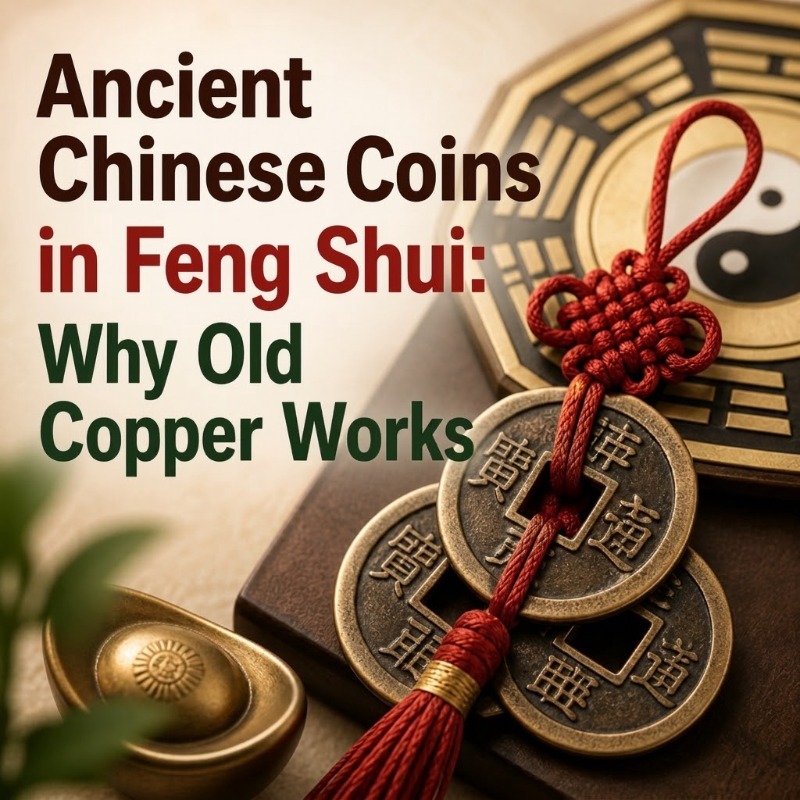
Ancient Chinese coins (古钱币) are among the most versatile feng shui tools in the Chinese tradition. The metal element, the round-square design (天圆地方), the emperor's reign title at the centre, and the qi absorbed through centuries of circulation and burial make them powerful for wealth attraction, sha qi blocking, and home protection. This is the deep guide to ancient coins in feng shui — the four reasons they work, the five main combinations (大五帝钱, 小五帝钱, 六帝钱, 八帝钱, 36-coin sets), the placement rules, the cautions, and how to choose authentic coins.
Last updated: September 2, 2026 · ~13 min read · TaoFlow Feng Shui ResearchThe 30-second answer: Ancient Chinese coins work in feng shui for four reasons. (1) The material is copper, which belongs to the metal element (金) and can dissolve negative earth energy such as the Five Yellow (五黄) and Two Black (二黑) afflictions. (2) The shape is round outside, square inside — 天圆地方 (heaven is round, earth is square) — and the emperor's reign title in the centre represents the human, giving one coin the complete 三才 (three powers) of heaven, earth, and human. (3) The coins have absorbed human qi through centuries of circulation as currency and earth qi through burial in the ground. (4) The coins were minted during prosperous eras, and are believed to carry the qi of those eras. The most common combinations are the small Five Emperor Coins (小五帝钱) of the Qing dynasty, the large Five Emperor Coins (大五帝钱) of the Qin, Han, Tang, Song, and Ming dynasties, the Six Emperor Coins (六帝钱) for dissolving the Five Yellow and Two Black, the Eight Emperor Coins (八帝钱) for complex sha qi, and the 36-coin combination for unstable house energy. Coins are used for wealth attraction (in cash registers, safes, wallets), for sha qi blocking (at door thresholds, on door lintels, on windows, facing beams or bathroom doors), and for home protection (9 strings of 9 coins buried under the threshold for long-lasting protection).
Why Ancient Coins Work in Feng Shui: The 4 Reasons
An ancient Chinese coin (古钱币) is not just a piece of metal. In the Chinese feng shui tradition, the ancient coin is one of the most versatile and effective tools, used for wealth attraction, sha qi blocking, and home protection. The power of the ancient coin comes from four distinct sources, each contributing a different layer of qi to the object. Understanding these four reasons helps to understand why the ancient coin has held its place in the feng shui toolkit for over a thousand years.
Reason 1: The Material Belongs to the Metal Element (材质五行属金)
Ancient Chinese coins were almost always made of copper (铜), with varying amounts of tin, lead, and zinc in the alloy. In the five-element system (五行, wǔ xíng), copper belongs to the metal element (金, jīn). The metal element has a specific function in feng shui: it is the element that controls and dissolves the earth element (土, tǔ). This is one of the controlling cycles of the five elements (金克木, jīn kè mù — metal controls wood; and in the more complex interactions, metal drains earth). For this reason, the metal element is the standard remedy for two of the most dangerous annual and periodic flying star afflictions: the Five Yellow (五黄煞, wǔ huáng shà) and the Two Black (二黑煞, èr hēi shà), both of which are earth-element stars associated with disaster, illness, and accidents.
Copper is considered more effective than gold or silver for this purpose. The reason is that copper is a more porous and reactive metal at the mineral level — it absorbs, conducts, and transforms qi more readily than the more inert gold and silver. Copper also oxidizes (turns green) over time, which in the feng shui tradition is interpreted as the qi of the metal actively transforming. Gold and silver, by contrast, do not oxidize — they remain chemically stable, which in the feng shui interpretation means they hold qi but do not transform it. For dissolving negative earth energy, the active transformation of copper is more effective than the static holding of gold or silver.
Reason 2: The Shape Embodies the Three Powers (形制蕴含三才)
The shape of the ancient Chinese coin is one of the most profound cosmological designs in any human tradition. The coin is round on the outside, with a square hole in the centre. The four Chinese characters of the emperor's reign title (年号, nián hào) are inscribed on the four sides of the square hole, one character per side. This is not a casual design — it is a deliberate embodiment of one of the most fundamental cosmological principles of Chinese thought: the three powers (三才, sān cái).
The three powers are heaven (天, tiān), earth (地, dì), and human (人, rén). The three are the fundamental forces of Chinese cosmology: heaven provides the cosmic order and the timing, earth provides the material substrate and the location, human provides the conscious will and the action. The three powers must be in alignment for any undertaking to succeed. In the ancient coin, the outer round represents heaven (the boundless, infinite, continuous round of the celestial sphere), the inner square represents earth (the stable, four-sided, four-cornered structure of the material world), and the emperor's reign title in the centre represents the human (the conscious will, the social order, the cultural identity of the people under that emperor). One coin thus contains the complete three powers in a single object — a remarkably compact cosmological diagram.
Reason 3: The Coin Has Absorbed Both Human Qi and Earth Qi (凝聚人气与地气)
The ancient coin is unique among feng shui tools because of its long history of being handled, circulated, and eventually buried. As currency, the coin passed through the hands of millions of people over the centuries — emperors, officials, merchants, farmers, soldiers, priests, travellers. Each hand left a trace of qi on the coin, layer upon layer, until the coin became a condensed record of human activity. In the feng shui interpretation, this condensation gives the coin an unusually rich and varied human qi, a kind of accumulated social energy that no other feng shui tool possesses.
Many ancient coins, especially those recovered by farmers and metal-detectorists in modern times, were buried in the ground for decades or centuries. During this burial, the coin absorbed earth qi (地气, dì qì) — the slow, deep, mineral qi of the soil, the water table, the bedrock. This earth qi is considered the counterpart to the human qi absorbed during circulation. The combination of human qi (from circulation) and earth qi (from burial) gives the ancient coin a unique dual-natured qi that no newly made reproduction coin can replicate. The TaoFlow feng shui perspective is that the dual-natured qi is the deepest layer of the coin's power — it is what makes the ancient coin qualitatively different from a modern reproduction, even if the reproduction is identical in shape, size, and inscription.
Reason 4: The Coin Carries the Qi of Its Era (承载盛世之气)
Ancient coins were minted during specific historical periods, each of which had its own character. A coin minted during the reign of Emperor Kangxi of the Qing dynasty carries the qi of the Kangxi era — a period of territorial expansion, cultural flourishing, and economic prosperity known as the beginning of the 康乾盛世 (Kang-Qian Golden Age, 1662–1795 CE). A coin minted during the reign of Emperor Qianlong carries the qi of the Qianlong era — the peak of Qing prosperity, with the empire at its greatest territorial extent. The feng shui interpretation is that the prosperity of the era is encoded in the coin, and that the coin transmits this prosperity to whoever uses it in feng shui.
This is one of the reasons that the Qing dynasty Five Emperor Coins (Shunzhi, Kangxi, Yongzheng, Qianlong, Jiaqing) are the most popular in modern feng shui practice — the Shunzhi through Jiaqing period (1644–1820 CE) covers most of the 康乾盛世, the most prosperous era of the Qing dynasty and one of the most prosperous eras in all of Chinese history. The small Five Emperor Coins are believed to carry the prosperity qi of this 176-year golden age, concentrated into five coins. The TaoFlow feng shui perspective is that the era qi is a real cultural phenomenon — the coins are physical artefacts of a specific historical period, and that period's character is part of what is being transmitted when the coin is used in feng shui.
The four reasons, summarized: An ancient Chinese coin works in feng shui because (1) copper is the metal element and can dissolve negative earth energy, (2) the round-square-with-inscription shape embodies the three powers of heaven, earth, and human, (3) the coin has absorbed human qi through centuries of circulation and earth qi through burial, and (4) the coin carries the qi of the era in which it was minted. These four reasons are not mutually exclusive — they work together, each reinforcing the others. The metal-element property provides the elemental function, the three-powers shape provides the cosmological structure, the dual qi provides the lived energy, and the era qi provides the cultural resonance. Together, they make the ancient coin one of the most complete feng shui objects ever designed.
The Three Powers Inside One Coin
The three-powers (三才, sān cái) design of the ancient Chinese coin deserves a closer look, because it is the most distinctive feature of the coin as a feng shui object. The three powers are the cosmological trinity of heaven, earth, and human — the three forces that, in alignment, make any undertaking possible. The ancient coin is one of the few objects in any culture that explicitly contains all three powers in a single physical form.
The outer round represents heaven. The round shape is the shape of the celestial sphere, the sky, the heavens. In Chinese cosmology, the round has no beginning and no end, no preferred direction, infinite continuity — these are the qualities of the boundless heavens. The round outer edge of the coin thus embodies the heavens in their entirety. The four Chinese characters of the emperor's reign title in the centre represent the human. The emperor's reign title is the name of the era, the cultural identity, the social order of the people under that emperor — it is the human, the conscious will, the cultural will of a people and a time. The inner square represents the earth. The square has four sides and four corners, definite boundaries, stable structure — these are the qualities of the stable, contained, material earth.
The three powers are arranged in a specific order. Heaven is on the outside (the round), earth is at the centre (the square), and human is at the very centre of the centre (the inscription within the square). This arrangement is significant: the human is surrounded by the earth, which is surrounded by the heavens. The human is at the centre of the universe, supported by the earth, encompassed by the heavens. This is the classical Chinese cosmological view of the human's place in the universe, made physical in a single coin.
When the coin is used in feng shui, the three-powers design is activated. The coin is not just a piece of metal — it is a complete cosmological diagram, a three-dimensional representation of the universe in miniature, a small object that contains the same three powers that govern the large universe. This is why a single ancient coin can be used for multiple feng shui purposes (wealth, sha qi blocking, protection) — because the coin contains the full cosmological power of heaven, earth, and human, and can be deployed in any of the three domains (heaven for timing, earth for location, human for action).
The 5 Main Coin Combinations
Ancient coins are rarely used individually in modern feng shui practice. They are usually combined in sets of 5, 6, 8, or 36 coins, each set designed for a specific feng shui purpose. The five main combinations are listed below, with the dynasty or era of the coins, the typical feng shui use, and a brief explanation of why that particular combination is used.
Large Five Emperor Coins (大五帝钱)
Qin 半两 · Han 五铢 · Tang 开元通宝 · Song 宋元通宝 · Ming 永乐通宝
The large Five Emperor Coins contain five coins from the five greatest dynasties of imperial Chinese history: the Qin (221–206 BCE, the 半两 bàn liǎng), the Han (206 BCE – 220 CE, the 五铢 wǔ zhū), the Tang (618–907 CE, the 开元通宝 kāi yuán tōng bǎo), the Song (960–1279 CE, the 宋元通宝 sòng yuán tōng bǎo), and the Ming (1368–1644 CE, the 永乐通宝 yǒng lè tōng bǎo). The large Five spans more than 1,800 years of Chinese history and is considered to have a more expansive qi field than the small Five. The large Five is used for镇宅 (home protection), 化煞 (sha qi dissolution), and 招福 (blessing attraction). The 1,800-year qi field is the distinctive feature — the large Five is preferred when the feng shui situation calls for the deepest possible qi foundation.
Small Five Emperor Coins (小五帝钱)
Qing 顺治 · 康熙 · 雍正 · 乾隆 · 嘉庆
The small Five Emperor Coins contain five coins from the Qing dynasty (1644–1912 CE): the Shunzhi (顺治, 1644–1661), the Kangxi (康熙, 1662–1722), the Yongzheng (雍正, 1723–1735), the Qianlong (乾隆, 1736–1795), and the Jiaqing (嘉庆, 1796–1820). The small Five spans about 176 years and covers most of the 康乾盛世 (Kang-Qian Golden Age), the most prosperous era of the Qing dynasty and one of the most prosperous eras in all of Chinese history. The small Five is the most popular combination in modern feng shui practice, used for挡煞 (sha qi blocking), 防小人 (protection from petty people), 辟邪 (evil-warding), and 旺财 (wealth activation). The small Five is preferred when the feng shui situation calls for a more accessible and historically compact qi field.
Six Emperor Coins (六帝钱)
Qing 顺治 · 康熙 · 雍正 · 乾隆 · 嘉庆 · 道光
The Six Emperor Coins are the small Five plus the Daoguang (道光, 1821–1850) reign coin, making six coins from six consecutive Qing dynasty emperors. The Six Emperor Coins are specifically used to dissolve the Five Yellow (五黄煞) and Two Black (二黑煞) sha qi — the two most dangerous annual and periodic flying star afflictions in feng shui. The Five Yellow is associated with disaster, accidents, and sudden loss; the Two Black is associated with illness, chronic sickness, and prolonged suffering. Both are earth-element stars, and the metal-element coins are the standard remedy. The Six Emperor Coins are considered especially effective because the additional Daoguang coin completes a specific numerical and qi alignment that targets the earth-element negative energy. The Six Emperor Coins are commonly placed at the door threshold, on the door lintel, or in the centre of a home or business facing one of these afflictions.
Eight Emperor Coins (八帝钱)
Qing 顺治 · 康熙 · 雍正 · 乾隆 · 嘉庆 · 道光 · 咸丰 · 同治
The Eight Emperor Coins are the small Five plus the Daoguang (道光), Xianfeng (咸丰, 1851–1861), and Tongzhi (同治, 1862–1874) reign coins, making eight coins from eight consecutive Qing dynasty emperors. The Eight Emperor Coins are used to dissolve more complex sha qi arrangements that the smaller sets (5 or 6) cannot fully address. The typical applications include: door facing a staircase (门对楼梯), door facing an elevator shaft (门对电梯口), sharp corner of a building pointing at the home or business (墙角冲射), road or T-junction pointing directly at the door, and other complex multi-source sha qi configurations. The Eight Emperor Coins are considered a 'heavy-duty' feng shui remedy. The eight-coin set is sometimes combined with other feng shui tools (a wu lou, a bagua mirror) for the most complex situations.
36-Coin Combination (三十六枚古钱)
Any authentic ancient coin · 36 = 36 Heavenly Spirits (三十六天罡)
The 36-coin combination is not a specific set of historical coins but a numerical combination. The 36 represents the 36 Heavenly Spirits (三十六天罡) — the 36 stellar deities in Chinese mythology who are said to govern the earthly realm. The 36-coin combination is used to address complex structural and energetic problems that the smaller sets (5, 6, 8) cannot address. The typical applications include: unstable house energy (房屋气场不稳), missing corners in a floor plan (缺角), uneven terrain or sloped land (地势不平), sofa or main seat with no backing support (沙发无靠), and other complex spatial irregularities. Any authentic ancient coin can be used in the 36-coin combination, but the most common are the Qing dynasty Five Emperor Coins multiplied into 36 (with some repeats allowed), or a mixed set of major-dynasty coins. The 36-coin combination is usually placed in a wooden box or wrapped in red cloth and placed in the centre of the home or the specific problem area.
| Combination | Coins | Era | Main Use |
|---|---|---|---|
| 大五帝钱 | 5 (秦汉唐宋明) | 1,800+ years | Home protection, sha qi dissolution |
| 小五帝钱 | 5 (顺治–嘉庆) | 176 years (Qing) | Sha qi blocking, anti-petty people, wealth |
| 六帝钱 | 6 (small 5 + 道光) | 206 years (Qing) | Five Yellow & Two Black specific remedy |
| 八帝钱 | 8 (small 5 + 道光 + 咸丰 + 同治) | 230 years (Qing) | Complex multi-source sha qi |
| 36 枚 | 36 (any ancient) | Mixed | Structural problems, unstable energy |
How to Use Ancient Coins: 7 Placement Methods
Ancient coins can be used in a wide variety of feng shui applications. The seven most common placement methods are listed below, organized by the purpose of the placement (wealth attraction, sha qi blocking, or home protection).
For Wealth Attraction (招财旺运)
- Cash register or money drawer of a business: Place a string of 5 small Five Emperor Coins in the cash register or money drawer. The coins activate the wealth qi of the transaction point.
- Safe of a business or wealthy household: Place a string of 5 or 6 Emperor Coins inside the safe. The coins protect and amplify the wealth stored in the safe.
- Personal wallet, handbag, or purse: Carry one or two Five Emperor Coins in the wallet. The coins keep the wealth qi of the personal finances in alignment.
- Wealth corner of the home (财位): Place a string of 5 Emperor Coins in the wealth corner — the southeast corner of the home or the diagonal corner from the front door (depending on the feng shui school).
For Sha Qi Blocking (挡煞化煞)
- Front door threshold (门槛下): Place 5, 6, or 8 Emperor Coins under the front door threshold. The coins block the sha qi that enters through the front door. The text side (with the emperor's reign title) faces up, and the character feet point inward toward the home.
- Front door lintel (门楣上): Hang a string of 5 or 6 Emperor Coins on the front door lintel with red string. The coins block the sha qi before it reaches the door.
- Window or balcony (窗户/阳台): Hang Emperor Coins on the window or balcony that faces the source of the sha qi (a sharp corner, a road, a T-junction). The coins deflect the sha qi before it enters the home.
- Facing internal sha qi sources: Hang Emperor Coins facing internal sha qi sources such as a beam (横梁压顶), a sharp corner (墙角), or a bathroom door (厕所门正对). The coins dissolve the internal sha qi.
For Home and Personal Protection (镇宅保平安)
- Under the front door threshold, 9 strings of 9 coins: For major new construction or major renovation, bury 9 strings of 9 coins (81 coins total) under the front door threshold. The 9 × 9 = 81 represents 'long long jiu jiu' (长长久久), the wish for long-lasting stability and protection. This is a one-time installation, not a regular practice.
- Under the pillow (枕头下): Place one or two Emperor Coins under the pillow for personal protection during sleep. The coins ward off nightmares and disturbing dreams.
- In the car (车内): Hang a single Emperor Coin on the rear-view mirror of the car. The coin protects the driver and passengers from accidents and negative energy on the road.
TaoFlow Five Emperor Coins (五帝钱) — Feng Shui Wealth & Protection
Authentic-style Five Emperor Coins (五帝钱, Xiao Wu Di Qian) — set of 5 copper coins from the Qing dynasty era (Shunzhi, Kangxi, Yongzheng, Qianlong, Jiaqing), spanning the Kang-Qian Golden Age (1662–1820 CE). Used in feng shui for wealth attraction, sha qi blocking, and home protection. Each set is consecrated and prepared according to traditional feng shui method — the coins are cleansed in salt water, exposed to sunlight, and wrapped in red cloth. The set comes with instructions for the most common placements: cash register, wallet, door threshold, wealth corner. A complete feng shui tool in five small coins.
$24.90
View Five Emperor Coins →4 Important Cautions When Using Ancient Coins
Four important cautions to keep in mind when using ancient coins for feng shui. These cautions help to ensure that the coins are used effectively and respectfully, and that the user has a clear understanding of what the coins can and cannot do.
Caution 1: Authenticity and Consecration (真伪与开光)
Some practitioners believe that only authentic ancient coins (coins actually minted in the historical period) carry the full qi of the era. Reproductions made today, even if identical in shape and inscription, are said to lack the dual human-earth qi that gives the ancient coin its distinctive power. The TaoFlow feng shui perspective is that authentic coins are preferable when available, but that high-quality reproductions prepared through traditional consecration methods (cleansing, sunlight exposure, red cloth wrapping) are acceptable substitutes when authentic coins are not accessible or affordable. Buried ancient coins may have absorbed 'yin qi' (阴气, negative or stagnant energy) along with the earth qi, and should be cleansed or consecrated before use. The consecration typically involves washing the coins in salt water or clean water, exposing them to sunlight for several hours, and in some traditions having a Taoist priest perform a formal 开光 (kāi guāng) ceremony.
Caution 2: Placement Rules (摆放禁忌)
The placement of the coins is not arbitrary. The standard rule for coins placed under a door threshold is that the text side (the side with the emperor's reign title) faces up, and the character feet point inward toward the home. Coins placed with the text side down, or with the character feet pointing outward, are said to either be inactive or to actively direct the qi away from the home. The wrong placement is not dangerous, but it is ineffective. The TaoFlow feng shui recommendation is to verify the placement carefully before installing the coins, and to consult a feng shui practitioner if there is any doubt.
Caution 3: Combination and Number (组合与数量)
Different numbers of coins have different specific uses, and more is not always better. Five coins is the standard for general wealth and protection. Six coins is specifically for the Five Yellow and Two Black afflictions. Eight coins is for complex multi-source sha qi. Thirty-six coins is for structural and energy-stability problems. Using the wrong number for a specific situation is not harmful, but it may be less effective than the correct number. The TaoFlow feng shui recommendation is to match the combination to the specific situation — do not assume that more coins means more power.
Caution 4: A Rational View (理性看待)
The feng shui effectiveness of ancient coins is, in part, a cultural and psychological phenomenon. The coins carry real symbolic power (the metal element, the three-powers shape, the era qi), and the use of the coins in a thoughtful and consistent way can contribute to a sense of order, intention, and cultural continuity in a home or business. But the coins are not magical objects that override physical reality. The TaoFlow feng shui perspective is that the coins should be used as part of a broader feng shui practice (proper layout, good lighting, clean space, intention) and not as a substitute for practical action. A string of Five Emperor Coins under the door threshold does not replace the need to fix a broken lock, a leaky roof, or a difficult relationship. The coins are a complement, not a replacement, for the practical work of building a good home and a good life.
The Bottom Line: What to Do With Ancient Coins
Ancient Chinese coins are among the most versatile feng shui tools in the Chinese tradition. They work because of four distinct reasons — the metal element of the copper, the three-powers design of the round-square-with-inscription shape, the dual human-earth qi absorbed through centuries of circulation and burial, and the era qi of the historical period in which they were minted. The five main combinations (大五帝钱, 小五帝钱, 六帝钱, 八帝钱, 36-coin sets) cover the most common feng shui applications, from general wealth and protection to the specific Five Yellow and Two Black afflictions to the complex structural problems that require the heaviest remedy.
The most useful thing to do with ancient coins is to choose the right combination for your specific situation, place them in the correct location with the correct orientation (text side up, character feet pointing inward), and use them as part of a broader feng shui practice. The coins are a complement to good feng shui design, not a replacement for it. The coins are also a cultural artefact — a small piece of Chinese history that you can hold in your hand, a tangible connection to the 1,800 years of imperial Chinese civilization, and a daily reminder of the three powers of heaven, earth, and human that the coin embodies in a single object.
The ancient coin is one of the most complete feng shui objects ever designed. The metal element, the three-powers shape, the dual qi, and the era qi together make the ancient coin a tool that no other culture has produced. The TaoFlow Five Emperor Coins set is the most accessible entry point — five Qing dynasty coins, spanning the most prosperous era in Chinese history, ready to be placed in a cash register, a wallet, a door threshold, or a wealth corner. Five small coins. The full three powers. The full metal element. The full Qing dynasty era qi. The ancient coin is small. The feng shui tradition is large. The two meet in your hand.
Related Topics (For Deeper Reading)
For readers who want to explore the underlying concepts referenced in this article, the following standalone guides cover the most directly related topics.
Frequently Asked Questions
What are ancient Chinese coins used for in feng shui?
Why is copper used in feng shui coins (not gold or silver)?
What does 天圆地方 mean in coin feng shui?
What is 三才 and how does it relate to coins?
What is the difference between 大五帝钱 and 小五帝钱?
What is 六帝钱 used for?
What is 八帝钱 used for?
What does 36 coins do?
Where should I place ancient coins in my home?
Do ancient coins need to be consecrated (开光)?
"The ancient Chinese coin is small. The feng shui tradition is large. The two meet in your hand. A copper disc, round on the outside, square on the inside, with the emperor's reign title at the centre. Heaven. Earth. Human. Three powers in one object. Five emperors. Six emperors. Eight emperors. Thirty-six heavenly spirits. The coins carry the metal element that dissolves the negative earth energy. The coins carry the three-powers design that activates the cosmological order. The coins carry the human qi of centuries of circulation. The coins carry the earth qi of centuries of burial. The coins carry the prosperity qi of the eras in which they were minted. The coins are one of the most complete feng shui objects ever designed. Place them with intention. Place them with the text side up. Place them with the character feet pointing inward. Place them under the door threshold, in the cash register, in the wallet, in the wealth corner. The coins will do their part. You will do yours."
0users like this.


Your cart is currently empty.