
Feng Shui

The 8 Trigrams Explained: What Each One Means
The 8 Trigrams Explained: What Each One Means
The 8 trigrams (八卦, bāguà) are the foundational symbols of the I Ching, the cosmological map of Chinese philosophy, and the building blocks of the 64 hexagrams. This is the deep, single-topic guide — the structure of a trigram, each of the 8 trigrams in detail, the two traditional arrangements (Fu Xi Early Heaven and King Wen Later Heaven), how trigrams combine into 64 hexagrams, and how they function in Chinese cosmology, feng shui, and divination.
Last updated: August 31, 2026 · ~14 min read · TaoFlow Feng Shui ResearchThe 30-second answer: The 8 trigrams are 8 three-line symbols, each line either solid (yang ⚊) or broken (yin ⚋), that together form the foundational cosmological map of Chinese philosophy. The 8 possible combinations of three lines (2 × 2 × 2 = 8) yield the 8 trigrams: Qian (☰, heaven), Kun (☷, earth), Zhen (☳, thunder), Xun (☴, wind), Kan (☵, water), Li (☲, fire), Gen (☶, mountain), and Dui (☱, lake). Each trigram represents a fundamental quality of reality. Two trigrams stack to form a hexagram; the 64 possible combinations of two trigrams are the 64 hexagrams of the I Ching. The trigrams are the building blocks of the I Ching, of feng shui, of traditional Chinese medicine, and of Chinese cosmology more broadly. This article is the deep dive into the trigrams themselves — their structure, their meanings, their arrangements, and their use.
What the 8 Trigrams Are
The 8 trigrams (八卦, bāguà) are the foundational symbols of Chinese cosmology, the building blocks of the I Ching (易经, Book of Changes), and the cosmological map of the traditional Chinese understanding of reality. The word bagua literally translates to "8 trigrams" (ba = eight, gua = trigram). A trigram (卦, guà) is a stack of three lines, each line either solid (yang, ⚊) or broken (yin, ⚋). The 8 possible combinations of three lines yield the 8 trigrams.
The 8 trigrams are the oldest systematic symbolic framework in the East Asian intellectual tradition. The earliest textual reference to the trigrams is found in the I Ching, traditionally attributed to King Wen of Zhou (c. 1100 BCE) and the mythical culture hero Fu Xi (c. 3000 BCE), though the system is almost certainly older. The trigrams were used in ancient China for divination, calendar calculation, military strategy, medical diagnosis, and the analysis of natural cycles. Over the centuries, the trigrams became the foundational symbolic vocabulary of Chinese philosophy, integrated into Confucianism, Taoism, and Chinese Buddhism, and applied to virtually every field of Chinese intellectual life.
The 8 trigrams are:
Each trigram represents a fundamental quality of reality. Qian is the pure yang quality — heaven, the creative, the strong. Kun is the pure yin quality — earth, the receptive, the nurturing. Zhen is the energy of new beginnings, sudden awakening, the arousing. Xun is the energy of gentle penetration, the wind. Kan is the energy of depth, the abyss, danger. Li is the energy of brightness, clarity, the clinging. Gen is the energy of stillness, the keeping still, the mountain. Dui is the energy of joy, completion, the lake. Together, the 8 trigrams form a complete map of the qualities of reality.
Each trigram also has a family of correspondences: a natural image (heaven, earth, thunder, wind, water, fire, mountain, lake), a body part, a colour, a direction, a season, a virtue, a stage of development, and a family member (the father, the mother, the three sons, the three daughters). The correspondences are not arbitrary — they emerge from the underlying quality of each trigram. Qian is the father because pure yang represents the active, generating, leading quality of the father. Kun is the mother because pure yin represents the receptive, nurturing, supporting quality of the mother. The correspondences are developed in detail in the classical I Ching commentary.
The Structure of a Trigram
A trigram is a stack of three lines, each line either solid (yang, ⚊) or broken (yin, ⚋). The three lines are read from bottom to top, and the sequence of lines determines which of the 8 trigrams the figure represents.
The bottom line is called the "earth position" (地位, dìwèi) or the "first position" (初位, chūwèi). It represents the incipient, the foundational, the beginning of a process. The middle line is called the "human position" (人位, rénwèi) or the "second position" (中位, zhōngwèi). It represents the centre, the choice, the developing process. The top line is called the "heaven position" (天位, tiānwèi) or the "third position" (上位, shàngwèi). It represents the culmination, the result, the transcendent. The three positions together represent the cycle of becoming — from earth (foundation) through human (development) to heaven (culmination).
The two kinds of lines, yang (⚊) and yin (⚋), are the most fundamental binary opposition in Chinese philosophy. Yang represents the qualities of activity, brightness, hardness, heat, masculinity, heaven, and the active. Yin represents the qualities of receptivity, darkness, softness, coolness, femininity, earth, and the receptive. The two qualities are not opposites in a moral sense — they are complementary poles of a single dynamic, the way that inhale and exhale are complementary poles of breathing. The 8 trigrams are the 8 possible combinations of the three yin/yang positions.
The mathematical structure of the trigrams is significant. With 3 positions, each of which can be either yin or yang, the total number of possible combinations is 2 × 2 × 2 = 8. This is the same binary structure that underlies modern digital computing, where every piece of information is encoded as a sequence of 0s and 1s. The 8 trigrams can be thought of as the earliest systematic binary code in human history, developed 3,000 years before Leibniz formalised the modern binary system in the 17th century. The mathematical elegance of the system is part of its enduring appeal.
The philosophical significance of the line structure: The three-line structure of the trigram is not just a mathematical convenience — it reflects a profound philosophical claim about the nature of reality. The claim is that all situations, all qualities, all changes can be analysed in terms of three positions (foundation, development, culmination) and two qualities (yin, yang). The 8 trigrams are the 8 possible ways of combining these three positions with these two qualities. The 64 hexagrams, formed by stacking two trigrams, are the 64 possible ways of combining two 8-trigram situations. The system claims to be a complete symbolic map of all possible situations of human experience — a claim that has been taken seriously for over 3,000 years.
The 8 Trigrams in Detail
Each of the 8 trigrams is a complete symbol with its own quality, image, family of correspondences, and philosophical meaning. The deep dive into each trigram follows. The symbol is shown in Unicode form, which is the standard way to represent the trigrams in modern text.
1. Qian (乾, Qián) — Heaven, The Creative
Pure Yang · Three solid lines · The Creative
Qian is the trigram of pure yang, three solid lines stacked from bottom to top. The trigram represents the creative, the strong, the leading, the active, the masculine, the father. The natural image is heaven — the vast, unyielding, ever-moving sky. The virtue of Qian is creativity in its purest form: the unceasing generation of all things, without preference, without rest, without end. The I Ching says of Qian, "The Creative works sublime success, furthering the perseverance of the superior man." The superior man (君子, jūnzǐ) is the Confucian ideal — the cultivated person who lives in accordance with the creative principle.
The 6-line figure of Qian (Qian over Qian) is the first hexagram of the I Ching, the hexagram of "The Creative." It is the most yang of all hexagrams and represents the pure yang energy in its full strength. The dragon (龍, lóng) is the symbol of Qian — a creature of heaven that embodies strength, vitality, and the creative principle. The first hexagram contains the line "Hidden dragon. Do not act" (潛龍勿用), one of the most quoted lines in the I Ching.
2. Kun (坤, Kūn) — Earth, The Receptive
Pure Yin · Three broken lines · The Receptive
Kun is the trigram of pure yin, three broken lines stacked from bottom to top. The trigram represents the receptive, the yielding, the supporting, the nurturing, the feminine, the mother. The natural image is the earth — the vast, yielding, all-receiving ground that supports all things without distinction. The virtue of Kun is receptivity in its purest form: the unconditional welcoming of what is, the generous holding of all things, the patient waiting for the seed to grow. The I Ching says of Kun, "The Receptive works sublime success, furthering the perseverance of the mare." The mare is the symbol of Kun — a creature of the earth that embodies receptivity, patience, and the generative power of the yielding.
The 6-line figure of Kun (Kun over Kun) is the second hexagram of the I Ching, the hexagram of "The Receptive." It is the most yin of all hexagrams and represents the pure yin energy in its full strength. Kun is the complement of Qian — together they form the polar pair that generates all things. Where Qian is the active, leading, creating principle, Kun is the receptive, supporting, completing principle. The second hexagram contains the line "Frost underfoot. Solid ice is not far off" (履霜堅冰至), one of the most quoted lines in the I Ching, warning of the slow accumulation of consequences.
3. Zhen (震, Zhèn) — Thunder, The Arousing
Yang below, Yin above · Solid under, broken over
Zhen is the trigram of thunder, a yang line at the bottom and two yin lines above. The trigram represents the energy of sudden awakening, new beginnings, the shock that breaks through inertia. The natural image is thunder — the sudden, startling sound that breaks the silence and rouses all beings to attention. The virtue of Zhen is the courage to begin, the energy of the first movement, the vitality of the spring awakening. The eldest son is the family member associated with Zhen — the firstborn who initiates the new generation.
The I Ching says of Zhen, "Thunder comes shouting. Shock, oh shock! In the noise and excitement, laughter and words are heard. Shock brings success." Zhen is the trigram of the shock that awakens — the unexpected event that breaks the routine, the call to action, the disruption that forces a new beginning. Zhen is also associated with the east direction (where the sun rises), the spring season (when the earth awakens), and the colour green (the colour of new growth).
4. Xun (巽, Xùn) — Wind, The Gentle
Yin below, Yang above · Broken under, solid over
Xun is the trigram of wind, a yin line at the bottom and two yang lines above. The trigram represents the energy of gentle penetration, the slow and persistent force that accomplishes what brute strength cannot. The natural image is the wind — the invisible, pervasive, gentle force that enters everywhere, that bends the grass, that carries the seed, that shapes the surface of the water. The virtue of Xun is the patient, persistent, gentle penetration that accomplishes the greatest works without violence. The eldest daughter is the family member associated with Xun.
The I Ching says of Xun, "Small accomplishments. It is favourable to go somewhere. It is favourable to see the great man." Xun is the trigram of the small, persistent, gentle approach — the soft power that achieves what the hard power cannot. Xun is also associated with the southeast direction (the direction of the gentle morning sun and the spring wind), the late spring season (when the wind carries the warmth), and the colour green-blue (the colour of the wind and the sky).
5. Kan (坎, Kǎn) — Water, The Abysmal
Yin-Yang-Yin · Broken-solid-broken
Kan is the trigram of water, a yang line in the middle and two yin lines above and below. The trigram represents the energy of depth, danger, the abyss, the pit. The natural image is water — the deep, dark, dangerous element that can drown the unwary, but that is also the source of all life. The virtue of Kan is the courage to face danger, the wisdom to navigate the depths, the patience to wait for the right moment to act. The middle son is the family member associated with Kan.
The I Ching says of Kan, "Water in the abyss. Success if you are sincere. The heart is stimulated." Kan is the trigram of danger and depth — the situation that requires careful navigation, the test that reveals character, the abyss that demands sincerity. Kan is also associated with the north direction (the direction of the dark, cold, deep north), the winter season (when water freezes and the world withdraws into itself), and the colour black or dark blue (the colour of the deep water).
6. Li (離, Lí) — Fire, The Clinging
Yang-Yin-Yang · Solid-broken-solid
Li is the trigram of fire, a yin line in the middle and two yang lines above and below. The trigram represents the energy of brightness, clarity, the clinging to what is bright and warm. The natural image is fire — the bright, warm, light-giving element that illuminates the darkness, that warms the cold, that transforms the raw into the cooked. The virtue of Li is the clarity of vision, the warmth of presence, the dependence on what is bright and true. The middle daughter is the family member associated with Li.
The I Ching says of Li, "Fire. The clinging. Perseverance in the middle brings good fortune. It is favourable to take action." Li is the trigram of brightness and clarity — the flame that burns steadily, the light that reveals, the warmth that gathers. Li depends on something to cling to — the fuel, the wick, the object that sustains the flame. The lesson of Li is that brightness and clarity are not self-generated; they require something to cling to. Li is also associated with the south direction (the direction of the midday sun and the summer heat), the summer season, and the colour red.
7. Gen (艮, Gèn) — Mountain, The Keeping Still
Yin-Yin-Yang · Broken-broken-solid
Gen is the trigram of the mountain, a yang line at the top and two yin lines below. The trigram represents the energy of stillness, the keeping still, the boundary, the meditation. The natural image is the mountain — the vast, immovable, silent presence that stands at the boundary of the world, that blocks the wind, that gathers the snow, that supports the sky. The virtue of Gen is the wisdom of stopping, the discipline of stillness, the boundary that defines. The youngest son is the family member associated with Gen.
The I Ching says of Gen, "Keeping the back still. He does not move his body. He goes and does not return. He does not see the people. He does not see the harm. No blame." Gen is the trigram of the deliberate stop — the moment when continuing is no longer wise, when stillness is the only correct action. Gen is also associated with the northeast direction (the direction of the cold, still northeast wind), the late winter season (the time of stillness before the spring awakening), and the colour yellow or brown (the colour of the mountain).
8. Dui (兌, Duì) — Lake, The Joyous
Yang-Yang-Yin · Solid-solid-broken
Dui is the trigram of the lake, a yin line at the top and two yang lines below. The trigram represents the energy of joy, completion, the lake, the marsh. The natural image is the lake — the still, deep, reflective body of water that gathers the rain, the rivers, the springs, that mirrors the sky, that sustains the fish, that gives joy to all who come to it. The virtue of Dui is the joy of completion, the pleasure of gathering, the delight of sharing. The youngest daughter is the family member associated with Dui.
The I Ching says of Dui, "The joyous. Perseverance brings good fortune." Dui is the trigram of joy — the inner satisfaction that comes from completion, the pleasure that comes from gathering, the delight that comes from sharing. Dui is also associated with the west direction (the direction of the sunset, the place of the gathering of the day), the autumn season (the time of harvest and completion), and the colour white or metallic (the colour of the metal and the harvest moon).
The Two Arrangements: Fu Xi Early Heaven and King Wen Later Heaven
There are two traditional arrangements of the 8 trigrams, each developed at a different time in Chinese history and each used for a different purpose. Both arrangements are circular — the 8 trigrams are placed around the perimeter of a circle, with each trigram occupying one of 8 positions (N, NE, E, SE, S, SW, W, NW). The two arrangements differ in which trigram is placed in which position, and the difference reflects the different philosophical purposes of the two systems.
The Fu Xi Early Heaven Arrangement (先天八卦, xiāntiān bāguà)
The Fu Xi Early Heaven arrangement is attributed to the mythical culture hero Fu Xi (伏羲, c. 3000 BCE), one of the legendary founders of Chinese civilisation. The arrangement represents the cosmic order before the world came into being — the underlying, eternal, abstract structure of reality. The arrangement is perfectly symmetric: opposite trigrams are complementary pairs (Qian opposite Kun, Zhen opposite Xun, Kan opposite Li, Gen opposite Dui). The symmetry reflects the perfect balance of the underlying cosmic order, before the world came into being and the dynamic, asymmetric processes of the experienced world began.
The Fu Xi arrangement begins with Qian (Heaven) at the top of the circle, and the trigrams are placed in the order of their natural generation: Qian (N), Dui (NW), Li (W), Zhen (NE), Xun (S), Kan (SE), Gen (E), Kun (SW). The placement follows the sequence of the "generation of the trigrams" (order of heaven), which describes how each trigram arises from the previous through the transformation of one line. The Fu Xi arrangement is used for the analysis of the underlying cosmic order — the eternal, abstract structure of reality that does not change with time.
The King Wen Later Heaven Arrangement (後天八卦, hòutiān bāguà)
The King Wen Later Heaven arrangement is attributed to King Wen of Zhou (周文王, c. 1100 BCE), the founder of the Zhou dynasty and the traditional author of the I Ching commentary. The arrangement represents the world as we experience it — the dynamic, ever-changing, asymmetric world of seasons, directions, and human affairs. The arrangement is asymmetric: opposite trigrams are not necessarily complementary, and the placement follows the actual observed cycles of nature.
The King Wen arrangement places Kan (Water, north, winter) at the top of the circle, and the trigrams are placed in the order of their actual occurrence in nature: Kan (N), Gen (NE), Zhen (E), Xun (SE), Li (S), Kun (SW), Dui (W), Qian (NW). The placement reflects the actual cycles of the seasons and the directions of the natural world. Kan (water, winter, north) is at the top because winter is the season of stillness, of water freezing, of the world withdrawing into its depths. Li (fire, summer, south) is at the bottom because summer is the season of fire, of the world opening out. The King Wen arrangement is used for the analysis of the changing world — the seasons, the directions, the practical affairs of human life.
| Feature | Fu Xi Early Heaven | King Wen Later Heaven |
|---|---|---|
| Attributed to | Fu Xi (c. 3000 BCE) | King Wen of Zhou (c. 1100 BCE) |
| Represents | Cosmic order (before world) | Experienced world (seasons, directions) |
| Symmetry | Symmetric (opposite = complementary) | Asymmetric (opposite = not necessarily related) |
| Top position | Qian (Heaven, NW in some arrangements) | Kan (Water, North) |
| Order | Generation sequence (line change) | Natural cycle (seasons, directions) |
| Used for | Cosmic order, abstract analysis | Seasonal cycles, feng shui, daily life |
| Best analogy | The blueprint of a house | The house as it is lived in |
Both arrangements are used in the I Ching, in feng shui, and in other Chinese traditional practices. The Fu Xi arrangement is used when the analysis is about the underlying, eternal, abstract structure of a situation. The King Wen arrangement is used when the analysis is about the dynamic, changing, practical aspects of a situation. A serious practitioner of the I Ching or feng shui learns both arrangements and uses them as different lenses on the same reality.
How the 8 Trigrams Combine into 64 Hexagrams
The 64 hexagrams (六十四卦, liùshísì guà) are formed by stacking two trigrams on top of each other, with the lower trigram representing the inner situation and the upper trigram representing the outer situation. Each hexagram has 6 lines (3 from the lower trigram and 3 from the upper trigram), and the 64 hexagrams are the 64 possible combinations of two trigrams (8 × 8 = 64).
The hexagram is read from the bottom line to the top line, with the lower trigram (lines 1-3) representing the inner, the foundational, the developing situation, and the upper trigram (lines 4-6) representing the outer, the situational, the result. The two trigrams together describe the dynamic relationship between the inner and the outer — the relationship between what is happening within a person (or a situation) and what is happening around them.
The 64 hexagrams are numbered 1-64 in the traditional King Wen sequence (the order established by King Wen of Zhou in the I Ching commentary). Each hexagram has a name (such as "Qian," "Kun," "Zhun," "Meng," "Xu," "Song"), a short image, a judgment, and a line-by-line commentary. The 64 hexagrams together form a complete map of the possible situations of human experience, and the I Ching is the commentary on these 64 situations.
The first hexagram (1) is Qian over Qian (☰☰, all yang, "The Creative"). The second hexagram (2) is Kun over Kun (☷☷, all yin, "The Receptive"). The third hexagram (3) is Kan over Kun (☵☷, "Difficulty at the Beginning"). The fourth hexagram (4) is Gen over Kan (☶☵, "Youthful Folly"). And so on, through all 64 combinations. The traditional order of the hexagrams is not arbitrary — it follows a specific sequence that groups related hexagrams together and tells the story of human experience from the most yang to the most yin and back again.
The 8 trigrams are the building blocks; the 64 hexagrams are the buildings. The trigrams describe the fundamental qualities of reality; the hexagrams describe the situations that arise from the combination of those qualities. The I Ching is the book of the 64 hexagrams; the trigrams are the system that the I Ching is built on. A serious student of the I Ching learns the trigrams first, then learns how the trigrams combine into the hexagrams, then studies the commentary on each hexagram.
How the 8 Trigrams Are Used
The 8 trigrams are used in three main domains of Chinese traditional practice: the I Ching (divination and philosophical reflection), feng shui (the analysis of space and qi), and traditional Chinese medicine (the analysis of the body and its qi). Each domain uses the trigrams in a different way, but the trigrams themselves are the same.
In the I Ching
In the I Ching, the trigrams are the building blocks of the 64 hexagrams, which are the units of divination. The questioner consults the I Ching by using one of several methods (the yarrow stalk method, the three-coin method, or a more modern method) to generate a hexagram from the trigrams. The resulting hexagram is then interpreted based on the classical I Ching text. The trigrams in the hexagram reveal the underlying qualities of the situation; the lines of the hexagram reveal the specific dynamics of the situation; the changing lines (if any) reveal the direction of the change.
In Feng Shui
In feng shui, the trigrams are the foundational map of reality. The trigrams are arranged in a 3×3 grid (the bagua map) and overlaid on the floor plan of a home, a room, or any defined space. Each sector of the bagua map corresponds to a trigram, and each trigram corresponds to a life area, a direction, an element, a colour, a shape, and a quality. The feng shui practitioner uses the trigram assignments to analyse the space and to apply feng shui principles. The trigrams are also used in the classical Compass school of feng shui (理气派), which uses the 24 mountains of the luo pan (the feng shui compass) to determine the qi of a space based on the trigrams and their combinations.
In Traditional Chinese Medicine
In traditional Chinese medicine (TCM), the trigrams are used to analyse the body and its qi. The 8 trigrams correspond to the 8 organ systems (the heart, liver, spleen, lungs, kidneys, pericardium, stomach, and bladder), the 8 extraordinary vessels (the eight meridians that store and regulate qi), and the 8 diagnostic principles (yin/yang, exterior/interior, cold/heat, deficiency/excess). The trigrams provide a framework for the TCM practitioner to understand the relationships between the organs, the meridians, and the overall pattern of qi in the body.
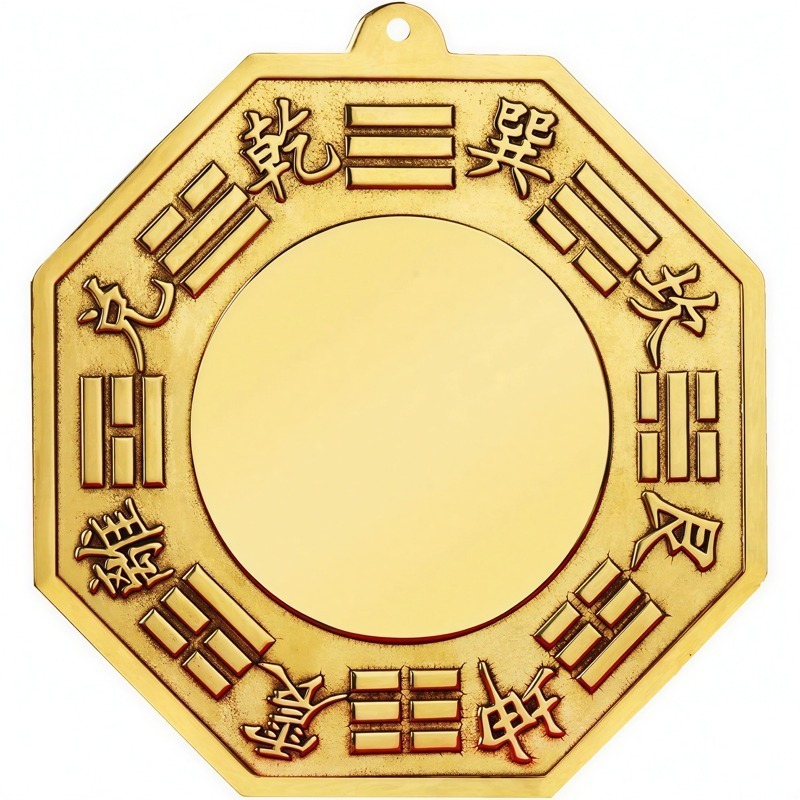
Brass Convex Bagua Mirror (Feng Shui)
All 8 trigrams, hand-engraved on a solid brass convex mirror. The trigrams are arranged in the Fu Xi Early Heaven order around the perimeter, with the Tai Ji symbol (the yin-yang circle) at the centre. The mirror is the most direct physical application of the trigram system — a single object that contains the complete cosmological map. Used over the front door (outside) to deflect negative energy (sha qi) from streets, T-junctions, sharp corners, and other confrontational arrangements. The convex shape disperses energy rather than concentrating it. Hand-engraved by TaoFlow Feng Shui.
$26.90
View Bagua Mirror →4 Common Misconceptions About the 8 Trigrams
Four common misconceptions that beginners have about the 8 trigrams. Avoiding these misconceptions will help you understand the system more accurately.
Misconception 1: The Trigrams Are Magical Symbols
The misconception: the trigrams are magical symbols that "channel energy" or "summon spirits" or have supernatural powers. The reality: the trigrams are a symbolic system — a way of representing the fundamental qualities of reality in a compact, memorable form. The system has been used for divination, feng shui, medicine, and other purposes, but the trigrams themselves are not magical. They are symbols, and the effectiveness of the system depends on the accuracy of the symbol-to-reality mapping, not on the magical power of the symbols.
Misconception 2: The Trigrams Are Only Used in Feng Shui
The misconception: the trigrams are primarily a feng shui tool. The reality: the trigrams are the foundational symbols of Chinese cosmology, used in the I Ching (divination and philosophy), in feng shui (the analysis of space), in traditional Chinese medicine (the analysis of the body), in Chinese martial arts (the analysis of strategy and movement), in Chinese astronomy (the analysis of the heavens), and in Chinese literature (the analysis of human situations). Feng shui is one application of the trigrams, not the primary one.
Misconception 3: The Two Arrangements Are Conflicting
The misconception: the Fu Xi Early Heaven arrangement and the King Wen Later Heaven arrangement are two conflicting systems. The reality: the two arrangements are two complementary lenses on the same reality. The Fu Xi arrangement is the abstract, eternal, underlying order. The King Wen arrangement is the dynamic, changing, experienced world. Both are correct; both are useful; both are needed. A serious practitioner learns both and uses them as different tools for different purposes.
Misconception 4: The Trigrams Predict the Future
The misconception: the trigrams (and the I Ching hexagrams built from them) can predict the future with certainty. The reality: the I Ching is not a fortune-telling system in the Western sense. It is a system of philosophical reflection on changing situations. The hexagram reveals the dynamics of the current situation, the tendencies at work, the possible outcomes if the current course is maintained, and the possible outcomes if the course is changed. The I Ching helps the questioner understand the situation and act in accordance with the natural flow of change. It does not predict the future with certainty, and it does not absolve the questioner of the responsibility to choose.
The Bottom Line: What to Do With the 8 Trigrams
The 8 trigrams are the foundational symbols of Chinese cosmology, the building blocks of the I Ching, and the cosmological map that underlies feng shui, traditional Chinese medicine, and Chinese philosophy more broadly. The trigrams are the most enduring symbolic system in East Asian intellectual history, and one of the most enduring in world intellectual history.
The most useful thing to do with the 8 trigrams is to learn them as a vocabulary for the fundamental qualities of reality. Each trigram is a complete symbol with its own quality, image, and family of correspondences. The 8 trigrams together form a complete map of the qualities of reality. Once you can see the trigrams in the world around you (Qian in the sky, Kun in the earth, Zhen in the thunder, Xun in the wind, Kan in the water, Li in the fire, Gen in the mountain, Dui in the lake), you can use the trigrams to think about any situation, to analyse any space, to reflect on any change.
The trigrams are 3,000 years old. The mathematical elegance of the system (2 × 2 × 2 = 8, then 8 × 8 = 64) is part of the enduring appeal. The philosophical depth of the system (each trigram as a complete symbol, the relationships between the trigrams, the two arrangements) is part of the lasting value. The practical utility of the system (in the I Ching, in feng shui, in medicine) is part of the continuing relevance. The trigrams are not just historical artefacts — they are a living tradition that continues to be studied, applied, and refined. The 8 trigrams are the foundation. The rest of the system is built on top of them.
Related Topics and Cluster Articles
This article is part of the Feng Shui 101 cluster. The following articles cover related aspects in depth.
Frequently Asked Questions
What are the 8 trigrams?
How do you pronounce bagua?
What is the difference between the Fu Xi and King Wen arrangements?
What does each trigram mean?
How are trigrams used in feng shui?
How are trigrams used in I Ching divination?
Are the trigrams a code or language?
How are the 64 hexagrams formed from the 8 trigrams?
What is the line sequence of a trigram?
Why are the trigrams important?
"The 8 trigrams are 8 three-line symbols, each line either solid or broken, that together form the foundational cosmological map of Chinese philosophy. The 8 possible combinations of three lines yield the 8 trigrams: Qian (heaven), Kun (earth), Zhen (thunder), Xun (wind), Kan (water), Li (fire), Gen (mountain), Dui (lake). Each trigram is a complete symbol with its own quality, image, and family of correspondences. Two trigrams stack to form a hexagram; the 64 possible combinations of two trigrams are the 64 hexagrams of the I Ching. The trigrams are the most enduring symbolic system in East Asian intellectual history. The mathematical elegance of the system (2 × 2 × 2 =
0users like this.


Your cart is currently empty.