
Feng Shui

The 4 Celestial Animals in Feng Shui: Azure Dragon, White Tiger, Vermilion Bird, Black Tortoise
The 4 Celestial Animals in Feng Shui: Azure Dragon, White Tiger, Vermilion Bird, Black Tortoise
The 4 Celestial Animals (四象, sì xiàng) are the ancient cosmological guardians of the four cardinal directions. They appear in the I Ching, in feng shui, in imperial architecture, in traditional Chinese medicine, and in the layout of every Chinese city built according to the cosmic order. This is the deep, single-topic guide to the 4 animals — their astronomical origins, their mythology, the 28 lunar mansions, the body mapping, and how they are used in classical feng shui.
Last updated: September 1, 2026 · ~14 min read · TaoFlow Feng Shui ResearchThe 30-second answer: The 4 Celestial Animals are the cosmological guardians of the four cardinal directions. The Azure Dragon (青龙, east) brings spring and new beginnings. The White Tiger (白虎, west) brings autumn and the warrior's energy. The Vermilion Bird (朱雀, south) brings summer and brightness. The Black Tortoise (玄武, north) brings winter and deep wisdom. Each animal is associated with a season, a colour, an element, a planet, a body part, a virtue, and a stage of life. The 4 animals come from ancient Chinese astronomy — they are the 4 quadrants of the 28 lunar mansions, the star groups the moon passes through each month. In feng shui, the 4 animals are the foundational directional guardians: the Azure Dragon should rise on the left, the White Tiger should crouch on the right, the Vermilion Bird should soar in front, and the Black Tortoise should support from behind. This 4-animal configuration is the basis of every imperial city, palace, and tomb in Chinese history, and the foundation of classical feng shui's directional analysis.
What the 4 Celestial Animals Are
The 4 Celestial Animals (四象, sì xiàng), also called the 4 Deities (四神, sì shén) or the 4 Sacred Animals (四灵, sì líng), are the cosmological guardians of the four cardinal directions in Chinese cosmology. They are: the Azure Dragon (青龙, Qīng Lóng) of the East, the White Tiger (白虎, Bái Hǔ) of the West, the Vermilion Bird (朱雀, Zhū Què) of the South, and the Black Tortoise (玄武, Xuán Wǔ) of the North. Each animal is associated with a season, a colour, an element, a planet, a body part, a virtue, and a stage of life.
The 4 animals are not just mythological symbols — they are rooted in ancient Chinese astronomy. The Chinese divided the sky into 4 quadrants based on the 28 lunar mansions (二十八宿, èrshí bā xiù), the star groups the moon passes through each month. Each quadrant was assigned one of the 4 animals as its guardian. The 4 animals are the mythological form of this astronomical reality. The 4-animal system is one of the oldest systematic cosmological frameworks in Chinese culture, with artifacts depicting the 4 animals dating to the Han dynasty (206 BCE – 220 CE) and probably much earlier.
The 4 animals became the imperial guardians of China. The emperor's throne faced south, with the Azure Dragon on the left (east) and the White Tiger on the right (west). The Forbidden City in Beijing, the imperial tombs, the temples, and most classical Chinese architecture follow the 4-animal configuration. In feng shui, the 4 animals are the foundational directional guardians that determine the qi of every property based on the geography of the surrounding landscape.
The Origin and History of the 4 Animals
The 4 Celestial Animals are rooted in ancient Chinese astronomy, which is one of the oldest continuous astronomical traditions in the world. The Chinese observed the sky systematically from at least the 2nd millennium BCE, and by the time of the Shang dynasty (c. 1600–1046 BCE) and the Zhou dynasty (c. 1046–256 BCE), the 4 quadrants of the sky had been identified and named after the 4 animals.
The astronomical basis of the 4 animals is the 28 lunar mansions (二十八宿, èrshí bā xiù), 28 star groups along the ecliptic (the path the moon takes through the sky each month). The moon passes through one mansion per day, completing the full cycle in about 28 days. The Chinese divided the 28 mansions into 4 quadrants of 7 mansions each, with each quadrant assigned one of the 4 animals. The 4 animals are the mythological guardians of the 4 quadrants; the 28 mansions are the astronomical content of each quadrant.
The 4-animal system became the cosmological framework of Chinese astronomy, Chinese astrology, the Chinese calendar, and Chinese imperial symbolism. The emperor was said to rule from the centre of the 4 animals, with the Vermilion Bird in front (the south-facing throne), the Black Tortoise behind (the protection of the north), the Azure Dragon on the left (the rising sun of the east), and the White Tiger on the right (the setting sun of the west). The 4 animals surrounded the emperor, defining the cosmic order that his rule was said to embody.
The 4 animals appear in Han dynasty (206 BCE – 220 CE) stone carvings (画像石) and tomb murals in remarkable detail. The most famous early representations are the 4-animal murals from the tomb of Emperor Wu of Han and the Han dynasty reliefs at Wu Liang Shrine. By the Tang dynasty (618–907 CE), the 4 animals were the standard cosmological guardians of every imperial building, every official tomb, and every major temple. The system has been continuously used for over 2,000 years and remains the foundation of feng shui's directional analysis today.
The astronomical reality behind the myth: The 4 animals are not arbitrary mythological symbols — they are the mythological form of an astronomical reality. The 7 mansions of the Azure Dragon (east) are the 7 star groups the moon passes through during the spring months. The 7 mansions of the Vermilion Bird (south) are the 7 star groups the moon passes through during the summer months. The 7 mansions of the White Tiger (west) are the 7 star groups the moon passes through during the autumn months. The 7 mansions of the Black Tortoise (north) are the 7 star groups the moon passes through during the winter months. The 4 animals are the mythological names of the 4 seasonal quadrants of the moon's path. The Chinese observed this for at least 3,000 years and built an entire cosmological system around it.
The 4 Celestial Animals in Detail
Each of the 4 animals is a complete symbol with its own direction, season, colour, element, planet, body part, virtue, and stage of life. The deep dive into each animal follows.
1. Azure Dragon (青龙, Qīng Lóng) — East, Spring
East · Spring · Wood · Blue-green · Jupiter
The Azure Dragon is the guardian of the East. The Chinese character 青 (qīng) is a colour that encompasses both blue and green — it is the colour of the young spring leaves, of the morning sky, of the jade stone. The Dragon is the most powerful of the 4 animals, the bringer of rain, the symbol of the emperor, the embodiment of yang rising. The Azure Dragon represents the beginning of life, the rising yang, the awakening of the world in spring. The Azure Dragon is associated with the left side of the body (when facing south), the wood element, the planet Jupiter (木星 mù xīng), the virtue of benevolence (仁, rén), and the stage of new beginnings.
In feng shui, the Azure Dragon should be on the left side of a property (when facing south) and should be slightly higher than the right side. The Azure Dragon "rises" above the White Tiger. The most famous physical representation of the Azure Dragon is the Nine-Dragon Wall (九龙壁) in the Forbidden City, a glazed-tile wall with 9 coiling dragons that embodies the Azure Dragon's energy of imperial power and cosmic authority.
2. Vermilion Bird (朱雀, Zhū Què) — South, Summer
South · Summer · Fire · Vermilion · Mars
The Vermilion Bird is the guardian of the South. The Chinese character 朱 (zhū) is a deep red-orange, the colour of cinnabar (vermilion), the colour of the imperial seal, the colour of life force. The Bird is a phoenix-like creature, the messenger of the sun, the bringer of summer heat and light. The Vermilion Bird represents brightness, visibility, fame, the full yang of the summer solstice. The Vermilion Bird is associated with the front of the body (when facing south), the fire element, the planet Mars (火星 huǒ xīng), the virtue of propriety (礼, lǐ), and the stage of full brightness.
In feng shui, the Vermilion Bird should be in front of a property (when facing south) and should be open, bright, and welcoming. There should be no tall blocking structure in front, no clutter, no dark or overgrown vegetation. The Vermilion Bird "soars" in front of the property. The Vermilion Bird is the most yang of the 4 animals, the most visible, the most associated with reputation, fame, and public image. Many traditional Chinese imperial thrones face south precisely so the emperor is positioned with the Vermilion Bird in front, signifying his cosmic authority.
3. White Tiger (白虎, Bái Hǔ) — West, Autumn
West · Autumn · Metal · White · Venus
The White Tiger is the guardian of the West. The White Tiger is the king of beasts, the most dangerous of the 4 animals, the warrior-protector. The White Tiger represents the descending yang, the harvest, the cut, the end of the cycle. The White Tiger is associated with the right side of the body (when facing south), the metal element, the planet Venus (金星 jīn xīng), the virtue of righteousness (义, yì) — but also the energy of killing, of war, of the soldier. The White Tiger is the autumn harvest in the sense that the harvest is the cutting down of the ripened crop — it is the necessary violence that completes the cycle.
In feng shui, the White Tiger should be on the right side of a property (when facing south) and should be slightly lower than the left side. The White Tiger "crouches" below the Azure Dragon. But the White Tiger is the most dangerous of the 4 animals — too much White Tiger energy (a tall structure on the right, a high road, a sharp corner pointing in from the right) brings accidents, legal problems, conflict with authority, and (for men) struggles with male authority figures. The remedy is usually to strengthen the Azure Dragon on the left to balance the White Tiger.
4. Black Tortoise (玄武, Xuán Wǔ) — North, Winter
North · Winter · Water · Black · Mercury
The Black Tortoise is the guardian of the North. The character 玄 (xuán) means "mysterious dark" — a colour that is deeper than ordinary black, the colour of the deepest water, the night sky at its darkest, the unseen depths. The Black Tortoise is actually a tortoise entwined with a snake — the snake's body wraps around the tortoise, the two animals forming a single symbol. The Black Tortoise is the oldest animal, the keeper of wisdom, the supporter of the world (in Chinese mythology, the world rests on the back of a great tortoise). The Black Tortoise represents hidden depth, the support of the unseen, the wisdom of winter, the resting state before the new cycle begins.
The Black Tortoise is associated with the back of the body (when facing south), the water element, the planet Mercury (水星 shuǐ xīng), the virtue of wisdom (智, zhì), and the stage of hidden depth. In feng shui, the Black Tortoise should be behind a property (when facing south) and should be supported by a hill, a building, or some other solid form. The Black Tortoise "supports" the property from behind. Without a strong Black Tortoise, a property has no backing, no protection, no foundation.
The 4 Animals and the 5 Elements (A Later Mapping)
The 4 animals are sometimes associated with the 5 elements, but this mapping is a later development, not original to the 4-animal system. The 4-animal system originated in astronomy; the 5-element system originated in cosmological philosophy. The two systems were syncretised during the Han dynasty (206 BCE – 220 CE), and the 5-element mapping of the 4 animals became widely used in feng shui, in imperial architecture, and in traditional Chinese medicine.
The 5-element mapping is: East (Azure Dragon) = Wood, South (Vermilion Bird) = Fire, West (White Tiger) = Metal, North (Black Tortoise) = Water, Centre = Earth. This mapping places Earth at the centre (where there is no animal) and assigns the other 4 elements to the 4 animals. The mapping reflects the productive cycle of the 5 elements: Wood feeds Fire, Fire creates Earth (ash), Earth produces Metal, Metal collects Water, Water nourishes Wood. The cycle of the 4 animals is the seasonal cycle, and the seasonal cycle is the cycle of the 5 elements.
It is important to note that the 5-element mapping is NOT original to the 4 animals. In the original astronomical 4-animal system, the elements are not central. The elements were added later when the 4 animals were integrated into the larger Chinese cosmological framework. If you are reading older sources (pre-Han), you will find the 4 animals without the elements. If you are reading feng shui sources, you will find the 4 animals with the 5-element mapping. Both are correct in their respective contexts.
| Direction | Animal | Element | Season | Colour |
|---|---|---|---|---|
| East | Azure Dragon | Wood | Spring | Blue-green (青) |
| South | Vermilion Bird | Fire | Summer | Vermilion (朱) |
| West | White Tiger | Metal | Autumn | White (白) |
| North | Black Tortoise | Water | Winter | Black (玄) |
| Centre | (Yellow Emperor) | Earth | Late summer | Yellow (黄) |
The 4 Animals and the 28 Lunar Mansions
The 4 animals and the 28 lunar mansions (二十八宿, èrshí bā xiù) are two levels of the same cosmological system. The 28 lunar mansions are 28 star groups along the ecliptic (the path the moon takes through the sky each month). The moon passes through one mansion per day, completing the cycle in about 28 days. The 4 animals divide the 28 mansions into 4 quadrants of 7 mansions each.
The 28 mansions are the foundation of Chinese astronomy, Chinese astrology, the Chinese calendar, and the calculation of eclipses, comets, and other celestial events. The 28 mansions were used for at least 3,000 years before the Common Era. Each mansion has a name (one or two Chinese characters), a primary star, and a symbolic meaning. The 4 animals are the mythological guardians of the 4 quadrants; the 28 mansions are the astronomical content of each quadrant.
| Animal | Direction | 7 Lunar Mansions |
|---|---|---|
| Azure Dragon | East | 角 Jiǎo, 亢 Kàng, 氐 Dī, 房 Fáng, 心 Xīn, 尾 Wěi, 箕 Jī |
| Black Tortoise | North | 斗 Dǒu, 牛 Niú, 女 Nǚ, 虛 Xū, 危 Wēi, 室 Shì, 壁 Bì |
| White Tiger | West | 奎 Kuí, 婁 Lóu, 胃 Wèi, 昴 Mǎo, 畢 Bì, 觜 Zī, 參 Shēn |
| Vermilion Bird | South | 井 Jǐng, 鬼 Guǐ, 柳 Liǔ, 星 Xīng, 張 Zhāng, 翼 Yì, 軫 Zhěn |
The 28 mansions are the basis of the 12 animal zodiac signs (生肖, shēngxiào) of Chinese astrology, although the relationship is indirect. The 12 zodiac animals are 12 of the 28 mansions selected to mark the 12 months of the year. The Tiger, the Dragon, the Snake, the Horse, the Goat, the Monkey, the Rooster, the Dog, the Pig, the Rat, the Ox, and the Rabbit are all either animals from the 28 mansions or symbolic combinations of them. The 4 animals (Azure Dragon, White Tiger, Vermilion Bird, Black Tortoise) are NOT the same as the 12 zodiac animals, although the Tiger and the Dragon appear in both systems. The 4 animals are cosmological guardians; the 12 zodiac animals are time markers.
The 4 Animals and the Human Body
In feng shui, traditional Chinese medicine, and Chinese martial arts, the 4 animals are mapped to the human body. The mapping is established when the person is facing south (the traditional imperial orientation):
- Azure Dragon (East) = the left side of the body
- White Tiger (West) = the right side of the body
- Vermilion Bird (South) = the front of the body (the face)
- Black Tortoise (North) = the back of the body
This body mapping is the basis of the famous feng shui principle "左青龙右白虎" (zuǒ Qīng Lóng yòu Bái Hǔ, "Azure Dragon on the left, White Tiger on the right"). When a property faces south, the Azure Dragon is on the left and the White Tiger is on the right. The same principle applies to a person facing south: the left side is the Azure Dragon side, the right side is the White Tiger side. The body mapping is the basis of the feng shui analysis of a property — the property is treated as a body, with the 4 animals in their proper positions.
The body mapping is also used in traditional Chinese medicine. The left side of the body is associated with the ascending qi (Wood, Liver, the Azure Dragon), the right side with the descending qi (Metal, Lungs, the White Tiger), the front with the bright qi (Fire, Heart, the Vermilion Bird), and the back with the deep qi (Water, Kidneys, the Black Tortoise). Martial arts and qigong also use the 4-animal body mapping for stance, movement, and the cultivation of qi in the 4 quadrants of the body.
How the 4 Animals Are Used in Feng Shui
The 4 animals are the foundational directional guardians in classical feng shui. The classical configuration is established when the property faces south. The 4 animals are then in their proper positions, and the feng shui analysis of the property is based on whether the surrounding geography (mountains, water, roads, buildings) supports or challenges each animal.
The "ideal" feng shui property, based on the 4 animals, has:
- Azure Dragon (left/east): Slightly higher ground, a hill, a tall building, or a tall tree. The Azure Dragon should "rise" on the left.
- White Tiger (right/west): Slightly lower ground, a road, an open space, or a low building. The White Tiger should "crouch" on the right.
- Vermilion Bird (front/south): Open space, water (a river, a lake, a pond), a low road, or a clear view. The Vermilion Bird should "soar" in front.
- Black Tortoise (back/north): A hill, a mountain, a tall building, or some other solid form. The Black Tortoise should "support" from behind.
This 4-animal configuration is the basis of every feng shui analysis of a property. The feng shui master walks the property, identifies the direction the property faces, and then assesses whether each of the 4 animals is in its proper position. The property is in alignment with the cosmic order when all 4 animals are properly positioned. The property is out of alignment when one or more of the animals is disturbed (a tall structure on the wrong side, an open space in the wrong place, a road pointing in from an inauspicious direction).
The 4 animals are also used in the design of imperial cities. The Forbidden City in Beijing faces south, with the Azure Dragon on the left (the hill to the east of the palace), the White Tiger on the right (the open space to the west), the Vermilion Bird in front (the open plaza to the south), and the Black Tortoise behind (the artificial hill to the north, Jingshan 景山). The imperial tombs follow the same 4-animal configuration. The classical Chinese city, in its ideal form, is a 4-animal configuration scaled up to urban planning.
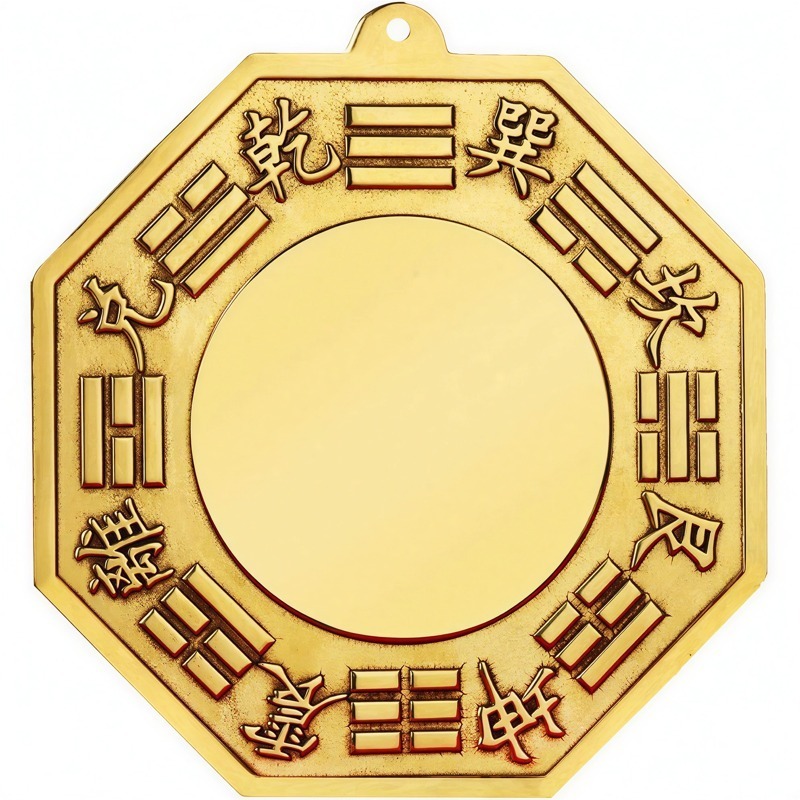
Brass Convex Bagua Mirror (Feng Shui)
Traditional convex bagua mirror with all 8 trigrams and the Tai Ji symbol at the centre, hand-engraved solid brass. In classical designs, the 4 Celestial Animals (Azure Dragon, White Tiger, Vermilion Bird, Black Tortoise) are carved at the four corners of the bagua mirror, representing the cosmological guardians of the four cardinal directions. The bagua mirror is the most direct physical application of the 4-animal system — a single object that contains the complete cosmological map. Used over the front door (outside) to deflect negative energy (sha qi) from streets, T-junctions, sharp corners, and other confrontational arrangements. Hand-engraved by TaoFlow Feng Shui.
$26.90
View Bagua Mirror →4 Common Misconceptions About the 4 Celestial Animals
Four common misconceptions that beginners have about the 4 Celestial Animals. Avoiding these misconceptions will help you understand the system more accurately.
Misconception 1: The 4 Animals Are Just Symbols
The misconception: the 4 animals are decorative symbols that "channel energy" or have spiritual meaning on their own. The reality: the 4 animals are an astronomical reality. They are the 4 quadrants of the 28 lunar mansions, the star groups the moon passes through each month. The 4 animals are the mythological form of this astronomical reality, observed and recorded for at least 3,000 years. The 4 animals are not arbitrary — they are based on the actual pattern of the moon's path through the sky.
Misconception 2: The 4 Animals Correspond to the Geographic Cardinal Directions
The misconception: the Azure Dragon is always to the geographic east, the White Tiger is always to the geographic west, etc. The reality: the 4 animals correspond to the directions relative to the person or the property facing south. If you face north, the 4 animals rotate 180°. The 4 animals are not "permanently attached" to the geographic east, south, west, and north — they are attached to the orientation of the person or the property. The imperial tradition always faced south, so the classic configuration has the Azure Dragon on the left and the White Tiger on the right. If you face a different direction, the configuration rotates with you.
Misconception 3: The 4 Animals Are the Same as the 12 Chinese Zodiac Animals
The misconception: the 4 animals are the same as the 12 Chinese zodiac animals (rat, ox, tiger, rabbit, dragon, snake, horse, goat, monkey, rooster, dog, pig). The reality: the 4 animals are cosmological guardians. The 12 zodiac animals are time markers (12 months, 12 years, 12 hours). The 4 animals and the 12 zodiac animals are two different systems. The only overlap is the Tiger and the Dragon, which appear in both systems. The 4 animals are about the directions and the seasons; the 12 zodiac animals are about the cycles of time.
Misconception 4: You Can Place the 4 Animals in Your Home to "Activate" Feng Shui
The misconception: placing statues or paintings of the 4 animals in your home will "activate" their energy and bring feng shui benefits. The reality: the 4 animals are not decorative elements. They are the directional guardians of the property, determined by the geography of the surrounding landscape (mountains, water, roads, buildings). The 4-animal configuration is something you READ, not something you PLACE. A property has a strong or weak Azure Dragon on the left based on whether there is a hill, a tall building, or a tall tree on the left — not based on whether you have an Azure Dragon statue in your living room.
The Bottom Line: What to Do With the 4 Celestial Animals
The 4 Celestial Animals are the cosmological guardians of the four cardinal directions. They are not just symbols — they are the 4 quadrants of the sky, the 4 seasons of the year, the 4 stages of life, the 4 guardians of the imperial throne, and the 4 directional forces that determine the qi of every property. The 4 animals are the astronomical reality of the moon's path through the sky, mythological for over 3,000 years and the foundation of Chinese cosmology, Chinese astronomy, Chinese imperial symbolism, and feng shui.
The most useful thing to do with the 4 animals is to learn to read them in the world around you. The Azure Dragon is on the left, the White Tiger is on the right, the Vermilion Bird is in front, the Black Tortoise is behind — when facing south. Every property, every city, every room can be read through the 4 animals. Once you can see the 4 animals in the geography of a property, you can use the 4 animals to assess the qi of the property and to apply feng shui principles.
The 4 animals are 3,000 years old. The astronomical basis of the 4 animals is real. The mythology of the 4 animals is rich. The feng shui application of the 4 animals is practical. The 4 animals are not just historical artefacts — they are a living tradition that continues to be used in feng shui, in imperial architecture, in traditional Chinese medicine, and in Chinese culture more broadly. The 4 animals are the cosmological guardians. The rest of the system (the I Ching, the bagua map, the 5 elements, the 8 trigrams) is built on top of them. Master the 4 animals, and the cosmic order becomes visible.
Related Topics and Cluster Articles
This article is part of the Feng Shui 101 cluster. The following articles cover related aspects in depth.
Frequently Asked Questions
What are the 4 Celestial Animals in feng shui?
How do you say the 4 animals in Chinese?
What is the Azure Dragon associated with?
What is the White Tiger associated with?
What is the Vermilion Bird associated with?
What is the Black Tortoise associated with?
Are the 4 animals the same as the 4 cardinal directions?
What is the relationship between the 4 animals and the 28 lunar mansions?
How are the 4 animals used in feng shui?
Why is the White Tiger considered dangerous in feng shui?
"The 4 Celestial Animals are the cosmological guardians of the four cardinal directions. They are not just symbols — they are the 4 quadrants of the sky, the 4 seasons of the year, the 4 stages of life, the 4 guardians of the imperial throne, and the 4 directional forces that determine the qi of every property. The Azure Dragon of the East brings spring and new beginnings. The Vermilion Bird of the South brings summer and full brightness. The White Tiger of the West brings autumn and the warrior's energy. The Black Tortoise of the North brings winter and deep wisdom. When the Azure Dragon rises on the left, when the White Tiger crouches on the right, when the Vermilion Bird soars in front, and when the Black Tortoise supports from behind — the property is in alignment with the cosmic order. The 4 animals are the cosmological guardians. The rest of the system is built on top of them. Master the 4 animals, and the cosmic order becomes visible."
0users like this.


Your cart is currently empty.